Blue infrastructures for ecological regeneration – The recovery of mining sites in Hamburg and Rome
DOI:
https://doi.org/10.69143/2464-9309/1832025Keywords:
quarry lakes, post-mining landscapes, blue-green infrastructures, nature-based solutions, industrial heritageAbstract
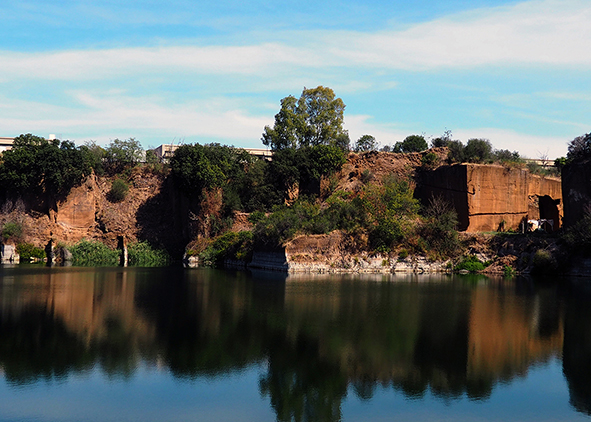
This paper explores the regenerative potential of water in post-industrial landscapes, with particular attention to disused quarries along the Elbe in Hamburg and the Aniene in Rome. Water is interpreted as an active ecological agent capable of transforming quarry lakes into continuous blue-green infrastructures that integrate biodiversity, heritage, mobility, and public space. Through a critical comparison, the study demonstrates that the former Kaltehofe waterworks in Hamburg and the surrounding quarries constitute a laboratory of transferable strategies for ecological reconnection, site memory, and climate resilience. In line with Sustainable Development Goals 6, 8, 11, and 15, and with European biodiversity policies, the article interprets the landscape transformations triggered by water as a model of ecological and cultural regeneration, recognising the Roman quarry lakes as potential nodes in a broader urban environmental network.
Article info
Received: 10/09/2025; Revised: 28/10/2025; Accepted: 29/10/2025
Downloads
Article Metrics Graph
References
Aliberti, L. (2015), Preadattamento e trasformabilità dei siti alterati da attività estrattiva, Tesi di Dottorato Progettazione architettonica e tecnologie innovative per la sostenibilità, Università degli Studi di Napoli Federico II, Napoli, Italia, Ciclo XXVII, Relatore Prof. Scarano, R. [Online] Available at: doi.org/10.6092/UNINA/FEDOA/10267 [Accessed 25 September 2025].
Baiani, S., Altamura, P., Turchetti, G. and Romano, G. (2024), “Transizione energetica e circolare del patrimonio industriale – Il caso dell’ex SNIA a Roma | Energy and circular transition of the industrial heritage – The Ex SNIA case in Rome”, in Agathón | International Journal of Architecture, Art and Design, vol. 15, pp. 190-203. [Online] Available at: doi.org/10.19229/2464-9309/15152024 [Accessed 25 September 2025].
Berger, A. (2006), Drosscape – Wasting Land in Urban America, Princeton Architectural Press, New York.
Berretta, T., Desideri, F. and Staltari, M. (2024), “Il progetto dello spazio pubblico, tra complessità e crisi ecologica – Da sfida a opportunità per la rigenerazione urbana | Public space project, between complexity and ecological crisis – From challenge to opportunity for urban regeneration”, in Agathón | International Journal of Architecture, Art and Design, vol. 16, pp. 74-87. [Online] Available at: doi.org/10.19229/2464-9309/1662024 [Accessed 25 September 2025].
Brears, R. C. (2023), Blue and Green Cities – The Role of Blue-Green Infrastructure in Managing Urban Water Resources, Palgrave Macmillan, Cham. [Online] Available at: doi.org/10.1007/978-3-031-41393-3 [Accessed 25 September 2025].
Casiddu, N., Burlando, F. and Chen, B. (2024), “Human-de-centred Design – Verso una (nuova) era della sofferenza | Human-de-centred Design – Towards a (new) era of suffering”, in Agathón | International Journal of Architecture, Art and Design, vol. 16, pp. 242-249. [Online] Available at: doi.org/10.19229/2464-9309/16212024 [Accessed 25 September 2025].
D’Ascanio, R. and Palazzo, A. L. (2023), “Unfolding the Aniene River in Peri-Urban Rome – From Conflicts to Opportunities for a Sustainable Strategy”, in Giudice, B., Novarina, G. and Voghera, A. (eds), Green Infrastructure – Planning Strategies and Environmental Design, Springer, Cham, pp. 43-53. [Online] Available at: doi.org/10.1007/978-3-031-28772-5_4 [Accessed 25 September 2025].
Della Porta, G., Hoppert, M., Hallmann, C., Schneider, D. and Reitner, J. (2022), “The influence of microbial mats on travertine precipitation in active hydrothermal systems (Central Italy)”, in The Depositional Record | The Journal of the International Association of Sedimentologists, vol. 8, issue 1, pp. 165-209. [Online] Available at: doi.org/10.1002/dep2.147 [Accessed 25 September 2025].
Diekmann, V. L. (2021), “Die Natur erobert sich die Billwerder Insel zurück”, in Hamburger Abendblatt, newspaper online, 18/08/2021. [Online] Available at: abendblatt.de/hamburg/bergedorf/article401910234/die-natur-erobert-sich-die-billwerder-insel-zurueck.html [Accessed 25 September 2025].
Dreiseitl, H. (2020), “Water and Sustainable Design”, in Meyers, R. A. (ed.), Encyclopedia of Sustainability Science and Technology, Springer, New York, pp. 1-19. [Online] Available at: doi.org/10.1007/978-1-4939-2493-6_1032-1 [Accessed 25 September 2025].
El-Hitami, H., Mahall, M. and Serbest, A. (2023), “Ecologia dello spazio – Progetto architettonico e relazioni transfrontaliere | An ecology of space – Architectural design for transboundary relationships”, in Agathón | International Journal of Architecture, Art and Design, vol. 13, pp. 153-164. [Online] Available at: doi.org/10.19229/2464-9309/13132023 [Accessed 25 September 2025].
European Commission (2020), Communication from the Commission to the European Parliament, the Council, the European Economic and Social Committee and the Committee of the Regions – EU Biodiversity Strategy for 2030 – Bringing nature back into our lives, document 52020DC0380, COM/2020/380 final. [Online] Available at: eur-lex.europa.eu/legal-content/EN/TXT/?uri=celex:52020DC0380 [Accessed 25 September 2025].
European Parliament and Council of the European Union (2024), Regulation (EU) 2024/1991 of the European Parliament and of the Council of 24 June 2024 on Nature Restoration and amending Regulation (EU) 2022/869, document 32024R1991. data.europa.eu/eli/reg/2024/1991/oj [Accessed 25 September 2025].
Exner, M. (2015), “Cholera epidemic in Hamburg, Germany 1892”, in Bartram, J., Baum, R., Coclanis, P, Gute, D., Kay, D., McFadyen, S., Pond, K., Robertson, W. and Rouse, M. (eds), Routledge Handbook of Water and Health, Routledge, London, pp. 644-647.
Fois, M., Cuena-Lombraña, A., Boi, M. E., McInnes, R. J. and Bacchetta, G. (2025), “Changes in biodiversity and ecosystem services over time in post-mining and quarry ponds”, in Hydrobiologia | The International Journal of Aquatic Sciences, article e13268, pp. 1-18. [Online] Available at: doi.org/10.1007/s10750-025-05892-4 [Accessed 25 September 2025].
Giardini, M. (2013), “La flora vascolare del Montarozzo del Barco Tivoli (Tivoli, Roma)”, in Annali del Museo Civico di Rovereto, vol. 28, pp. 161-197. [Online] Available at: fondazionemcr.it/UploadDocs/4972_art08_giardini.pdf [Accessed 25 September 2025].
Hamburg (2012), Naturschutz für Hamburg – 10 Jahre Sondervermögen für Naturschutz und Landschaftspflege. [Online] Available at: hamburg.de/resource/blob/172050/9d96fc1628e8a543ec547b9fcee9094a/ 10jahresov-broschuereb-data.pdf [Accessed 25 September 2025].
Hardman, M. and Samangooei, M. (2024), “Cities, climate change and the biodiversity crisis”, in Climate Interactions | An Elevate Journal, vol. 1, issue 1, article 2479355, pp. 1-2. [Online] Available at: doi.org/10.1080/29966876.2025.2479355 [Accessed 25 September 2025].
Hehl-Lange, S. and Lange, E. (2023), “Adaptive Transformation of Historic Water Works in Hamburg, Germany – From Essential Infrastructure and Cornerstone of Public Health to Valuable Man-Made Ecosystems and Designed Public Spaces”, in Landscape Architecture Frontiers, vol. 11, issue 6, pp. 44-52. [Online] Available at: doi.org/10.15302/J-LAF-1-020088 [Accessed 25 September 2025].
Jawecki, B., Kowalczyk, T. and Feng, Y. (2019), “The Evaluation of the Possibility to Use the Water from Quarry Lakes for Irrigation”, in Journal of Ecological Engineering, vol. 20, issue 9, pp. 188-201. [Online] Available at: doi.org/10.12911/22998993/112490 [Accessed 25 September 2025].
Kantor-Pietraga, I., Zdyrko-Bednarczyk, A. and Bednarczyk, J. (2025), “Importance of Blue-Green Infrastructure in the Spatial Development of Post-Industrial and Post-Mining Areas – The Case of Piekary Śląskie, Poland”, in Land, vol. 14, issue 5, article 918, pp. 1-24. [Online] Available at: doi.org/10.3390/land14050918 [Accessed 25 September 2025].
Kettermann, M. and Fartmann, T. (2023), “Quarry ponds are hotspots of amphibian species richness”, in Ecological Engineering, vol. 190, article 106935, pp. 1-11. [Online] Available at: doi.org/10.1016/j.ecoleng.2023.106935 [Accessed 25 September 2025].
Lecardane, R. (2023), “Natura Capitale –Transizione ecologica e fenomeni di trasformazione dello spazio aperto | Nature Capital – An ecological transition and open space transformation phenomena”, in Agathón | International Journal of Architecture, Art and Design, vol. 13, pp. 119-130. [Online] Available at: doi.org/10.19229/2464-9309/13102023 [Accessed 25 September 2025].
Lund, M. A. and Blanchette, M. L. (2023), “Closing pit lakes as aquatic ecosystems – Risk, reality, and future uses”, in WIREs Water, vol. 10, issue 4, article e1648, pp. 1-18. [Online] Available at: doi.org/10.1002/wat2.1648 [Accessed 25 September 2025].
Martines, F. and Pallottino, E. (2019), Tivoli, un laboratorio urbano – Ieri, oggi, domani, Roma Tre Press, Roma. [Online] Available at: romatrepress.uniroma3.it/wp-content/uploads/2019/03/Tivoli-un-laboratorio-urbano.-Ieri-oggi-domani.pdf [Accessed 25 September 2025].
Mehan, A. (2025), “Ripensare i paesaggi post-industriali attraverso la lente dello sviluppo sostenibile | Reimagining post-industrial landscapes through the lens of sustainable development”, in Agathón | International Journal of Architecture, Art and Design, vol. 17, pp. 120-129. [Online] Available at: doi.org/10.69143/2464-9309/1772025 [Accessed 25 September 2025].
Mitschke, A. (2015), Avifaunistische Begleitkartierung im Rahmen des Biotopschutzprogramms in der Kulturlandschaft Hamburgs – Berichtsperiode 1989 bis 2014, Gutachten im Auftrag der Abteilung Naturschutz Hamburg. [Online] Available at: hamburg.de/resource/blob/172380/a046ef688166e623ecc54e6169ff7e64/ download-wiesenvogelgutachten-2015-data.pdf [Accessed 25 September 2025].
Mortice, Z. (2015), “The history of Chicago is buried under one of its least-known and most astonishing parks [Palmisano Park]”, in Landscape Architecture, vol. 105, issue 11, pp. 150-163. [Online] Available at: dialnet.unirioja.es/servlet/articulo?codigo=6574216 [Accessed 25 September 2025].
Oke, C., Bekessy, S. A., Frantzeskaki, N., Bush, J., Fitzsimons, J. A., Garrard, G. E., Grenfell, M., Harrison, L., Hartigan, M., Callow, D. and Cotter, B. (2021), “Cities should respond to the biodiversity extinction crisis”, in npj | Urban Sustainability, vol. 1, article 11, pp. 1-4. [Online] Available at: doi.org/10.1038/s42949-020-00010-w [Accessed 25 September 2025].
Paudice, E. (2023), “White and blue. Water and travertine landscapes along the Aniene”, in Garcia, P. R., Mottogno, B. and Cappuccitti, A. (eds), Waterfront dialectics – Rome and its Region facing climate change impacts, TAB Edizioni, Roma, pp. 213-223. [Online] Available at: iris.uniroma1.it/retrieve/389ec92e-aeea-4151-8d55-e85518e13c6a/Paudice_White%20and%20blue_2023.pdf [Accessed 25 September 2025].
Pentecost, A. (2005), Travertine, Springer, Dordrecht. [Online] Available at: doi.org/10.1007/1-4020-3606-X [Accessed 25 September 2025].
Pirina, C., Comi, G. and d’Abramo, V. (2024), “Per una transizione progettuale – Composizione e progetto del verde per la città contemporanea | For a design transition – Green composition and design for the contemporary city”, in Agathón | International Journal of Architecture, Art and Design, vol. 15, pp. 124-137. [Online] Available at: doi.org/10.19229/2464-9309/1592024 [Accessed 25 September 2025].
Pulvirenti, E., Cervoni, F., Giardini, M., Mei, M. and Cerretti, P. (2024), “Rediscovery of Paracoenia beckeri (Kuntze, 1897) in the Acque Albule Plain, Italy – Implications for conservation and ecosystem restoration”, in Proceedings of ECCB 2024 – 7th European Congress of Conservation Biology – Biodiversity positive by 2030 – 17-21 June 2024 – Bologna, Italy, Dipartimento di Scienze Biologiche, Geologiche ed Ambientali Alma Mater Studiorum Università di Bologna, p. 254. [Online] Available at: doi.org/10.13140/RG.2.2.17154.49609 [Accessed 25 September 2025].
Redondo-Vega, J. M., Santos-González, J., Melón-Nava, A., Gómez-Villar, A., Pena-Pérez, S. A. and González-Gutiérrez, R. B. (2024), “Pit Lakes in Abandoned Slate Quarries in Northwestern Spain – Characteristics and Potential Uses”, in Water, vol. 16, issue 17, article 2403, pp. 1-13. [Online] Available at: doi.org/10.3390/w16172403 [Accessed 25 September 2025].
Sharma, V. and Franks, D. M. (2013), “In Situ Adaptation to Climatic Change – Mineral Industry Responses to Extreme Flooding Events in Queensland, Australia”, in Society & Natural Resources | An International Journal, vol. 26, issue 11, pp. 1252-1267. [Online] Available at: doi.org/10.1080/08941920.2013.797528 [Accessed 25 September 2025].
Talento, K., Amado, M. and Kullberg, J. C. (2020), “Quarries – From Abandoned to Renewed Places”, in Land, vol. 9, issue 5, article 136, pp. 1-21. [Online] Available at: doi.org/10.3390/land9050136 [Accessed 25 September 2025].
Tope, G., Blessing, J. and Adebisi Heritage, S. (2023), “The Role of Water in Landscape Design – Influencing Placemaking and Creating Meaningful Spaces”, in researchgate.net, August 2023. [Online] Available at: researchgate.net/publication/385621651 [Accessed 25 September 2025].
Tortora, P. and Pentecost, A. (1989), “Bagni di Tivoli, Lazio – A modern travertine depositing site and its associated microorganism”, in Bollettino della Società Geologica Italiana, vol. 108, fasc. 2, pp. 315-324. [Online] Available at: researchgate.net/publication/277476212_Bagni_di_Tivoli_Lazio_a_modern _travertine_depositing_site_and_its_associated_microorganism [Accessed 25 September 2025].
Vranayova, Z., Kaposztasova, D. and Lis, A. (2024), “Cognitive and Environmental Benefits of Blue-Green Infrastructure and Green Skills Training”, in Selected Scientific Papers | Journal of Civil Engineering, vol. 19, issue 1, article 20240015, pp. 1-8. [Online] Available at: doi.org/10.2478/sspjce-2024-0015 [Accessed 25 September 2025].
Downloads
Published
How to Cite
Issue
Section
Categories
License
Copyright (c) 2025 Sara Radi Ahmed, Alessandra Capuano

This work is licensed under a Creative Commons Attribution 4.0 International License.
This Journal is published under Creative Commons Attribution Licence 4.0 (CC-BY).
License scheme | Legal code
This License allows anyone to:
Share: copy and redistribute the material in any medium or format.
Adapt: remix, transform, and build upon the material for any purpose, even commercially.
Under the following terms
Attribution: Users must give appropriate credit, provide a link to the license, and indicate if changes were made; users may do so in any reasonable manner, but not in any way that suggests the licensor endorses them or their use.
No additional restrictions: Users may not apply legal terms or technological measures that legally restrict others from doing anything the license permits.
Notices
Users do not have to comply with the license for elements of the material in the public domain or where your use is permitted by an applicable exception or limitation.
No warranties are given. The license may not give users all of the permissions necessary for their intended use. For example, other rights such as publicity, privacy, or moral rights may limit how you use the material.