Urban agriculture and architecture – Water for optimising the building-vegetation synergies
DOI:
https://doi.org/10.69143/2464-9309/18122025Keywords:
urban agriculture, zero-emission production, sustainable urban metabolism, building-integrated agriculture, circular water managementAbstract
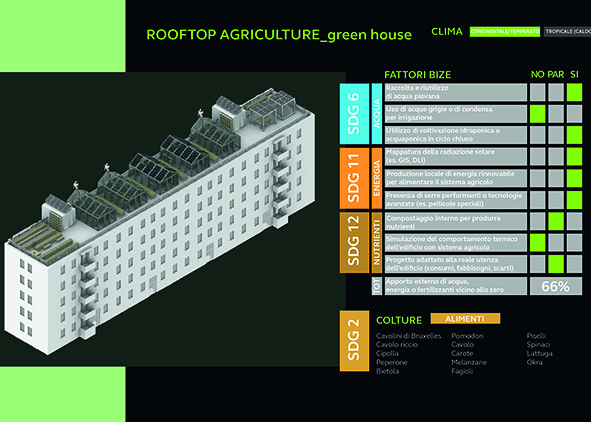
The paper invites reflection on how sustainable practices grounded in urban metabolism can generate synergies among the Sustainable Development Goals (SDGs). It proposes a methodological approach for the architectural integration of urban agriculture. It centres on water, to connect residents, the built environment, and green areas, thereby enhancing urban resilience. The methodology progresses from analysis at the neighbourhood scale to the block / building scale to define solutions for integrated agriculture within zero-emission buildings, aiming to close energy and water cycles and contribute to SDGs 2, 6, 11, and 12.
Article info
Received: 15/09/2025; Revised: 23/10/2025; Accepted: 25/10/2025
Downloads
Article Metrics Graph
References
Ahmadi, E., McLellan, B., Ogata, S., Mohammadi-Ivatloo, B. and Tezuka, T. (2020), “An Integrated Planning Framework for Sustainable Water and Energy Supply”, in Sustainability, vol. 12, issue 10, article 4295, pp. 1-37. [Online] Available at: doi.org/10.3390/SU12104295 [Accessed 17 October 2025].
Alcalde Sanz, L. and Man, B. (2014), Water reuse in Europe – Relevant guidelines, needs for and barriers to innovation – A Synoptic overview, Publications Office of the European Union, Luxembourg. [Online] Available at: data.europa.eu/doi/10.2788/29234 [Accessed 17 October 2025].
Ang, B. T. W., Fong, Y. M., Soh, C. B., Chien, S. C., An, H. and Soon Tay, R. H. (2024), “Passive Infrared-to-Visible-Light Upconversion Using NaYF4:Yb,Er Nanoparticle Films for Greenhouse Façades”, in ACS Applied Nano Materials, vol. 7, issue 16, pp. 18851-18860. [Online] Available at: pubs.acs.org/doi/10.1021/acsanm.4c02476 [Accessed 17 October 2025].
Armar-Klemesu M. (2000), “Urban agriculture and food security, nutrition and health”, in Bakker, N., Dubbeling, M., Guendel, S., Sabel Koschella, U. and De Zeeuw, H. (eds), Growing cities, growing food, urban agriculture on the policy agenda, Feldafing, pp. 99-118. [Online] Available at: cabidigitallibrary.org/doi/pdf/10.5555/20003032308 [Accessed 17 October 2025].
Basso, S., Bisiani, T., Martorana, P. and Venudo, A. (2023), “Vertical Farm – Dalle forme dell’agricoltura nuove architetture e città | Vertical Farm – New architectures and cities from the forms of agriculture”, in Agathón | International Journal of Architecture, Art and Design, vol. 13, pp. 141-152. [Online] Available at: doi.org/10.19229/2464-9309/13122023 [Accessed 17 October 2025].
Beisheim, M. and Weinlich, S. (2023), Germany and Namibia as Co-leads for the United Nations – Chances and challenges on the road to the 2024 UN Summit of the Future, SWP | Stiftung Wissenschaft und Politik, Berlin. [Online] Available at: doi.org/10.18449/2023C03 [Accessed 17 October 2025].
Bennich, T., Persson, Å., Beaussart, R., Allen, C. and Malekpour, S. (2023), “Recurring patterns of SDG interlinkages and how they can advance the 2030 Agenda”, in One Earth | A Cell Press Journal, vol. 6, issue 11, pp. 1465-1476. [Online] Available at: doi.org/10.1016/J.ONEEAR.2023.10.008 [Accessed 17 October 2025].
Carotti, L., Pistillo, A., Zauli, I., Meneghello, D., Martin, M., Pennisi, G., Gianquinto, G. and Orsini, F. (2023), “Improving water use efficiency in vertical farming – Effects of growing systems, far-red radiation and planting density on lettuce cultivation”, in Agricultural Water Management, vol. 285, article 108365, pp. 1-10. [Online] Available at: doi.org/10.1016/J.AGWAT.2023.108365 [Accessed 17 October 2025].
Chrysoulakis, N., De Castro, E. A. and Moors, E. J. (eds) (2014), Understanding Urban Metabolism – A Tool for Urban Planning. Routledge, Oxfordshire. [Online] Available at: doi.org/10.4324/9781315765846 108365 [Accessed 17 October 2025].
Clementi, M., Dessì, V., Podestà, G. M., Chien, S.-C., Ang, T. W. B. and Lucchi, E. (2024), “GIS-Based Digital Twin Model for Solar Radiation Mapping to Support Sustainable Urban Agriculture Design”, in Sustainability, vol. 6, issue 15, article 6590, pp. 1-24. [Online] Available at: doi.org/10.3390/su16156590 [Accessed 17 October 2025]
Clementi, M., Pereira Guimarães, M. and Dessì, V. (2024), “Mapping the climate in the urban fabric – The first step for farming the city”, in Territorio, vol. 108-109, pp. 107-117. [Online] Available at: torrossa.com/it/resources/an/6059624?digital=true [Accessed 17 October 2025].
D’Ostuni, M., Stanghellini, C., Boedijn, A., Zaffi, L. and Orsini, F. (2023), “Evaluating the impacts of nutrients recovery from urine wastewater in Building-Integrated Agriculture – A test case study in Amsterdam”, in Sustainable Cities and Society, vol. 91, article 104449, pp. 1-12. [Online] Available at: doi.org/10.1016/J.SCS.2023.104449 [Accessed 17 October 2025].
D’Ostuni, M., Zaffi, L., Appolloni, E. and Orsini, F. (2022), “Understanding the complexities of Building-Integrated Agriculture – Can food shape the future built environment?”, in Futures, vol. 144, article 103061, pp. 1-17. [Online] Available at: doi.org/10.1016/J.FUTURES.2022.103061 [Accessed 17 October 2025].
Deksissa, T., Trobman, H., Zendehdel, K. and Azam, H. (2021), “Integrating Urban Agriculture and Stormwater Management in a Circular Economy to Enhance Ecosystem Services: Connecting the Dots”, in Sustainability, vol. 13, issue 15, article 8293, pp. 1-19. [Online] Available at: doi.org/10.3390/su13158293 [Accessed 17 October 2025].
Dessì, V. and Clementi, M. (2023), “Mapping Urban Water Balance to support the integrated design of water cycles in the peri-urban areas”, in Journal of Physics | Conference Series, vol. 2600, article 172005, pp. 1-6. [Online] Available at: doi.org/10.1088/1742-6596/2600/17/172005 [Accessed 17 October 2025].
Fader, M., Cranmer, C., Lawford, R. and Engel-Cox, J. (2018), “Toward an understanding of synergies and trade-offs between water, energy, and food SDG targets”, in Frontiers in Environmental Science, vol. 6, article 112, pp. 1-11. [Online] Available at: doi.org/10.3389/FENVS.2018.00112 [Accessed 17 October 2025].
FAO – Food and Agriculture Organization of the United Nations (2021), The state of the world’s land and water resources for food and agriculture – Systems at breaking point – Synthesis report 2021. [Online] Available at: doi.org/10.4060/cb7654en [Accessed 17 October 2025].
FAO – Food and Agriculture Organization of the United Nations (2019), FAO framework for the Urban Food Agenda – Leveraging sub-national and local government action to ensure sustainable food systems and improved nutrition. [Online] Available at: doi.org/10.4060/ca3151en [Accessed 17 October 2025].
Goh, M. L. W., Teo, M. R. J., Wei, J. L., Ang, B. T. W., Soh, C. B., Clementi, M. and Dessi, V. (2025), “Urban microclimate modeling for side-facade farming and agrivoltaic deployment in town estates”, in Journal of Ecoscience and Plant Revolution, vol 4, issue 1, pp. 1-10. [Online] Available at: doi.org/10.37357/1068/JEPR/4.1.01 [Accessed 17 October 2025].
Herzog, T., Battisti, A. and Tucci, F. (2012), “Sperimentazioni di housing sociale tra efficienza energetico-ambientale e basso costo | Experimentation on Social housing between energy environmental efficiency and low cost”, in Techne | Journal of Technology for Architecture and Environment, 4, pp. 343-354. [Online] Available at: doi.org/10.13128/Techne-11535 [Accessed 17 October 2025].
Holmes, D. E., Dang, Y. and Smith, J. A. (2019), “Nitrogen cycling during wastewater treatment”, in Advances in Applied Microbiology, vol. 106, pp. 113-192. [Online] Available at: doi.org/10.1016/bs.aambs.2018.10.003 [Accessed 17 October 2025].
Horvath, S.-M., Muhr, M. M., Kirchner, M., Toth, W., Germann, V., Hundscheid, L., Vacik, H., Scherz, M., Kreiner, H., Fehr, F., Borgwardt, F., Gühnemann, A., Becsi, B., Schneeberger, A. and Gratzer, G. (2022), “Handling a complex agenda – A review and assessment of methods to analyse SDG entity interactions”, in Environmental Science and Policy, vol. 131, pp. 160-176. [Online] Available at: doi.org/10.1016/J.ENVSCI.2022.01.021 [Accessed 17 October 2025].
Hung, P. and Peng, K. (2017), “Green-energy, water-autonomous greenhouse system – An alternative-technology approach towards sustainable smart-green vertical greening in smart cities”, in International Review for Spatial Planning and Sustainable Development, vol. 5, issue 1, pp. 55-70. [Online] Available at: doi.org/10.14246/irspsd.5.1_55 [Accessed 17 October 2025].
Iungman, T., Cirach, M., Marando, F., Pereira-Barboza, E., Khomenko, S., Masselot, P., Quijal-Zamorano, M., Mueller, N., Gasparrini, A., Urquiza, J., Heris, M., Thondoo, M. and Nieuwenhuijsen, M. (2023), “Cooling cities through urban green infrastructure – A health impact assessment of European cities”, in The Lancet, vol. 401, issue 10376, pp. 577-589. [Online] Available at: doi.org/10.1016/S0140-6736(22)02585-5 [Accessed 17 October 2025].
Kay, M. (ed.) (2022), Improving agricultural water use efficiency and productivity in the Middle East – Pressures, status, impacts and responses, Turkish Water Institute and SUEN, Istanbul. [Online] Available at: bluepeaceme.org/storage/publications/September2023/Fu7pgHvKUtvBlL 8v2zmF.pdf [Accessed 17 October 2025].
Lin, B. B., Philpott, S. M. and Jha, S. (2015) “The future of urban agriculture and biodiversity-ecosystem services – Challenges and next steps”, in Basic and Applied Ecology, vol. 16, issue 3, pp. 189-201. [Online] Available at: doi.org/10.1016/j.baae.2015.01.005 [Accessed 17 October 2025].
Magwaza, S. T., Magwaza, L. S., Odindo, A. O., Mashilo, J., Mditshwa, A. and Buckley, C. (2020), “Evaluating the feasibility of human excreta-derived material for the production of hydroponically grown tomato plants – Part I – Photosynthetic efficiency, leaf gas exchange and tissue mineral content”, in Agricultural Water Management, vol. 234, article 106114, pp. 1-12. [Online] Available at: doi.org/10.1016/j.agwat.2020.106114 [Accessed 17 October 2025].
Muñoz-Liesa, J., Royapoor, M., López-Capel, E., Cuerva, E., Rufí-Salís, M., Gassó-Domingo, S. and Josa, A. (2020), “Quantifying energy symbiosis of building-integrated agriculture in a Mediterranean rooftop greenhouse”, in Renewable Energy, vol. 156, pp. 696-709. [Online] Available at: doi.org/10.1016/j.renene.2020.04.098 [Accessed 17 October 2025].
Nicholls, E., Ely, A., Birkin, L., Basu, P. and Goulson, D. (2020), “The contribution of small‑scale food production in urban areas to the sustainable development goals – A review and case study”, in Sustainability Science, vol. 15, pp. 1585-1599. [Online] Available at: doi.org/10.1007/s11625-020-00792-z [Accessed 17 October 2025].
Payen, F. T., Evans, D. L., Falagán, N., Hardman, C. A., Kourmpetli, S., Liu, L., Marshall, R., Mead, B. R, and Davies, J. A. C. (2022), “How much food can we grow in urban areas? Food production and crop yields of urban agriculture – A meta-analysis”, in Earth’s Future, vol. 10, issue 8, article e2022EF002748, pp. 1-22. [Online] Available at: doi.org/10.1029/2022EF002748 [Accessed 17 October 2025].
Pradhan, P. (2023), “A threefold approach to rescue the 2030 Agenda from failing”, in National Science Review, vol. 10, issue 7, article nwad015, pp. 1-3. [Online] Available at: doi.org/10.1093/NSR/NWAD015 [Accessed 17 October 2025].
Rajapakse, J., Otoo, M. and Danso, G. (2023), “Progress in delivering SDG6 – Safe water and sanitation”, in Cambridge Prisms | Water, vol. 1, article 6, pp. 1-15. [Online] Available at: doi.org/10.1017/WAT.2023.5 [Accessed 17 October 2025].
Raman, R., Lathabai, H. H. and Nedungadi, P. (2024), “Sustainable development goal 12 and its synergies with other SDGs – Identification of key research contributions and policy insights”, in Discover Sustainability, vol. 5, article 150, pp. 1-26. [Online] Available at: doi.org/10.1007/S43621-024-00289-0 [Accessed 17 October 2025].
Reinberg, G. W. (2006), Architecture by Georg W. Reinberg, Alinea International, Firenze.
Requejo-Castro, D., Giné-Garriga, R. and Pérez-Foguet, A. (2020), “Data-driven Bayesian network modelling to explore the relationships between SDG 6 and the 2030 Agenda”, in Science of The Total Environment, vol. 710, article 136014, pp. 1-19. [Online] Available at: doi.org/10.1016/J.SCITOTENV.2019.136014 [Accessed 17 October 2025].
Specht, K., Siebert, R., Hartmann, I., Freisinger, U. B., Sawicka, M., Werner, A., Thomaier, S., Henckel, D., Walk, H. and Dierich, A. (2014), “Urban agriculture of the future – An overview of sustainability aspects of food production in and on buildings”, in Agriculture and Human Values | Journal of Agriculture, Food, and Human Values Society, vol. 31, pp. 33-51. [Online] Available at: doi.org/10.1007/S10460-013-9448-4 [Accessed 17 October 2025].
Susca, T., Gaffin, S. R. and Dell’Osso, G. R. (2011), “Positive effects of vegetation – Urban heat island and green roofs”, in Environmental Pollution, vol. 159, issues 8-9, pp. 2119-2126. [Online] Available at: doi.org/10.1016/j.envpol.2011.03.007 [Accessed 17 October 2025].
Susca, T., Zanghirella, F. and Del Fatto, V. (2023), “Building integrated vegetation effect on micro-climate conditions for urban heat island adaptation – Lesson learned from Turin and Rome case studies”, in Energy and Buildings, vol. 295, article 113233, pp. 1-17. [Online] Available at: doi.org/10.1016/j.enbuild.2023.113233 [Accessed 17 October 2025].
Tervahauta, T. H. (2014), Phosphate and organic fertiliser recovery from black water, Doctoral Thesis, Wageningen University, Netherlands. [Online] Available at: doi.org/10.18174/313616 [Accessed 17 October 2025].
Thomaier, S., Specht, K., Henckel, D., Dierich, A., Siebert, R., Freisinger, U. B. and Sawicka, M. (2015), “Farming in and on urban buildings – Present practice and specific novelties of Zero-Acreage Farming (ZFarming)”, in Renewable Agriculture and Food Systems, vol. 30, issue 1, pp. 43-54. [Online] Available at: doi.org/10.1017/S1742170514000143 [Accessed 17 October 2025].
Tucci, F., Altamura, P. and Pani, M. M. (2023), “Modulare le dinamiche urbane in chiave climatica – Spazi intermedi e neutralità climatica | Modulating urban dynamics from a climate perspective – In-between spaces and climate neutrality”, in Agathón | International Journal of Architecture, Art and Design, vol. 14, pp. 204-215. [Online] Available at: doi.org/10.19229/2464-9309/14172023 [Accessed 17 October 2025].
UN – United Nations (2015), Transforming our world – The 2030 Agenda for Sustainable Development – A/RES/70/1. [Online] Available at: sustainabledevelopment.un.org/content/documents/21252030%20Agenda %20for%20Sustainable%20Development%20web.pdf [Accessed 17 October 2025].
Vacanti, A. and Leonardi, C. (2024), “Tecnologia, energia e tempi – Percorsi sperimentali per il design di tecnologie appropriate | Technology, Energy, and Time – Experimental paths for the design of appropriate technology”, in Agathón | International Journal of Architecture, Art and Design, vol. 15, pp. 316-323. [Online] Available at: doi.org/10.19229/2464-9309/15262024 [Accessed 17 October 2025].
Valente, R., Bosco, R., Giacobbe, S. and Losco, S. (2022), “Il progetto di infrastrutture verdi per le acque piovane – Note di metodo da un caso studio | Green stormwater infrastructures research through design – Method notes from a case study”, in Agathón | International Journal of Architecture, Art and Design, vol. 11, pp. 192-201. [Online] Available at: doi.org/10.19229/2464-9309/11172022 [Accessed 17 October 2025].
Valverde, J.-M. and Avilés-Palacios, C. (2021), “Circular Economy as a Catalyst for Progress towards the Sustainable Development Goals – A Positive Relationship between Two Self-Sufficient Variables”, in Sustainability, vol. 13, issue 22, article 12652, pp. 1-13. MDPI [Online] Available at: doi.org/10.3390/SU132212652 [Accessed 17 October 2025].
Van Puijenbroek, P. J. T. M., Beusen, A. H. W., Bouwman, A. F., Ayeri, T., Strokal, M. and Hofstra, N. (2023), “Quantifying future sanitation scenarios and progress towards SDG targets in the shared socioeconomic pathways”, in Journal of Environmental Management, vol. 346, article 118921, pp. 1-14. [Online] Available at: doi.org/10.1016/J.JENVMAN.2023.118921 [Accessed 17 October 2025].
Zaffi, L. and D’Ostuni, M. (2020), “Città metaboliche del futuro – Fra Agricoltura e Architettura | Metabolic cities of the future – Between Agriculture and Architecture”, in Agathón | International Journal of Architecture, Art and Design, vol. 8, pp. 82-93. [Online] Available at: doi.org/10.19229/2464-9309/882020 [Accessed 17 October 2025].
Žuvela-Aloise, M., Koch, R., Buchholz, S. and Früh, B. (2016), “Modelling the potential of green and blue infrastructure to reduce urban heat load in the city of Vienna”, in Climatic Change, vol. 135, pp. 425-438. [Online] Available at: doi.org/10.1007/s10584-016-1596-2 [Accessed 17 October 2025].
Downloads
Published
How to Cite
Issue
Section
Categories
License
Copyright (c) 2025 Valentina Dessì, Matteo Clementi, Erpinio Labrozzi, Filippo Oppimitti, Michele D’Ostuni, Chew B. Soh, Szu C. Chien, Barbara Ting W. Ang

This work is licensed under a Creative Commons Attribution 4.0 International License.
This Journal is published under Creative Commons Attribution Licence 4.0 (CC-BY).
License scheme | Legal code
This License allows anyone to:
Share: copy and redistribute the material in any medium or format.
Adapt: remix, transform, and build upon the material for any purpose, even commercially.
Under the following terms
Attribution: Users must give appropriate credit, provide a link to the license, and indicate if changes were made; users may do so in any reasonable manner, but not in any way that suggests the licensor endorses them or their use.
No additional restrictions: Users may not apply legal terms or technological measures that legally restrict others from doing anything the license permits.
Notices
Users do not have to comply with the license for elements of the material in the public domain or where your use is permitted by an applicable exception or limitation.
No warranties are given. The license may not give users all of the permissions necessary for their intended use. For example, other rights such as publicity, privacy, or moral rights may limit how you use the material.