The digital twin and the building process – Reflections on productivity, energy, and health
DOI:
https://doi.org/10.69143/2464-9309/1872025Keywords:
digital twin, building process, productivity, sustainable development, industry 5.0Abstract
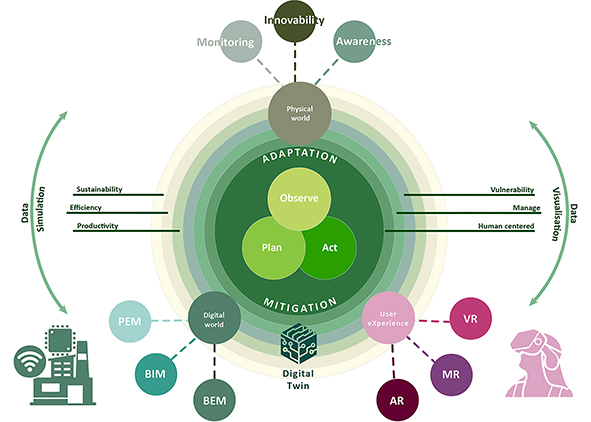
The construction sector, historically marked by inefficiencies and high environmental impacts, is at the centre of a digital transformation. Within this framework, the Digital Twin operates as a systemic platform that integrates data, processes, and stakeholders throughout the entire life cycle, enabling complex decision-making and generating value. The paper investigates how the use of the Digital Twin across the different phases of the building process can support productivity, work quality, and the development of new skills, while also promoting energy efficiency, health, and well-being. The analysis adopts a human-centred perspective, assessing the extent to which the Digital Twin improves the experience of clients, workers, and end users, and how it contributes to a fair and inclusive transition, in line with the vision of Industry 5.0, which places the human being at the centre of the decision-making process.
Article info
Received: 10/09/2025; Revised: 22/10/2025; Accepted: 23/10/2025
Downloads
Article Metrics Graph
References
Amarasinghe, I., Liu, T., Stewart, R. A. and Mostafa, S. (2025), “Paving the way for lowering embodied carbon emissions in the building and construction sector”, in Clean Technologies and Environmental Policy, vol 27, pp. 1825-1843. [Online] Available at: doi.org/10.1007/s10098-024-03023-6 [Accessed 30 September 2025].
BPIE – Buildings Performance Institute Europe (2024), Italy Buildings Climate Tracker – Is Italy on track to decarbonise its building stock?. [Online] Available at: bpie.eu/publication/italy-buildings-climate-tracker-is-italy-on-track-to-decarbonise-its-building-stock/ [Accessed 30 September 2025].
Celaschi, F., Casoni, G. and Formia, E. (2024), “La mediazione del Design – L’integrazione tra agenti artificiali autonomi, produzione manifatturiera e servizi | The mediation of Design – The integration between autonomous artificial agents, manufacturing production, and services”, in Agathón | International Journal of Architecture, Art and Design, vol. 16, pp. 334-343. [Online] Available at: doi.org/10.19229/2464-9309/16282024 [Accessed 30 September 2025].
Chacón, R., Posada, H., Ramonell, C., Jungmann, M., Hartmann, T., Khan, R. and Tomar, R. (2024), “Digital twinning of building construction processes – Case study – A reinforced concrete cast-in structure”, in Journal of Building Engineering, vol. 84, article 108522, pp. 1-23. [Online] Available at: doi.org/10.1016/j.jobe.2024.108522 [Accessed 30 September 2025].
Cumo, F., Giovenale, A. M., Pennacchia, E. and Tiburcio, V. A. (2025), “Towards a Healthier Hospital Environment – The Role of Digital Twins in Achieving Optimal Environmental Comfort”, in Digital Twins and Applications, vol. 2, issue 1, pp. 1-20. [Online] Available at: doi.org/10.1049/dgt2.70002 [Accessed 30 September 2025].
Ellul, C., Hamilton, N., Pieri, A. and Floros, G. (2024), “Exploring Data for Construction Digital Twins – Building Health and Safety and Progress Monitoring Twins Using the Unreal Gaming Engine”, in Buildings, vol. 14, issue 7, article 2216, pp 1-28. [Online] Available at: doi.org/10.3390/buildings14072216 [Accessed 30 September 2025].
European Commission (2019), Communication from the Commission to the European Parliament, the European Council, the Council, the European Economic and Social Committee and the Committee of the Regions – The European Green Deal, document 52019DC0640, 640 final. [Online] Available at: eur-lex.europa.eu/legal-content/EN/TXT/?uri=celex:52019DC0640 [Accessed 30 September 2025].
Gausa, M. (2024), “Complessità, n-città e sistemi dinamici multilivello – Verso una (geo)urbanità in rete e in reti | Complexity, n-city, and multilevel dynamic systems – Towards a networked (geo)urbanity and networks”, in Agathón | International Journal of Architecture, Art and Design, vol. 16, pp. 16-29. [Online] Available at: doi.org/10.19229/2464-9309/1612024 [Accessed 30 September 2025].
Holden, E., Linnerud, K. and Banister, D. (2014), “Sustainable development – Our Common Future revisited”, in Global Environmental Change, vol. 26, pp. 130-139. [Online] Available at: doi.org/10.1016/j.gloenvcha.2014.04.006 [Accessed 30 September 2025].
Iliuţă, M.-E., Moisescu, M.-A., Pop, E., Ionita, A.-D., Caramihai, S.-I. and Mitulescu, T.-C. (2024), “Digital Twin – A Review of the Evolution from Concept to Technology and Its Analytical Perspectives on Applications in Various Fields”, in Applied Sciences, vol. 14, issue 13, article 5454, pp. 1-38. [Online] Available at: doi.org/10.3390/app14135454 [Accessed 30 September 2025].
Kaewunruen, S., Rungskunroch, P. and Welsh, J. (2019), “A Digital-Twin Evaluation of Net Zero Energy Building for Existing Buildings”, in Sustainability, vol. 11, issue 1, article 159, pp. 1-22. [Online] Available at: doi.org/10.3390/su11010159 [Accessed 30 September 2025].
Lee, D., Lee, S. H., Masoud, N., Krishnan, M. S. and Li, V. C. (2021), “Integrated digital twin and blockchain framework to support accountable information sharing in construction projects”, in Automation in Construction, vol. 127, article 103688, pp. 1-9. [Online] Available at: doi.org/10.1016/j.autcon.2021.103688 [Accessed 30 September 2025].
Longo, D., Turillazzi, B., Roversi, R., Lilla, S., Nucci, C. A., Piccinini, A. and Costa, A. (2024), “Gemello digitale urbano e modellazione energetica – Esperienze e analisi di casi d’uso | Urban Digital Twin and Energy Modeling – Experiences and case study analyses”, in Agathón | International Journal of Architecture, Art and Design, vol. 15, pp. 160-169. [Online] Available at: doi.org/10.19229/2464-9309/15122024 [Accessed 30 September 2025].
Luiso, P. (2021), Digital Twin – Parco della Salute, della Ricerca e dell’Innovazione di Torino – Analisi costi della sicurezza in periodo Covid-19 e approccio alla sicurezza in cantiere attraverso il Digital Twin | Digital Twin – Park of Health, Research and Innovation in Turin – Safety cost analysis in the Covid-19 period and approach to safety on site through the Digital Twin, Tesi di Laurea Magistrale, Politecnico di Torino; Relatori Osello, A. and Manzone, F. [Online] Available at: webthesis.biblio.polito.it/id/eprint/20803 [Accessed 30 September 2025].
Ministero dello Sviluppo Economico, Ministero dell’Ambiente e della Tutela del Territorio e del Mare e Ministero delle Infrastrutture e dei Trasporti (2023), Piano Nazionale Integrato per l’Energia e il Clima. [Online] Available at: mimit.gov.it/images/stories/documenti/PNIEC_finale_17012020.pdf [Accessed 18 October 2024].
Mousavi, Y., Gharineiat, Z., Karimi, A. A., McDougall, K., Rossi, A. and Gonizzi Barsanti, S. (2024), “Digital Twin Technology in Built Environment – A Review of Applications, Capabilities and Challenges”, in Smart Cities, vol. 7, issue 5, pp. 2594-2615. [Online] Available at: doi.org/10.3390/smartcities7050101 [Accessed 30 September 2025].
Nava, C. and Melis, A. (2024), “IA generativa e complessità – Verso un nuovo paradigma nel design digitale rigenerativo | Generative IA and complexity – Towards a new paradigm in regenerative digital design”, in Agathón | International Journal of Architecture, Art and Design, vol. 16, pp. 40-49. [Online] Available at: doi.org/10.19229/2464-9309/1632024 [Accessed 30 September 2025].
Nguyen, T. D. and Adhikari, S. (2023), “The Role of BIM in Integrating Digital Twin in Building Construction – A Literature Review”, in Sustainability, vol. 15, issue 13, article 10462, pp. 1-26. [Online] Available at: doi.org/10.3390/su151310462 [Accessed 30 September 2025].
Osello, A., Del Giudice, M., Donato, A. J. and Fratto, A. (2024a), “Verso la Neutralità Climatica – Il ruolo chiave del Digital Twin nell’Industria 5.0 | Towards Climate Neutrality – The key role of the Digital Twin in Industry 5.0”, in Agathón | International Journal of Architecture, Art and Design, vol. 15, pp. 276-285. [Online] Available at: doi.org/10.19229/2464-9309/15222024 [Accessed 30 September 2025].
Osello, A., Zucco, M., Iacono, E. and Del Giudice, M. (2024b), “Logiche nascoste della complessità – Interfacce grafiche e algoritmi per il sistema edificio | Hidden logic of complexity – Graphical interfaces and algorithms for the building system”, in Agathón | International Journal of Architecture, Art and Design, vol. 16, pp. 202-211. [Online] Available at: doi.org/10.19229/2464-9309/16172024 [Accessed 30 September 2025].
Peng, Y., Zhang, M., Yu, F., Xu, J. and Gao, S. (2020), “Digital Twin Hospital Buildings – An Exemplary Case Study through Continuous Lifecycle Integration”, in Advances in Civil Engineering, vol. 2020, article 8846667, pp. 1-13. [Online] Available at: doi.org/10.1155/2020/8846667 [Accessed 30 September 2025].
Rafsanjani, H. N. and Nabizadeh, A. H. (2023), “Towards digital architecture, engineering, and construction (AEC) industry through Virtual Design and Construction (VDC) and digital twin”, in Energy and Built Environment, vol. 4, issue 2, pp. 169-178. [Online] Available at: doi.org/10.1016/j.enbenv.2021.10.004 [Accessed 30 September 2025].
Sharma, R. and Gupta, H. (2024), “Leveraging cognitive digital twins in Industry 5.0 for achieving sustainable development goal 9 – An exploration of inclusive and sustainable industrialisation strategies”, in Journal of Cleaner Production, vol. 448, article 141364, pp. 1-23. [Online] Available at: doi.org/10.1016/j.jclepro.2024.141364 [Accessed 30 September 2025].
Sposito, C. and Scalisi, F. (2024), “Riflessioni e traiettorie di ricerca interdisciplinari sulla transizione energetica | Reflections and trajectories for interdisciplinary research on the energetic transition”, in Agathón | International Journal of Architecture, Art and Design, vol. 15, pp. 3-17. [Online] Available at: doi.org/10.19229/2464-9309/1502024 [Accessed 30 September 2025].
Ugliotti, F. M., D’Addetta, C. and Fabbricatore, M. (2024), “Digital Twin and Artificial Intelligence – Matrix Automation for Design, Monitoring, and Management of Spaces”, in Giordano, A., Russo, M. and Spallone, R. (eds), Advances in Representation – New AI- and XR-Driven Transdisciplinarity, Springer, Cham, Switzerland, pp. 727-743 [Online] Available at: doi.org/10.1007/978-3-031-62963-1_44 [Accessed 30 September 2025].
UN – United Nations (2015a), Transforming our World – The 2030 Agenda for Sustainable Development, document A/RES/70/1. [Online] Available at: docs.un.org/en/A/RES/70/1 [Accessed 30 September 2025].
UN – United Nations (2015b), Paris Agreement. [Online] Available at: unfccc.int/files/essential_background/convention/application/pdf/english _paris_agreement.pdf [Accessed 30 September 2025].
UNI 10838:1999, Edilizia – Terminologia riferita all'utenza, alle prestazioni, al processo edilizio e alla qualità edilizia. [Online] Available at: store.uni.com/uni-10838-1999 [Accessed 30 September 2025].
Wang, B., Zhou, H., Li, X., Yang, G., Zheng, P., Song, C., Yuan, Y., Wuest, T., Yang, H. and Wang, L. (2024), “Human Digital Twin in the context of Industry 5.0”, in Robotics and Computer-Integrated Manufacturing, vol. 85, article 102626, pp. 1-25. [Online] Available at: doi.org/10.1016/j.rcim.2023.102626 [Accessed 30 September 2025].
Wang, T. and Chen, H.-M. (2023), “Integration of building information modeling and project management in construction project life cycle”, in Automation in Construction, vol. 150, article 104832, pp. 1-12. [Online] Available at: doi.org/10.1016/j.autcon.2023.104832 [Accessed 30 September 2025].
Wang, Z. (2020), “Digital Twin Technology”, in Bányai, T., Petrilloand, A. and De Felice, F. (eds), Industry 4.0 – Impact on Intelligent Logistics and Manufacturing, IntechOpen, Rijeka, pp. 95-114. [Online] Available at: dx.doi.org/10.5772/intechopen.80974 [Accessed 30 September 2025].
Weichbroth, P., Jandy, K. and Zurada, J. (2024), “Toward Sustainable Development – Exploring the Value and Benefits of Digital Twins”, in Telecom, vol. 5, issue 3, pp. 774-791. [Online] Available at: doi.org/10.3390/telecom5030039 [Accessed 30 September 2025].
World Green Building Council (2024), Annual Report 2023-2024. [Online] Available at: worldgbc.org/wp-content/uploads/2025/02/WorldGBC-Annual-Report-2023-2024.pdf?utm_campaign=website&utm_medium=email&utm_source=sendgrid.com [Accessed 14 October 2025].
Xu, H., Kim, J. I. and Chen, J. (2025), “Improved framework for estimating carbon emissions from prefabricated buildings during the construction stage – Life cycle assessment and case study”, in Building and Environment, vol. 272, article 112599, pp. 1-15. [Online] Available at: doi.org/10.1016/j.buildenv.2025.112599 [Accessed 30 September 2025].
Yang, Z., Tang, C., Zhang, T., Zhang, Z. and Doan, D. T. (2024), “Digital Twins in Construction – Architecture, Applications, Trends and Challenges”, in Buildings, vol. 14, issue 9, article 2616, pp. 1-28. [Online] Available at: doi.org/10.3390/buildings14092616 [Accessed 30 September 2025].
Zannoni, M., Succini, L., Rosato, L. and Pasini, V. (2024), “Transitional industrial designer – La responsabilità di progettisti e imprese per una transizione sostenibile | Transitional industrial designer – The responsibility of designers and companies for a sustainable transition”, in Agathón | International Journal of Architecture, Art and Design, vol. 15, pp. 332-343. [Online] Available at: doi.org/10.19229/2464-9309/15282024 [Accessed 30 September 2025].
Zhang, A., Yang, J. and Wang, F. (2023), “Application and enabling digital twin technologies in the operation and maintenance stage of the AEC industry – A literature review”, in Journal of Building Engineering, vol. 80, article 107859, pp. 1-24. [Online] Available at: doi.org/10.1016/j.jobe.2023.107859 [Accessed 30 September 2025].
Downloads
Published
How to Cite
Issue
Section
Categories
License
Copyright (c) 2025 Alexandra Eika D’Amore

This work is licensed under a Creative Commons Attribution 4.0 International License.
This Journal is published under Creative Commons Attribution Licence 4.0 (CC-BY).
License scheme | Legal code
This License allows anyone to:
Share: copy and redistribute the material in any medium or format.
Adapt: remix, transform, and build upon the material for any purpose, even commercially.
Under the following terms
Attribution: Users must give appropriate credit, provide a link to the license, and indicate if changes were made; users may do so in any reasonable manner, but not in any way that suggests the licensor endorses them or their use.
No additional restrictions: Users may not apply legal terms or technological measures that legally restrict others from doing anything the license permits.
Notices
Users do not have to comply with the license for elements of the material in the public domain or where your use is permitted by an applicable exception or limitation.
No warranties are given. The license may not give users all of the permissions necessary for their intended use. For example, other rights such as publicity, privacy, or moral rights may limit how you use the material.