Progettare con l’acqua – Strategie, protocolli e progetti nell’architettura e per le città
DOI:
https://doi.org/10.69143/2464-9309/1892025Parole chiave:
gestione dell’acqua, architettura sostenibile, rigenerazione urbana, conservazione dell’acqua, progetto resilienteAbstract
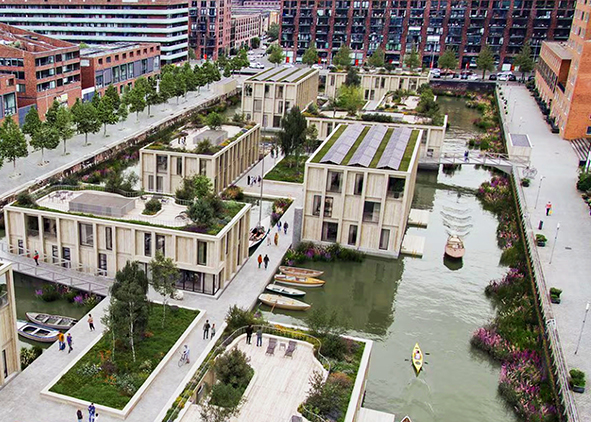
La gestione dell’acqua è sempre più centrale nel progetto di architettura e di rigenerazione urbana, sia per le nuove costruzioni che per il Patrimonio esistente. La carenza globale di acqua dolce, aggravata dalle ricorrenti siccità, ne richiede un ripensamento radicale dell’uso, in linea con il riconoscimento delle Nazioni Unite dell’accesso all’acqua come diritto umano. Promuoverne l’efficienza richiede strategie integrate come la raccolta e il riciclo dell’acqua piovana, i sistemi di infiltrazione e le tecnologie di monitoraggio avanzate. La progettazione deve adottare materiali sostenibili che minimizzino i consumi e garantiscano un’efficienza a lungo termine. Questo articolo analizza le pratiche attuali e i casi di studio, proponendo protocolli e buone pratiche replicabili. L’acqua diventa non solo una risorsa gestita ma anche un generatore di valore, resilienza e benessere a supporto dell’Agenda 2030 per lo Sviluppo Sostenibile.
Info sull'articolo
Ricevuto: 10/09/2025; Revisionato: 25/10/2025; Accettato: 27/10/2025
Downloads
##plugins.generic.articleMetricsGraph.articlePageHeading##
Riferimenti bibliografici
ANSA (2017), “Trento, 18 milioni a progetto ‘Santa Chiara open lab”, in ANSA.it, newspaper online, 18/12/2017. [Online] Available at: ansa.it/trentino/notizie/2017/12/18/trento-18-milioni-a-progetto-santa-chiara-open-lab_aecbf131-d5d9-4ed3-903b-b382f922f138.html [Accessed 28 September 2025].
Avramidou, M. and Manika, S. (2021), “Interaction of modern architectural design with the environment – Evaluation and application in urban open spaces for developing resilient cities”, in ICED2021 | 2nd International Conference on Environmental Design, Athens, Greece, October 23-24, 2021, IOP Conference Series | Earth and Environmental Science, vol. 899, article 012011, Purpose-Led Publishing, pp. 1-8. [Online] Available at: doi.org/10.1088/1755-1315/899/1/012011 [Accessed 28 September 2025].
Badarnah, L. (2016), “Water management lessons from nature for applications to buildings”, in Procedia Engineering, vol. 145, pp. 1432-1439. [Online] Available at: doi.org/10.1016/j.proeng.2016.04.180 [Accessed 28 September 2025].
Bahari, A. (2012), Integrated Urban Water Management, Global Water Partnership, Stockholm. [Online] Available at: gwp.org/globalassets/global/toolbox/publications/background-papers/16-integrated-urban-water-management-2012.pdf [Accessed 29 September 2025].
Barnett, J. (2006), “Climate change, insecurity and injustice”, in Adger, W. N., Paavola, J., Huq, S. and Mace, M. J. (eds), Fairness in Adaptation to Climate Change, MIT Press, Cambridge (MA), pp. 115-130. [Online] Available at: doi.org/10.7551/mitpress/2957.003.0011 [Accessed 29 September 2025].
Berizzi, C., Mazurkiewicz, M. and Terlicher, G. (2025), “Public Open Spaces and Water – Urban Design in Response to Climate Change”, in Hanzl, M., Kantarek, A. A., Zaguła, A., Musiaka, L. and Figlus, T. (eds), Urban Morphology versus Urban Redevelopment and Revitalisation – Proceedings of the XXIX Conference of the International Seminar on Urban Form 2022, Łódź and Kraków, Poland, September 2-11, 2022, Springer, Cham, pp. 521-544. [Online] Available at: doi.org/10.1007/978-3-031-77752-3_26 [Accessed 28 September 2025].
Biswas, A. K. (2008), “Current directions – Integrated water resources management – A second look”, in Water International, vol. 33, issue 3, pp. 274-278. [Online] Available at: doi.org/10.1080/02508060802272812 [Accessed 28 September 2025].
Blečić, I., Cois, E., Muroni, E. and Saiu, V. (2024), “Spaces seeking activities - activities seeking spaces – Evaluation and policy design of neighbourhood-wide urban community spaces”, in City, Culture and Society, vol. 39, article 100606, pp.1-9. [Online] Available at: doi.org/10.1016/j.ccs.2024.100606 [Accessed 28 September 2025].
Brisotto, C., Carney, J., Macaione, I. and Raffa, A. (2023), “Cambiamenti climatici nei paesaggi di bonifica – Adattamento tra modulo e modularità | Climate change in reclamation landscapes – Adaptation between module and modularity”, in Agathón | International Journal of Architecture, Art and Design, vol. 14, pp. 62-73. [Online] Available at: doi.org/10.19229/2464-9309/1442023 [Accessed 28 September 2025].
Butera, F. M. (2024), “La Città Ideale | The Ideal City”, in Agathón | International Journal of Architecture, Art and Design, vol. 16, pp. 30-39. [Online] Available at: doi.org/10.19229/2464-9309/1622024 [Accessed 28 September 2025].
Cascone, S. M., Margani, G. and Sapienza, V. (2020), New Horizons for Sustainable Architecture | Nuovi orizzonti per l’architettura sostenibile, EdicomEdizioni, Monfalcone.
Castellini, M., Faiella, I., Lavecchia, L., Miniaci, R. and Valbonesi, P. (eds) (2024), Rapporto Annuale – Anno 2023. [Online] Available at: oipeosservatorio.it/wp-content/uploads/2024/03/rapporto_2023_IT.pdf [Accessed 28 September 2025].
Ciccarese, L. and Fino, A. (2003), Le relazioni tra cambiamenti del clima ed ecosistemi vegetali, Agenzia per la Protezione dell’Ambiente e per i servizi Tecnici, Rapporti 32/2003 [Online] Available at: isprambiente.gov.it/contentfiles/00003800/3806-cambiamenti-clima.pdf [Accessed 28 September 2025].
Consiglia, M., Lahmar, A., Azrour, M. and Lahmar, A. (2025), “Towards resilient architecture in technological innovation and AI”, in Kharmich, H., El Harrouni, K., Baba, K. and Karibi, K. (eds), Vernacular Architecture – Support for Territorial Development, National School of Architecture of Rabat, Rabat, Morocco, October 4-5, 2024, Materials Research Proceedings, vol. 47, Material Research Forum LLC., Millersville (PA), pp. 327-342. [Online] Available at: doi.org/10.21741/9781644903391-38 [Accessed 28 September 2025].
Corradi, M., Stevens, T., Macaione, I., Raffa, A. and Andaloro, B. (2024), “Rigenerazione climatica green degli streetscapes – L’esperienza di De Urbanisten ad Anversa | Green climate-adaptive streetscapes regeneration – The De Urbanisten Experience in Antwerp”, in Agathón | International Journal of Architecture, Art and Design, vol. 16, pp. 60-73. [Online] Available at: doi.org/10.19229/2464-9309/1652024 [Accessed 28 September 2024].
Crosby, P. (2023), “Towards an Anti-Antiutopia – Solarpunk Cities and the Precarity of Our Urban Future”, in Enquiry | The ARCC Journal for Architectural Research, vol. 20, issue 2, pp. 79-91. [Online] Available at: doi.org/10.17831/enqarcc.v20i2.1159 [Accessed 28 September 2025].
Dolman, N. and Verlinde, J. (2024), “Achieving a Water-Resilient Rotterdam – Past, Present and Future Perspectives”, in Blue Papers, vol. 3, issue 1, pp. 164-177. [Online] Available at: doi.org/10.58981/bluepapers.2024.1.13 [Accessed 28 September 2025].
Donofrio, J., Kuhn, Y., McWalter, K. and Winsor, M. (2009), “Water-Sensitive Urban Design – An Emerging Model in Sustainable Design and Comprehensive Water-Cycle Management”, in Environmental Practice, vol. 11, issue 3, pp. 179-189. [Online] Available at: doi.org/10.1017/S1466046609990263 [Accessed 28 September 2025].
European Commission (2019), Communication from the Commission to the European Parliament, the Council, the European Economic and Social Committee and the Committee of the Regions – The European Green Deal, document 52019DC0640, COM/2019/640 final. [Online] Available at: eur-lex.europa.eu/legal-content/EN/TXT/?uri=celex:52019DC0640 [Accessed 28 September 2025].
Faranda, D., Ginesta, M., Alberti, T., Coppola, E. and Anzidei, M. (2023), “Attributing Venice Acqua Alta events to a changing climate and evaluating the efficacy of MoSE adaptation strategy”, in Climate and Atmospheric Science, vol. 6, article 181, pp. 1-8. [Online] Available at: doi.org/10.1038/s41612-023-00513-0 [Accessed 28 September 2025].
Ferrans, P., Torres, M. N., Temprano, J. and Rodríguez Sánchez, J. P. (2022), “Sustainable urban drainage system (SUDS) modeling supporting decision-making – A systematic quantitative review”, in Science of The Total Environment, vol. 806, issue 2, article 150447, pp. 1-14. [Online] Available at: doi.org/10.1016/j.scitotenv.2021.150447 [Accessed 28 September 2025].
González-Campaña, J., Lafaurie-Debany, N. and Rabazo Martin, M. (2023), “Realizzare paesaggi innovativi – Balmori Associaties ridefinisce il rapporto uomo-natura per le città del futuro | Making innovative landscapes – Balmori Associates redefining the human-nature relationship for the cities of the future”, in Agathón | International Journal of Architecture, Art and Design, vol. 13, pp. 31-42. [Online] Available at: doi.org/10.19229/2464-9309/1322023 [Accessed 28 September 2025].
Grigg, N. S. (2025), “Integrated Water Resources Management After 2030 – An Agenda for Educators”, in Water, vol. 17, issue 2, article 189, pp. 1-15. [Online] Available at: doi.org/10.3390/w17020189 [Accessed 28 September 2025].
Hendawy, M., Junaid, M. and Amin, A. (2024), “Integrating sustainable development goals into the architecture curriculum –Experiences and perspectives”, in City and Environment Interactions, vol. 21, article 100138, pp. 1-11. [Online] Available at: doi.org/10.1016/j.cacint.2023.100138 [Accessed 28 September 2025].
IPCC – Intergovernmental Panel on Climate Change (2023), Climate Change 2021 – The Physical Science Basis – Contribution of Working Group I to the Sixth Assessment Report of the Intergovernmental Panel on Climate Change, Cambridge University Press, Cambridge (UK) and New York (NY). [Online] Available at: doi.org/10.1017/9781009157896 [Accessed 29 September 2025].
Javanroodi, K., Nik, V. M. and Scartezzini, J. L. (2021), “Quantifying the impacts of urban morphology on modifying microclimate conditions in extreme weather conditions”, in Journal of Physics | Conference Series, vol. 2042, article 012058, pp. 1-6. [Online] Available at: doi.org/10.1088/1742-6596/2042/1/012058 [Accessed 28 September 2025].
Kepekci, H. and Asma, A. (2020), “Comparative Analysis of Heat Sink Performance Using Different Materials”, in AJER | American Journal of Engineering Research, vol. 9, issue 4, pp. 204-210. [Online] Available at: ajer.org/papers/Vol9-issue4/Z0904204210.pdf [Accessed 28 September 2025].
Liu, Y. (2023), “Analysis of the Vertical Forest of Milan in Terms of High-Rise Architecture and Biodiversity”, in Highlights in Art and Design, vol. 3, issue 2, pp. 47-52. [Online] Available at: doi.org/10.54097/hiaad.v3i2.10043 [Accessed 28 September 2025].
Marzot, N. (2019), “L’avventura del progetto e il destino dell’uomo – Architettura e costruzione della realtà sociale”, in Rivista di Estetica, vol. 71, pp. 148-172. [Online] Available at: doi.org/10.4000/estetica.5566 [Accessed 28 September 2025].
Matthies, F. and Menne, B. (2009), “Prevention and management of health hazards related to heatwaves”, in International Journal of Circumpolar Health, vol. 68, issue 1, pp. 8-12. [Online] Available at: doi.org/10.3402/ijch.v68i1.18293 [Accessed 28 September 2025].
Maziotis, A., Sala-Garrido, R. and Molinos-Senante, M. (2024), “Assessing energy efficiency and its dynamic changes in the water sector integrating heterogeneity and carbon emissions”, in Journal of Cleaner Production, vol. 480, article 144137, pp. 1-12. [Online] Available at: doi.org/10.1016/j.jclepro.2024.144137 [Accessed 28 September 2025].
Mecca, B., Gaballo, M. and Todella, E. (2023), “Measuring and evaluating urban sustainability | Misurare e valutare la sostenibilità urbana”, in Valori e Valutazioni, vol. 32, pp. 17-29. [Online] Available at: doi.org/10.48264/VVSIEV-20233203 [Accessed 28 September 2025].
Mitchell, V. G. (2006), “Applying Integrated Urban Water Management Concepts – A Review of Australian Experience”, in Environmental Management, vol. 37, pp. 589-605. [Online] Available at: doi.org/10.1007/s00267-004-0252-1 [Accessed 28 September 2025].
Mössner, S. (2015), “Urban development in Freiburg, Germany – Sustainable and neoliberal?”, in Die Erde | Journal of the Geographic Society of Berlin, vol. 146, issue 2-3, pp. 189-193. [Online] Available at: doi.org/10.12854/erde-146-16 [Accessed 28 September 2025].
Ness, D. (2024), “La decarbonizzazione degli edifici sarà sufficiente? – Limitare e ridistribuire l’aumento di superficie costruita | Will decarbonising buildings be enough? – Constrain and redistribute growth in floor area”, in Agathón | International Journal of Architecture, Art and Design, vol. 15, pp. 84-97. [Online] Available at: doi.org/10.19229/2464-9309/1562024 [Accessed 30 August 2025].
Ofori, A. and Mdee, A. (2021), “Integrated Water Resource Management”, in Leal Filho, W., Azul, A. M., Brandli, L., Lange Salvia, A. and Wall, T. (eds), Clean Water and Sanitation – Encyclopedia of the UN Sustainable Development Goals, Springer, Cham, pp. 1-13. [Online] Available at: doi.org/10.1007/978-3-319-70061-8_4-1 [Accessed 28 September 2025].
Olatunde, T. M., Okwandu, A. C., Akande, D. O. and Sikhakhane, Z. Q. (2024), “Energy efficiency in architecture – Strategies and technologies”, in Open Access Research Journal of Multidisciplinary Studies, vol. 7, issue 2, pp. 31-41. [Online] Available at: doi.org/10.53022/oarjms.2024.7.2.0024 [Accessed 28 September 2025].
Patsidis, A., Dyśko, A., Booth, C., Oulis Rousis, A., Kalliga, P. and Tzelepis, D. (2023), “Digital Architecture for Monitoring and Operational Analytics of Multi-Vector Microgrids Utilizing Cloud Computing, Advanced Virtualization Techniques, and Data Analytics Methods”, in Energies, vol. 16, issue 16, article 5908, pp. 1-19. [Online] Available at: doi.org/10.3390/en16165908 [Accessed 28 September 2025].
Peng, L., Salem, M., Blazek, V., Prokop, L., Al-Bahrani, M. and Misak, S. (2023), “Thermal energy storage applications in solar water heaters – An updated review”, in Sustainable Energy Technologies and Assessments, vol. 57, article 103230, pp. 1-11. [Online] Available at: doi.org/10.1016/j.seta.2023.103230 [Accessed 28 September 2025].
Prestamburgo, S., Sgroi, F., Venudo, A. and Zanin, C. (2021), “Universal design as resilient urban space plan strategy – New scenarios for environmental resources’ sustainable management”, in AIMS Environmental Science, vol. 8, issue 4, pp. 321-340. [Online] Available at: doi.org/10.3934/environsci.2021021 [Accessed 28 September 2025].
Rahman, M. M., Rahman, M. A., Haque, M. M. and Rahman, A. (2019), “Sustainable water use in construction”, in Tam, V. W. Y. and Le, K. N. (eds), Sustainable Construction Technologies – Life-Cycle Assessment, Butterworth-Heinemann, Oxford (UK), pp. 211-235. [Online] Available at: doi.org/10.1016/B978-0-12-811749-1.00006-7 [Accessed 28 September 2025].
Rossi, G. E. (2019), “Adattamento urbano, strategie e progetto – Il divario fra le politiche e la loro implementazione | Urban adaptation, strategies and projects – The gap between policies and their implementation”, in Agathón | International Journal of Architecture, Art and Design, vol. 6, pp. 46-57. [Online] Available at: doi.org/10.19229/2464-9309/652019 [Accessed 28 September 2025].
Sananse, N., Povekar, S., Wagh, A., Donde, S., Gurani, K. and Khadke, N. (2023), “The Canal Top Solar Power Generation Project”, in IJRASET | International Journal for Research in Applied Science and Engineering Technology, vol. 11, issue 4, pp. 3942-3947. [Online] Available at: doi.org/10.22214/ijraset.2023.51144 [Accessed 28 September 2025].
Shrivastava, E., Segura D’Angelo, G. A. and Lai, Y. (2021), Gioia 22 – Re-Articulating Porta Nuova – A public high-rise proposal in Milan skyline, Thesis, Politecnico di Milano (Italy), Tutor Prof. Folli, M. G., co-Tutors Prof. Pecora, C., Dotelli, G., Imperadori, M. and Romano, F. [Online] Available at: hdl.handle.net/10589/181717 [Accessed 28 September 2025].
Sposito, C. (2017), “Costruire con l’acqua – Nuovi paradigmi dell’architettura sostenibile | Building with water – new standards of sustainable architecture”, in Agathón | International Journal of Architecture, Art and Design, vol. 2, pp. 117-126. [Online] Available at: doi.org/10.19229/2464-9309/2162017 [Accessed 28 September 2025].
Turki, H., Zhang, J. Y., Ferroni, F. and Ramanan, D. (2023), “SUDS – Scalable Urban Dynamic Scenes”, in Computer Science, arXiv:2303.14536v1, pp. 1-14. [Online] Available at: doi.org/10.48550/arXiv.2303.14536 [Accessed 28 September 2025].
Umgiesser, G. (2020), “The impact of operating the mobile barriers in Venice (MOSE) under climate change”, in Journal for Nature Conservation, vol. 54, article 125783, pp. 1-10. [Online] Available at: doi.org/10.1016/j.jnc.2019.125783 [Accessed 28 September 2025].
UN – United Nations (2015), Transforming our world – The 2030 Agenda for Sustainable Development – A/RES/70/1. [Online] Available at: sustainabledevelopment.un.org/content/documents/21252030%20Agenda %20for%20Sustainable%20Development%20web.pdf [Accessed 28 September 2025].
Vacanti, A. and Leonardi, C. (2024), “Tecnologia, energia e tempo – Percorsi sperimentali per il design di tecnologie appropriate | Technology, energy and time – Experimental paths for the design of appropriate technology”, in Agathón | International Journal of Architecture, Art and Design, vol. 15, pp. 316-323. [Online] Available at: doi.org/10.19229/2464-9309/15262024 [Accessed 30 August 2025].
Valente, R., Mozingo, L. A., Bosco, R. and Giacobbe, S. (2024), “Gestione integrata delle risorse naturali in contesti urbani sostenibili | Integrated natural resource management in sustainable urban context”, in Agathón | International Journal of Architecture, Art and Design, vol. 15, pp. 180-189. [Online] Available at: doi.org/10.19229/2464-9309/15142024 [Accessed 29 September 2024].
Vosoughkhosravi, S., Dixon-Grasso, L. and Jafari, A. (2022), “The impact of LEED certification on energy performance and occupant satisfaction – A case study of residential college buildings”, in Journal of Building Engineering, vol. 59, article 105097, pp. 1-16. [Online] Available at: doi.org/10.1016/j.jobe.2022.105097 [Accessed 28 September 2025].
WHO – World Health Organization (2024), Water safety planning – A roadmap to supporting resources. [Online] Available at: cdn.who.int/media/docs/default-source/wash-documents/water-safety-and-quality/water-safety-planning/revised_wsp_roadmap_23sept2024.pdf?sfvrsn=39eca14b_3&download=true [Accessed 28 September 2025].
Xiangfeng, L. and Tianxing, S. (2007), “Conceptual Development of Transparent Water Storage Envelopes”, in Architectural Science Review, vol. 50, issue 1, pp. 18-25. [Online] Available at: doi.org/10.3763/asre.2007.5003 [Accessed 28 September 2025].
Yap, K. G. and Koh, A. (2010), “Creating a City of Gardens and Water – Singapore’s Active, Beautiful, Clean Waters Programme”, in Proceedings of the Water Environment Federation, Water Environment Federation, vol. 2010, issue 2, pp. 1-14. [Online] Available at: accesswater.org/publications/proceedings/-297673/creating-a-city-of-gardens-and-water---singapore-s-active--beautiful--clean-waters-programme?pdfdownload=true [Accessed 28 September 2025].
Zacharias, I., Dimitriou, E. and Koussouris, T. (2003), “Developing sustainable water management scenarios by using thorough hydrologic analysis and environmental criteria”, in Journal of Environmental Management, vol. 69, issue 4, pp. 401-412. [Online] Available at: doi.org/10.1016/j.jenvman.2003.09.017 [Accessed 28 September 2025].
Zanzottera, F. (2022), Vetra Building – Storia di un’architettura nel cuore di Milano, Liberedizioni – BAMS Edizioni, Montichiari.
##submission.downloads##
Pubblicato
Come citare
Fascicolo
Sezione
Categorie
Licenza
Copyright (c) 2025 Tiziana Campisi, Luisa Lombardo

TQuesto lavoro è fornito con la licenza Creative Commons Attribuzione 4.0 Internazionale.
AGATHÓN è pubblicata sotto la licenza Creative Commons Attribution License 4.0 (CC-BY).
License scheme | Legal code
Questa licenza consente a chiunque di:
Condividere: riprodurre, distribuire, comunicare al pubblico, esporre in pubblico, rappresentare, eseguire e recitare questo materiale con qualsiasi mezzo e formato.
Modificare: remixare, trasformare il materiale e basarti su di esso per le tue opere per qualsiasi fine, anche commerciale.
Alle seguenti condizioni
Attribuzione: si deve riconoscere una menzione di paternità adeguata, fornire un link alla licenza e indicare se sono state effettuate delle modifiche; si può fare ciò in qualsiasi maniera ragionevole possibile, ma non con modalità tali da suggerire che il licenziante avalli l'utilizzatore o l'utilizzo del suo materiale.
Divieto di restrizioni aggiuntive: non si possono applicare termini legali o misure tecnologiche che impongano ad altri soggetti dei vincoli giuridici su quanto la licenza consente di fare.
Note
Non si è tenuti a rispettare i termini della licenza per quelle componenti del materiale che siano in pubblico dominio o nei casi in cui il nuovo utilizzo sia consentito da una eccezione o limitazione prevista dalla legge.
Non sono fornite garanzie. La licenza può non conferire tutte le autorizzazioni necessarie per l'utilizzo che ci si prefigge. Ad esempio, diritti di terzi come i diritti all'immagine, alla riservatezza e i diritti morali potrebbero restringere gli usi del materiale.