PUNTOnet H2O – From field investigation to the prototype of a multifunctional water station
DOI:
https://doi.org/10.69143/2464-9309/18232025Keywords:
urban furniture, drinking water, public space, pilot project, virtuous pro-environmental behavioursAbstract
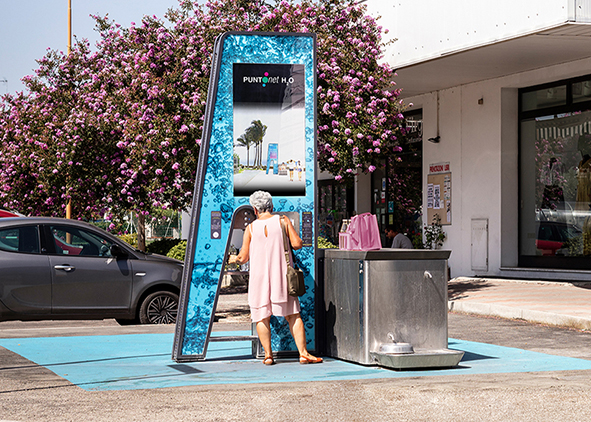
Adequate availability of drinking water in cities can improve the quality of life and public spaces, while also encouraging sustainable mobility models and healthy, eco-friendly habits. However, drinking fountains are currently an ‘urban species in danger of extinction’, often dismissed or regarded with suspicion, largely ignored by both the scientific community and design experimentation. This paper presents part of a research project that led to the design, prototyping, and real-world demonstration of one possible solution to reinvent the image of the urban water point and assign it new functions that serve the neighbourhood. In particular, it illustrates the results and the role of the preliminary listening and field observation phase in defining the design brief for PUNTOnet H2O, a multifunctional, sentient piece of urban furniture that extends access to drinking water in collective open spaces.
Article info
Received: 12/09/2025; Revised: 19/10/2025; Accepted: 20/10/2025
Downloads
Article Metrics Graph
References
Aguas de Cádiz (2021), Fuentes Públicas de agua potable – Elementos para el Derecho Humano al Agua y su accesibilidad. [Online] Available at: aguasdecadiz.es/wp-content/uploads/2021/10/Libro_FPAP_web.pdf [Accessed 25 September 2025].
ARPAE – Agenzia Prevenzione Ambiente Energia (2025), Rapporto IdroMeteoClima Emilia-Romagna – Dati 2024. [Online] Available at: arpae.it/it/notizie/tempo-e-clima-in-emilia-romagna-1 [Accessed 10 September 2025].
Bedimo-Rung, A. L., Gustat, J., Tompkins, B. J., Rice, J. and Thomson, J. (2006), “Development of a direct observation instrument to measure environmental characteristics of parks for physical activity”, in Journal of Physical Activity and Health, vol. 3, issue 1, pp. 176-189. [Online] Available at: doi.org/10.1123/jpah.3.s1.s176 [Accessed 25 September 2025].
Benente, M. (2011), “Toret – Fontanelle pubbliche a Torino – Da patrimonio diffuso a carattere identitario della città”, in Pretelli, M., Ugolini, A., Lazzarini, G., Pistocchi, E., Serrau, A. and Signorelli, L. (eds), Le fontane storiche – Eredità di un passato recente – Restauro, valorizzazione e gestione di un patrimonio complesso, Alinea, Firenze, pp. 278-285.
Buffoli, M., Capolongo, S., Oberti, I., Plantamura, F. and Rebecchi, A. (2017), “Requisiti e schede tecniche per la realizzazione Green Urban Spaces efficienti”, in Capolongo, S. and D’Alessandro, D. (eds), Città in salute – Strategie per la tutela e la promozione della salute nei contesti urbani, Maggioli Editore, Santarcangelo di Romagna, pp. 120-142.
Casiddu, N., Burlando, F. and Chen, B. (2024), “Human-de-centred Design – Verso una (nuova) era della sofferenza | Human-de-centred Design – Towards a (new) era of suffering”, in Agathón | International Journal of Architecture, Art and Design, vol. 16, pp. 242-249. [Online] Available at: doi.org/10.19229/2464-9309/16212024 [Accessed 18 September 2025].
Comune di Ferrara (2024), “Oggi è la giornata mondiale della bicicletta – Ferrara, capitale della bici – La città in numeri”, in Cronaca Comune | Quotidiano online del Comune di Ferrara, newspaper online, 03/06/2024. [Online] Available at: cronacacomune.it/notizie/52776/oggi-e-la-giornata-mondiale-della-bicicletta-ferrara-capitale-della-bici-la-citta-numeri.html [Accessed 19 September 2025].
D’Angelis, E. and Grassi, M. (2024), La nuova civiltà dell’Acqua – Il Piano Nazionale per la Sicurezza Idrica e Idrogeologica e l’adattamento al cambiamento climatico, Polistampa, Firenze.
Decreto Legislativo 19 giugno 2025, n. 102 – Disposizioni integrative e correttive del decreto legislativo 23 febbraio 2023, n. 18, di attuazione della direttiva (UE) 2020/2184 del Parlamento europeo e del Consiglio, del 16 dicembre 2020, concernente la qualità delle acque destinate al consumo umano. [Online] Available at: gazzettaufficiale.it/eli/id/2025/07/04/25G00106/SG [Accessed 25 September 2025].
Ercolini, R. (2024), Noi siamo oceano – Manifesto per un’ecologia del cambiamento, Baldini+Castoldi, Milano.
FEMTEC (2015), Water and health – How water protects and improves health overall. [Online] Available at: femteconline.org/Water-Health/Consensus_Paper_en.pdf [Accessed 19 September 2025].
Ferraro, L. (2019), Design for Quality – Metodi di Pugh e QBench a confronto | Design for Quality – A comparison between Pugh and QBench methods, Thesis, Corso di Laurea Magistrale in Ingegneria Gestionale, Politecnico di Torino (Italy), Relatore Prof. Franceschini, F. [Online] Available at: webthesis.biblio.polito.it/10578/ [Accessed 25 September 2025].
Gianfrate, V. and Longo, D. (2017), Urban micro-design – Tecnologie integrate, adattabilità e qualità degli spazi pubblici, FrancoAngeli, Milano.
Gleick, P. H. (2011), Bottled and Sold – The Story Behind Our Obsession with Bottled Water, Island Press, Washington (DC).
Haraway, D. J. (2023), Manifesto delle specie compagne – Cani, persone e altri partner, Contrasto, Milano.
Ivanov, J. (2015), Drinking fountains – The past and future of free public water in the United States, Thesis, Massachusetts Institute of Technology (Massachusetts), Advisor Whiston Spirn, A. [Online] Available at: hdl.handle.net/1721.1/99098 [Accessed 24 September 2025].
Koohsari, M. J., Mavoa, S., Villanueva, K., Sugiyama, T., Badland, H., Kaczynski, A. T., Owen, N. and Giles-Corti, B. (2015), “Public open space, physical activity, urban design and public health – Concepts, methods and research agenda”, in Health and place, vol. 33, pp. 75-82. [Online] Available at: doi.org/10.1016/j.healthplace.2015.02.009 [Accessed 25 September 2025].
Lee, R. E., Booth, K. M., Reese-Smith, J. Y., Regan, G. and Howard, H. H. (2005), “The physical activity resource assessment (PARA) instrument – Evaluating features, amenities, and incivilities of physical activity resources in urban neighborhoods”, in International Journal of Behavioral Nutrition and Physical Activity, vol. 2, article 13, pp. 1-9. [Online] Available at: doi.org/10.1186/1479-5868-2-13 [Accessed 25 September 2025].
London’s Child Obesity Taskforce (2019), Every Child a Healthy Weight – Ten ambitions for London. [Online] Available at: london.gov.uk/sites/default/files/every_child_a_healthy_weight.pdf [Accessed 26 September 2025].
Magnago Lampugnani, V. (2021), Frammenti Urbani – I piccoli oggetti che raccontano le città, Bollati Boringhieri, Torino.
Manzini, E. (2021), Abitare la prossimità – Idee per la città dei 15 minuti, Egea, Milano.
Maspoli, R. (2018), “Inclusione sociale, benessere psico-fisico e qualità dello spazio pubblico attrezzato”, in Angelucci, F. (ed.), Smartness e healthiness per la transizione verso la resilienza – Orizzonti di ricerca interdisciplinare sulla città e il territorio, FrancoAngeli, Milano, pp. 77-94.
Mattern, S. (2023), “Fountain Society”, in Places Journal, 02/2023. [Online] Available at: doi.org/10.22269/230214 [Accessed 25 September 2025].
Moreno, C. (2024), La città dei 15 minuti – Per una cultura urbana democratica, add editore, Torino.
Phurisamban, R. and Gleick, P. (2017), Drinking Fountains and Public Health – Improving National Water Infrastructure to Rebuild Trust and Ensure Access, Pacific Institute, Oakland. [Online] Available at: pacinst.org/wp-content/uploads/2017/02/Drinking_Fountains_and_Public_Health_Feb_2017-1.pdf [Accessed 25 September 2025].
Rossi, A. (2014), “Fontanelle, ovvero quel che manca a Ferrara – Il discreto fascino dell’acqua sotto il sole d’agosto”, in Listone Magazine, newspaper online, 22/08/2014. [Online] Available at: listonemag.it/2014/08/22/fontanelle-ovvero-quel-che-manca-a-ferrara/ [Accessed 26 September 2025].
Saelens, B. E., Frank, L. D., Auffrey, C., Whitaker, R. C., Burdette, H. L. and Colabianchi, N. (2006), “Measuring physical environments of parks and playgrounds – EAPRS instrument development and inter-rater reliability”, in Journal of Physical Activity and Health, vol. 3, issue 1, pp.190-207. [Online] Available at: doi.org/10.1123/jpah.3.s1.s190 [Accessed 25 September 2025].
Salzman, J. (2012), Drinking Water – A History, Overlook Duckworth, New York.
Schuler, T. A. (2015), “Public Space has a Drinking Problem – As drinking fountains fade from view, a call to make them iconic again”, in Landscape Architecture Magazine | The Magazine of the American Society of Landscape Architects, newspaper online, 10/11/2015. [Online] Available at: landscapearchitecturemagazine.org/2015/11/10/public-space-has-a-drinking-problem/ [Accessed 25 September 2025].
Sennet, R. (2018), Costruire e abitare – Etica per la città, Feltrinelli, Milano.
Sim, D. (2019), Soft City – Building Density for Everyday Life, Island Press, Washington (DC).
The European House – Ambrosetti (2025), Libro Bianco 2025 – Valore Acqua per l’Italia. [Online] Available at: giornatamondialeacqua.ambrosetti.eu/wp-content/uploads/2025/03/ValoreAcqua2025_Report_ITA-DIGITALE.pdf [Accessed 12 October 2025].
Vinti, C. (2019), “Il design come campo di indagine – Le ricerche e la scrittura di Ugo La Pietra”, in La Pietra, U., Argomenti per un dizionario del design, Quodlibet, Macerata, pp. 11-27.
Downloads
Published
How to Cite
Issue
Section
Categories
License
Copyright (c) 2025 Ilaria Fabbri

This work is licensed under a Creative Commons Attribution 4.0 International License.
This Journal is published under Creative Commons Attribution Licence 4.0 (CC-BY).
License scheme | Legal code
This License allows anyone to:
Share: copy and redistribute the material in any medium or format.
Adapt: remix, transform, and build upon the material for any purpose, even commercially.
Under the following terms
Attribution: Users must give appropriate credit, provide a link to the license, and indicate if changes were made; users may do so in any reasonable manner, but not in any way that suggests the licensor endorses them or their use.
No additional restrictions: Users may not apply legal terms or technological measures that legally restrict others from doing anything the license permits.
Notices
Users do not have to comply with the license for elements of the material in the public domain or where your use is permitted by an applicable exception or limitation.
No warranties are given. The license may not give users all of the permissions necessary for their intended use. For example, other rights such as publicity, privacy, or moral rights may limit how you use the material.