Reinterpreting water’s ecological role – Integrating living materials for inclusive design
DOI:
https://doi.org/10.69143/2464-9309/18222025Keywords:
water and public space, sensory urban planning, research-through-design, micro-architectures, ecological and social resilienceAbstract
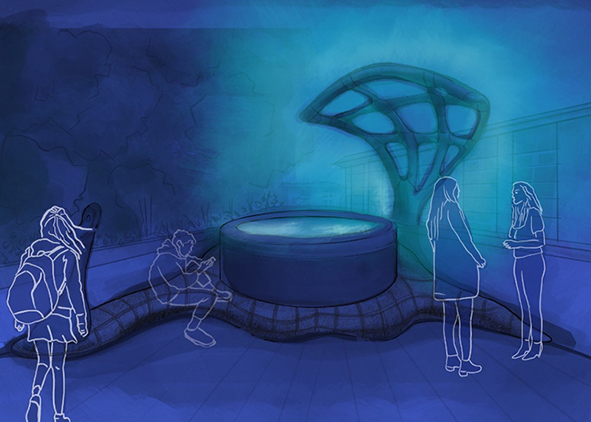
Water has historically acted as a cultural catalyst for space, shaping collective life through its ecological and sensory presence. With this in mind, the article reinterprets the ecological role of water through a ‘research-through-design’ approach that develops a conceptual framework for micro-architectural design. The study explores how bio-based materials, particularly mycelium composites and bioluminescent systems, can enhance multisensory engagement and ecological awareness in public spaces. Drawing on recent international literature and design research, the contribution identifies parameters for luminous performance, material behaviour, and environmental responsiveness. The resulting proposal positions water as an active, perceptible, and inclusive spatial medium, contributing to current debates on multispecies design, sensory urbanism, and the link between SDGs 6, 11, and 13.
Article info
Received: 10/09/2025; Revised: 20/10/2025; Accepted: 22/10/2025
Downloads
Article Metrics Graph
References
Adamatzky, A., Gandia, A. and Chiolerio, A. (2021), “Towards fungal sensing skin”, in Fungal Biol Biotechnol, vol. 8, issue 6, pp. 1-7. [Online] Available at: doi.org/10.1186/s40694-021-00113-8 [Accessed 11 October 2025].
Aiduang, W., Jatuwong, K., Luangharn, T., Jinanukul, P., Thamjaree, W., Teeraphantuvat, T., Waroonkun, T. and Lumyong, S. (2024), “A Review Delving into the Factors Influencing Mycelium-Based Green Composites (MBCs) Production and Their Properties for Long-Term Sustainability Targets”, in Biomimetics, vol. 9, issue 6, article 337, pp. 1-25. [Online] Available at: doi.org/10.3390/biomimetics9060337 [Accessed 11 October 2025].
Aiduang, W., Kumla, J., Srinuanpan, S., Thamjaree, W., Lumyong, S. and Suwannarach, N. (2022), “Mechanical, Physical, and Chemical Properties of Mycelium-Based Composites Produced from Various Lignocellulosic Residues and Fungal Species”, in Journal of Fungi, vol. 8, issue 11, article 1125, pp. 1-21. [Online] Available at: doi.org/10.3390/jof8111125 [Accessed 11 October 2025].
Alaneme, K. K., Anaele, J. U., Oke, T. M., Kareem, S. A., Adediran, M., Ajibuwa, O. A. and Anabaranze, Y. O. (2023), “Mycelium based composites – A review of their bio-fabrication procedures, material properties and potential for green building and construction applications”, in Alexandria Engineering Journal, vol. 83, pp. 234-250. [Online] Available at: doi.org/10.1016/j.aej.2023.10.012 [Accessed 11 October 2025].
Appels, F. V. W., Camere, S., Montalti, M., Karana, E., Jansen, K. M. B., Dijksterhuis, J., Krijgsheld, P. and Wösten, H. A. B. (2019), “Fabrication factors influencing mechanical, moisture- and water-related properties of mycelium-based composites”, in Materials and Design, vol. 161, pp. 64-71. [Online] Available at: doi.org/10.1016/j.matdes.2018.11.027 [Accessed 11 October 2025].
Armstrong, R. (2012), Living Architecture – How Synthetic Biology Can Remake Our Cities and Reshape Our Lives, TED Conferences, New York.
Berretta, T., Desideri, F. and Staltari, M. (2024), “Il progetto dello spazio pubblico, tra complessità e crisi ecologica – Da sfida a opportunità per la rigenerazione urbana | Public space project, between complexity and ecological crisis – From challenge to opportunity for urban regeneration”, in Agathón | International Journal of Architecture, Art and Design, vol. 16, pp. 74-87. [Online] Available at: doi.org/10.19229/2464-9309/1662024 [Accessed 11 October 2025].
Bille, M. and Sorensen, T. F. (eds) (2016), Elements of Architecture – Assembling archaeology, atmosphere and the performance of building spaces, Routledge, London.
Camere, S. and Karana, E. (2018), “Fabricating materials from living organisms – An emerging design practice”, in Journal of Cleaner Production, vol. 186, pp. 570-584. [Online] Available at: doi.org/10.1016/j.jclepro.2018.03.081 [Accessed 11 October 2025].
Chayaamor-Heil, N., Houette, T., Demirci, Ö. and Badarnah, L. (2024), “The Potential of Co-Designing with Living Organisms – Towards a New Ecological Paradigm in Architecture”, in Sustainability, vol. 16, issue 2, article 673, pp. 1-36. [Online] Available at: doi.org/10.3390/su16020673 [Accessed 11 October 2025].
Corradi, M., Stevens, T., Macaione, I., Raffa, A. and Andaloro, B. (2024), “Rigenerazione climatica green degli streetscapes – L’esperienza di De Urbanisten ad Anversa | Green climate-adaptive streetscapes regeneration – The De Urbanisten Experience in Antwerp”, in Agathón | International Journal of Architecture, Art and Design, vol. 16, pp. 60-73. [Online] Available at: doi.org/10.19229/2464-9309/1652024 [Accessed 11 October 2025].
Cortesão, J. and Lenzholzer, S. (2022), “Research through design in urban and landscape design practice”, in Journal of Urban Design, vol. 27, issue 6, pp. 617-633. [Online] Available at: doi.org/10.1080/13574809.2022.2062313 [Accessed 11 October 2025].
Elsacker, E., Vandelook, S., Van Wylick, A., Ruytinx, J., De Laet, L. and Peeters, E. (2020), “A comprehensive framework for the production of mycelium-based lignocellulosic composites”, in Science of The Total Environment, vol. 725, article 138431, pp. 1-16. [Online] Available at: doi.org/10.1016/j.scitotenv.2020.138431 [Accessed 11 October 2025].
Fletcher, T. D., Shuster, W., Hunt, W. F., Ashley, R., Butler, D., Arthur, S., Trowsdale, S., Barraud, S., Semadeni-Davies, A., Bertrand-Krajewski, J.-L., Mikkelsen, P. S., Rivard, G., Uhl, M., Dagenais, D. and Viklander, M. (2015), “SUDS, LID, BMPs, WSUD and more – The evolution and application of terminology surrounding urban drainage”, in Urban Water Journal, vol. 12, issue 7, pp. 525-542. [Online] Available at: doi.org/10.1080/1573062X.2014.916314 [Accessed 11 October 2025].
Gaver, W. (2012), “What should we expect from Research Through Design?”, in Konstan, J. A., Chi, E. H. and Höök, K. (eds), CHI’12 – Proceedings of the SIGCHI Conference on Human Factors in Computing Systems, Austin, Texas, May 5-10, 2012, Association for Computing Machinery, New York (NY), pp. 937-946. [Online] Available at: dl.acm.org/doi/10.1145/2207676.2208538 [Accessed 11 October 2025].
Gezer, E. D. and Kuştaş, S. (2024), “Acoustic and Thermal Properties of Mycelium-based Insulation Materials Produced from Desilicated Wheat Straw – Part B”, in BioResources, vol. 19, issue 1, pp. 1348-1364. [Online] Available at: doi.org/10.15376/biores.19.1.1348-1364 [Accessed 11 October 2025].
Gruosso, S., Del Signore, M. and Di Cinzio, S. (2025), “The extended mind of public space: how urban design shapes human experience”, in Frontiers in Built Environment, vol. 10, article 1504549, pp. 1-14. [Online] Available at: doi.org/10.3389/fbuil.2025.1504549 [Accessed 16 October 2025].
.Haddock, S. H. D., Moline, M. A. and Case, J. F. (2010), “Bioluminescence in the sea”, in Annual Review of Marine Science, vol. 2, pp. 443-493. [Online] Available at: doi.org/10.1146/annurev-marine-120308-081028 [Accessed 11 October 2025].
Holt, G. A., McIntyre, G., Flagg, D., Bayer, E., Wanjura, J. D. and Pelletier, M. G. (2012), “Fungal mycelium and cotton plant materials in the manufacture of biodegradable molded packaging material – Evaluation study of select blends of cotton byproducts”, in Journal of Biobased Materials and Bioenergy, vol. 6, issue 4, pp. 431-439. [Online] Available at: doi.org/10.1166/jbmb.2012.1241 [Accessed 11 October 2025].
Kaika, M. (2005), City of Flows – Modernity, Nature, and the City, Routledge, New York.
Kaku, T., Sugiura, K., Entani, T., Osabe, K. and Nagai, T. (2021), “Enhanced Brightness of Bacterial Luciferase by Bioluminescence Resonance Energy Transfer”, in Scientific Reports, vol. 11, article 14994, pp. 1-10. [Online] Available at: doi.org/10.1038/s41598-021-94551-4 [Accessed 11 October 2025].
Karana, E., Barati, B., Rognoli, V. and Zeeuw van der Laan, A. (2015), “Material Driven Design (MDD) – A method to design for material experiences”, in International Journal of Design, vol. 9, issue 2, pp. 35-54. [Online] Available at: ijdesign.org/index.php/IJDesign/article/viewFile/1965/687 [Accessed 11 October 2025].
Koi Khoo, C. and Shin, J.-W. (2018), “Designing with Biomaterials for Responsive Architecture – A soft responsive bio-structural hydrogel skin”, in Material Studies, vol. 2, pp. 285-292. [Online] Available at: papers.cumincad.org/data/works/att/ecaade2018_125.pdf?utm_source [Accessed 11 October 2025].
Langie, K., Rybak-Niedźiółka, K. and Hubačíková, V. (2022), “Principles of Designing Water Elements in Urban Public Spaces”, in Sustainability, vol. 14, issue 11, article 6877, pp. 1-12. [Online] Available at: doi.org/10.3390/su14116877 [Accessed 11.10 2025].
Lu, P., Sani, N. M., Li, Y. and Wang, Y. (2025), “How does urban blue space affect human well-being? A study based on the stimulus–organism–response theory”, in Frontiers in Psychology, vol. 16, article 1553296, pp. 1-20. [Online] Available at: doi.org/10.3389/fpsyg.2025.1553296 [Accessed 16 October 2025].
Manni, V. and Valzano, L. S. (2023), “Modularità e architettura adattiva – Una strategia per la gestione di sistemi d’involucro complessi | Modularity and adaptive architecture – A strategy for managing complex envelope systems”, in Agathón | International Journal of Architecture, Art and Design, vol. 14, pp. 134-151. [Online] Available at: doi.org/10.19229/2464-9309/14112023 [Accessed 11 October 2025].
Mascitti, J. and Paciotti, D. (2024), “Verbal Design Modelling – Complessità, IA e innovazione di prodotto | Verbal Design Modelling – Complexity, AI and product innovation”, in Agathón | International Journal of Architecture, Art and Design, vol. 16, pp. 344-353. [Online] Available at: doi.org/10.19229/2464-9309/16292024 [Accessed 16 October 2025].
Moschetti, V. (2020), “Avamposti – Inventari progettuali per un future possible tra natura e artefatto | Outposts – Design inventories for a possible future between biology and the artefact”, in Agathón | International Journal of Architecture, Art and Design, vol. 8, pp. 94-105. [Online] Available at: doi.org/10.19229/2464-9309/892020 [Accessed 11 October 2025].
Myers, W. (2012), Bio Design – Nature, Science, Creativity, MoMA, New York. [Online] Available at: moma.org/momaorg/shared/pdfs/docs/publication_pdf/3167/BioDesign_ PREVIEW.pdf?1349967238 [Accessed 11 October 2025].
Newman, P. (2020), “Cool planning – How urban planning can mainstream responses to climate change”, in Cities, vol. 103, article 102651, pp. 1-14. [Online] Available at: doi.org/10.1016/j.cities.2020.102651 [Accessed 11 October 2025].
Norberg-Schulz, C. (1980), Genius Loci – Towards a Phenomenology of Architecture, Rizzoli, New York.
Önge, Y. (1997), Türk Mimarisinde Selçuklu ve Osmanlı, Türk Tarih Kurumu, Ankara.
Pallasmaa, J. (2005), The Eyes of the Skin – Architecture and the Senses, John Wiley and Sons, Hoboken.
Ruiz Galloza, G. (2025), Lumínico – Bioluminescent Habitat to Enhance the Biodiversity, Fab Lab Barcelona Institute for Advanced Architecture of Catalonia. [Online] Available at: class.textile-academy.org/2025/germarilis-ruiz/images/home/RevGermarilisRuizFabricademy25.pdf?utm_source [Accessed 11 October 2025].
Selman, P. (2012), Sustainable landscape planning – The reconnection agenda, Taylor and Francis, Hoboken.
Solarek, K., Pudełko, A., Mierzwicki, K., Solarek, K., Bartosik, Z. and Pyjor, A. (2022), “The potential of the Research by Design method in balancing water problems – An integrated water and space management program for a part of the Warsaw agglomeration”, in Cities, vol. 121, article 103455, pp. 1-7. [Online] Available at: doi.org/10.1016/j.cities.2021.103455 [Accessed 11 October 2025].
Sposito, C. (2017), “Costruire con l’acqua – Nuovi paradigmi dell’architettura sostenibile | Building with Water – New standards of sustainable architecture”, in Agathón | International Journal of Architecture, Art and Design, vol. 2, pp. 117-126. [Online] Available at: doi.org/10.19229/2464-9309/2162017 [Accessed 11 October 2025].
Sydor, M., Bonenberg, A., Doczekalska, B. and Cofta, G. (2022), “Mycelium-Based Composites in Art, Architecture, and Interior Design – A Review”, in Polymers, vol. 14, issue 1, article 145, pp. 1-21. [Online] Available at: doi.org/10.3390/polym14010145 [Accessed 11 October 2025].
UN – United Nations (2015), Transforming Our World – The 2030 Agenda for Sustainable Development. [Online] Available at: sustainabledevelopment.un.org/post2015/transformingourworld/publication [Accessed 11 October 2025].
Uzunkaya, A. and Paker Kahvecioğlu, N. (2022), “Architectural design research through reflection – A sub-approach under ‘research by design’”, in Open House International, vol. 47, issue 4, pp. 688-709. [Online] Available at: doi.org/10.1108/OHI-07-2021-0155 [Accessed 11 October 2025].
Valente, R., Bosco, R., Giacobbe, S. and Losco, S. (2022), “Il progetto di infrastrutture verdi per le acque piovane – Note di metodo da un caso studio | Green stormwater infrastructures research through design – Method notes from a case study”, in Agathón | International Journal of Architecture, Art and Design, vol. 11, pp. 192-201. [Online] Available at: doi.org/10.19229/2464-9309/11172022 [Accessed 11 October 2025].
Violo, M. (2025), “Bioluminescent Wood Created Using Fungi – A New Sustainable Lighting Material”, in mycostories, 13/06/25. [Online] Available at: mycostories.com/post/bioluminescent-wood-created-using-fungi-a-new-sustainable-lighting-material?utm_source [Accessed 11 October 2025].
Wattanavichean, N., Phanthuwongpakdee, J., Koedrith, P., Laoratanakul, P., Thaithatgoon, B., Somrithipol, S., Kwantong, P., Nuankaew, S., Pinruan, U., Chuaseeharonnachai, C. and Boonyuen, N. (2025), “Mycelium-Based Breakthroughs – Exploring Commercialization, Research, and Next-Gen Possibilities”, in Circular Economy and Sustainability, vol. 5, pp. 3211–3253. [Online] Available at: doi.org/10.1007/s43615-025-00539-x [Accessed 15 October 2025].
White, M. P., Alcock, I., Wheeler, B. W. and Depledge, M. H. (2013), “Would you be happier living in a greener urban area? – A fixed-effects analysis of panel data”, in Psychological Science, vol. 24, issue 6, pp. 920-928. [Online] Available at: doi.org/10.1177/0956797612464659 [Accessed 11 October 2025].
Williams, C. F., Geroni, G. M., Lloyd, D., Choi, H., Clark, N., Pirog, A., Lees, J. and Porch, A. (2019), “Bioluminescence of Vibrio fischeri – Bacteria respond quickly and sensitively to pulsed microwave electric (but not magnetic) fields”, in Journal of Biomedical Optics, vol. 24, issue 5, article 051412, pp. 1-11. [Online] Available at: doi.org/10.1117/1.JBO.24.5.051412 [Accessed 11 October 2025].
Downloads
Published
How to Cite
Issue
Section
Categories
License
Copyright (c) 2025 Elif Süyük Makaklı, Ebru Yücesan Altay

This work is licensed under a Creative Commons Attribution 4.0 International License.
This Journal is published under Creative Commons Attribution Licence 4.0 (CC-BY).
License scheme | Legal code
This License allows anyone to:
Share: copy and redistribute the material in any medium or format.
Adapt: remix, transform, and build upon the material for any purpose, even commercially.
Under the following terms
Attribution: Users must give appropriate credit, provide a link to the license, and indicate if changes were made; users may do so in any reasonable manner, but not in any way that suggests the licensor endorses them or their use.
No additional restrictions: Users may not apply legal terms or technological measures that legally restrict others from doing anything the license permits.
Notices
Users do not have to comply with the license for elements of the material in the public domain or where your use is permitted by an applicable exception or limitation.
No warranties are given. The license may not give users all of the permissions necessary for their intended use. For example, other rights such as publicity, privacy, or moral rights may limit how you use the material.