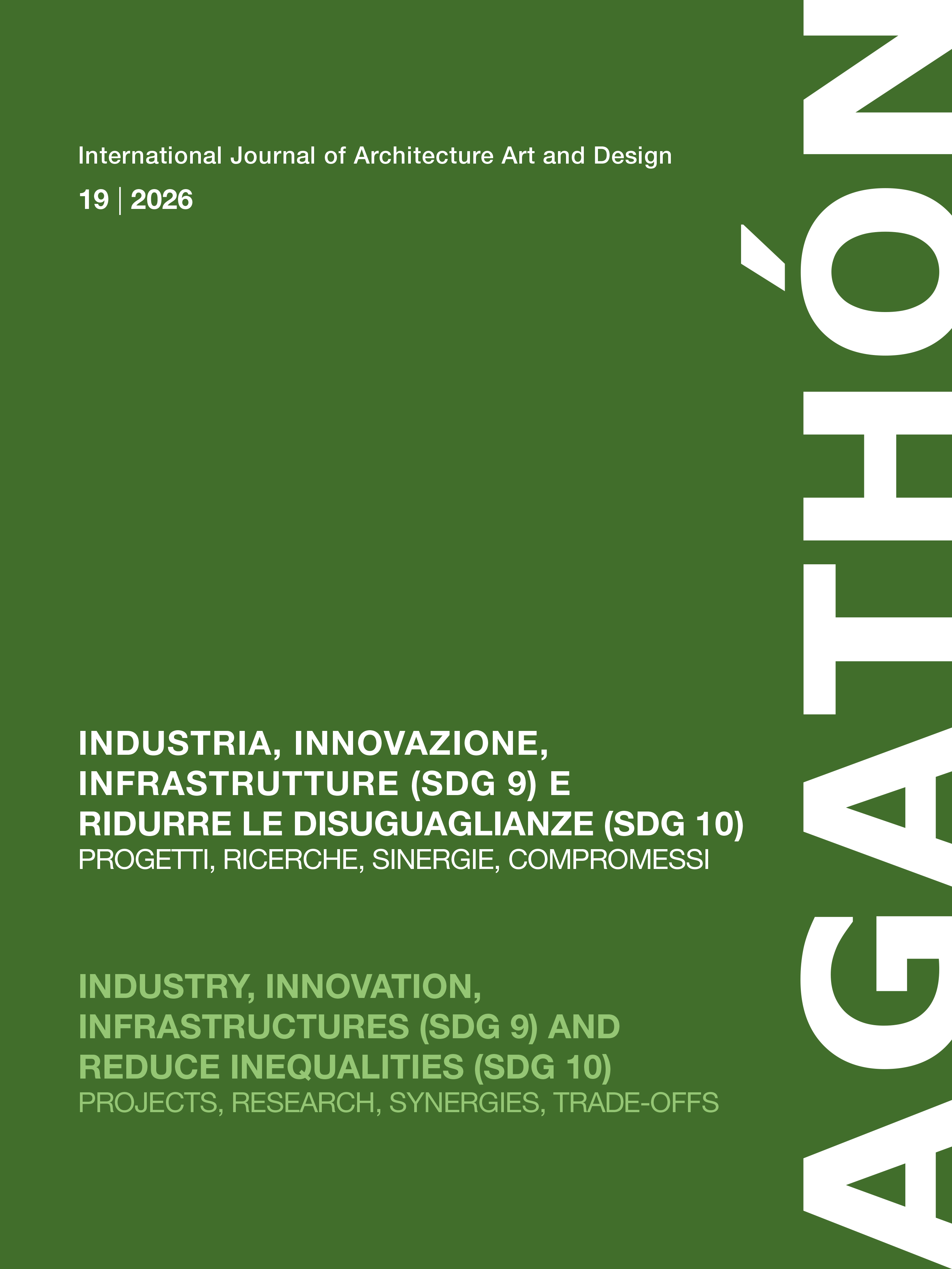
Riflessioni e traiettorie sul contributo delle discipline dell’Architettura agli SDG 9 e 10 – Industria, Innovazione, Infrastrutture e Ridurre le Disuguaglianze
DOI:
https://doi.org/10.69143/2464-9309/1902026Parole chiave:
industria, innovazione, infrastrutture, ridurre le disuguaglianze, editorialeAbstract
L’editoriale del volume 19 di AGATHÓN riflette sul contributo delle discipline dell’Architettura agli SDG 9 e 10, assumendo innovazione, infrastrutture e riduzione delle disuguaglianze come ambiti interdipendenti della transizione. Dal quadro critico dell’Agenda 2030, il testo evidenzia sinergie e compromessi tra gli Obiettivi di Sviluppo Sostenibile e la necessità di strumenti progettuali e valutativi capaci di misurare effetti ambientali, sociali e distributivi. I contributi sono letti attraverso una sequenza multiscalare, dalle infrastrutture teoriche e informative ai paesaggi, dagli insediamenti agli edifici, dai sistemi produttivi alle interfacce, fino alla materia: ne emerge una visione del progetto come infrastruttura critica, capace di collegare conoscenza, decisione e azione, rendendo l’innovazione credibile quando riduce divari, rafforza capacità e orienta trasformazioni più eque dell’ambiente costruito.
Downloads
##plugins.generic.articleMetricsGraph.articlePageHeading##
Riferimenti bibliografici
Alfarano, G., Spennato, A. and Filieri, J. (2026), “Superfici come infrastrutture – Design e manifattura additiva nell’Industria 5.0 | Surfaces as infrastructure – Design and additive manufacturing in Industry 5.0”, in Agathón | International Journal of Architecture, Art and Design, vol. 19, pp. 498-515. [Online] Available at: doi.org/10.69143/2464-9309/19292026 [Accessed 30 June 2026].
Amin, A. (2014), “Lively Infrastructure”, in Theory, Culture & Society, vol. 31, issue 7-8, pp. 137-161. [Online] Available at: doi.org/10.1177/0263276414548490 [Accessed 30 June 2026].
Antikainen, M., Uusitalo, T. and Kivikytö-Reponen, P. (2018), “Digitalisation as an Enabler of Circular Economy”, in Sakao, T., Lindahl, M., Liu, Y. and Dalhammar, C. (eds), 10th CIRP Conference on Industrial Product-Service Systems (IPS2 2018), Linköping, Sweden, May 29-31, 2018, Procedia CIRP, vol. 73, Elsevier B.V., Amsterdam, pp. 45-49. [Online] Available at: doi.org/10.1016/j.procir.2018.04.027 [Accessed 30 June 2026].
Askar, R., Bragança, L. and Gervásio, H. (2021), “Adaptability of Buildings – A Critical Review on the Concept Evolution”, in Applied Sciences, vol. 11, issue 10, article 4483, pp. 1-32. [Online] Available at: doi.org/10.3390/app11104483 [Accessed 30 June 2026].
Augustiniok, N., Houbart, C., Plevoets, B. and Van Cleempoel, K. (2025), “Adaptive reuse of built heritage – Conserving and designing with values”, in Journal of Cultural Heritage Management and Sustainable Development, vol. 15, issue 1, pp. 24-41. [Online] Available at: doi.org/10.1108/JCHMSD-05-2023-0068 [Accessed 30 June 2026].
Ayala-Garcia, C., Paul, N. R., Bordini, L., Stepanovic, M. and Cohen, N. (2026), “Valorizzazione di materiali residui nelle filiere produttive agro-industriali – Transizioni circolari in Alto Adige (Italia) | Valorisation of residual materials in agro-industrial production chains – Circular transitions in South Tyrol (Italy)”, in Agathón | International Journal of Architecture, Art and Design, vol. 19, pp. 416-431. [Online] Available at: doi.org/10.69143/2464-9309/19242026 [Accessed 30 June 2026].
Ayala-Garcia, C., Perez Rodriguez, C., Forero Lesmes, C. L., Cruz Perea, T., Porras, J. S., Maranon, A., Hernandez Acevedo, C., Álvarez Solano, O. and Porras Holguín, A. (2026), “Anacardo circolare – Progetto centrato sulle persone per filiere circolari di produzione dell’anacardio | Cashew in-cycle – Human-centred design for circular cashew production chains”, in Agathón | International Journal of Architecture, Art and Design, vol. 19, pp. 432-449. [Online] Available at: doi.org/10.69143/2464-9309/19252026 [Accessed 30 June 2026].
Babacan Demirel, A. and Çınar Çıtak, C. (2026), “Passaporti dell’edificio e dei materiali come infrastrutture socio-tecniche per l’economia circolare e l’equità | Building and material passports as socio-technical infrastructures for the circular economy and equity”, in Agathón | International Journal of Architecture, Art and Design, vol. 19, pp. 294-309. [Online] Available at: doi.org/10.69143/2464-9309/19172026 [Accessed 30 June 2026].
Barelles-Vicente, E., Torner-Feltrer, M. E., Llinares Millán, J. and Oliver-Faubel, I. (2026), “Riuso adattivo come infrastruttura territoriale per le aree rurali – Valutazione con indicatori per il riuso a Moya (Spagna) | Adaptive reuse as territorial infrastructure for rural areas – Indicator-based evaluation of reuse in Moya (Spain)”, in Agathón | International Journal of Architecture, Art and Design, vol. 19, pp. 118-133. [Online] Available at: doi.org/10.69143/2464-9309/1972026 [Accessed 30 June 2026].
Barquet, K., Järnberg, L., Alva, I. L. and Weitz, N. (2022), “Exploring mechanisms for systemic thinking in decision-making through three country applications of SDG Synergies”, in Sustainability Science, vol. 17, issue 4, pp. 1557-1572. [Online] Available at: doi.org/10.1007/s11625-021-01045-3 [Accessed 30 June 2026].
Bellato, L. and Pollock, A. (2025), “Regenerative tourism – A state-of-the-art review”, in Tourism Geographies | An International Journal of Tourism Space, Place and Environment, vol. 27, issue 3-4, pp. 558-567. [Online] Available at: doi.org/10.1080/14616688.2023.2294366 [Accessed 30 June 2026].
Bonini Lessing, E., Bosco, A., Ciaramitaro, M. and Pavlov, G. (2026), “Design per il turismo rigenerativo – Musei, alleanze territoriali e rafforzamento delle competenze | Design for regenerative tourism – Museums, territorial alliances, and capacity building”, in Agathón | International Journal of Architecture, Art and Design, vol. 19, pp. 400-415. [Online] Available at: doi.org/10.69143/2464-9309/19232026 [Accessed 30 June 2026].
Bruno, D., Palmieri, S., Palomba, R., D’Alessandro, F. and Bisson, M. (2024), “Infrastrutture di mobilità intelligenti e sostenibili – Un nuovo sistema di connessioni urbane | Smart and sustainable mobility infrastructure – A new system of urban connections”, in Agathón | International Journal of Architecture, Art and Design, vol. 15, pp. 286-295. [Online] Available at: doi.org/10.19229/2464-9309/15232024 [Accessed 30 June 2026].
Buchholz, M. and Lützkendorf, T. (2023), “Building passports and material passports as enablers of circular economy in the built environment”, in IOP Conference Series – Earth and Environmental Science, vol. 1196, article 012074, pp. 1-10. [Online] Available at: doi.org/10.1088/1755-1315/1196/1/012074 [Accessed 30 June 2026].
Bull, B. and Banik, D. (2025), “The Rebirth of the Global South – Geopolitics, Imageries and Developmental Realities”, in Forum for Development Studies, vol. 52, issue 2, pp. 195-214. [Online] Available at: doi.org/10.1080/08039410.2025.2490696 [Accessed 30 June 2026].
Canina, M. and Efremenko, T. (2026), “Co-creare futuri sostenibili – Il MUSAE Factory model per un’innovazione con arte e tecnologia orientata agli SDG | Co-creating sustainable futures – The MUSAE Factory Model for SDG-oriented innovation through art and technology”, in Agathón | International Journal of Architecture, Art and Design, vol. 19, pp. 346-367. [Online] Available at: doi.org/10.69143/2464-9309/19202026 [Accessed 30 June 2026].
Dorfles, G. (1972), Il disegno industriale e la sua estetica, Cappelli, Bologna.
European Commission (2023), Better Regulation – Toolbox 2023. [Online] Available at: commission.europa.eu/document/download/9c8d2189-8abd-4f29-84e9-abc843cc68e0_en?filename=BR%20toolbox%20-%20Jul%202023%20-%20FINAL.pdf [Accessed 30 June 2026].
European Commission (2021), Industry 5.0 – Towards a sustainable, human-centric and resilient European industry, Publications Office of the European Union, Luxembourg. [Online] Available at: doi.org/10.2777/308407 [Accessed 30 June 2026].
European Commission (2019), Communication from the Commission to the European Parliament, the Council, the European Economic and Social Committee and the Committee of the Regions – The European Green Deal, document 52019DC0640, COM/2019/640 final. [Online] Available at: eur-lex.europa.eu/legal-content/EN/TXT/?uri=CELEX%3A52019DC0640 [Accessed 30 June 2026].
Galindo-Rueda, F. and Millot, V. (2015), “Measuring Design and its Role in Innovation”, in OECD Science, Technology and Industry Working Papers, vol. 01, pp. 1-51. [Online] Available at: doi.org/10.1787/5js7p6lj6zq6-en [Accessed 30 June 2026].
Germanà, M. L. and Madonia, G. (2026), “Adattabilità e inclusione – Strategie contro le disuguaglianze | Adaptability and inclusion – Strategies to reduce inequality in the built environment”, in Agathón | International Journal of Architecture, Art and Design, vol. 19, pp. 68-81. [Online] Available at: doi.org/10.69143/2464-9309/1942026 [Accessed 30 June 2026].
Gibson, I., Rosen, D., Stucker, B. and Khorasani, M. (2021), Additive manufacturing technologies, Springer, Cham. [Online] Available at: doi.org/10.1007/978-3-030-56127-7 [Accessed 30 June 2026].
IGS – Independent Group of Scientists appointed by the Secretary-General (2023), Times of crisis, times of change – Science for accelerating transformations to sustainable development – Global Sustainable Development Report 2023, United Nations, New York. [Online] Available at: sdgs.un.org/sites/default/files/2023-09/FINAL%20GSDR%202023-Digital%20-110923_1.pdf [Accessed 30 June 2026].
Ingaramo, M. O., Chiara, E. C. C., Leme Fleury, A. and Stamatopoulos, C. H. (2026), “Design e ricerca attiva per gli SDG – Ecosistemi di innovazione sostenibile | Design and active research for SDGs – Ecosystems of sustainable innovation”, in Agathón | International Journal of Architecture, Art and Design, vol. 19, pp. 382-399. [Online] Available at: doi.org/10.69143/2464-9309/19222026 [Accessed 30 June 2026].
IPCC – Intergovernmental Panel on Climate Change (2023), Climate Change 2022 – Impacts, Adaptation and Vulnerability – Working Group II Contribution to the Sixth Assessment Report of the Intergovernmental Panel on Climate Change, Cambridge University Press, Cambridge. [Online] Available at: doi.org/10.1017/9781009325844 [Accessed 30 June 2026].
Karana, E., Barati, B., Rognoli, V. and Zeeuw van der Laan, A. (2015), “Material Driven Design (MDD) – A method to design for material experiences”, in International Journal of Design, vol. 9, issue 2, pp. 35-54. [Online] Available at: ijdesign.org/index.php/IJDesign/article/view/1965 [Accessed 30 June 2026].
Khadim, N., Agliata, R., Marino, A., Thaheem, M. J. and Mollo, L. (2022), “Critical review of nano and micro-level building circularity indicators and frameworks”, in Journal of Cleaner Production, vol. 357, article 131859, pp. 1-14. [Online] Available at: doi.org/10.1016/j.jclepro.2022.131859 [Accessed 30 June 2026].
Kostetckaia, M. and Hametner, M. (2022), “How Sustainable Development Goals interlinkages influence European Union countries’ progress towards the 2030 Agenda”, in Sustainable Development, vol. 30, issue 5, pp. 916-926. [Online] Available at: doi.org/10.1002/sd.2290 [Accessed 30 June 2026].
Laghi, V., Savino, E. and Gasparini, G. (2025), “Reduction of the environmental impact of complex-shaped steel joints through topology optimization and large-scale metal 3D printing”, in Results in Engineering, vol. 27, article 105610, pp. 1-14. [Online] Available at: doi.org/10.1016/j.rineng.2025.105610 [Accessed 30 June 2026].
Levasseur, A., Lesage, P., Margni, M., Deschênes, L. and Samson, R. (2010), “Considering time in LCA – Dynamic LCA and its application to global warming impact assessments”, in Environmental Science & Technology, vol. 44, issue 8, pp. 3169-3174. [Online] Available at: doi.org/10.1021/es9030003 [Accessed 30 June 2026].
Longo, D., Roversi, R., Mercuri, R. and Turillazzi, B. (2026), “Rifugi climatici come infrastrutture urbane adattive – Una rete sistemica per ridurre le disuguaglianze | Climate shelters as adaptive urban infrastructures – A systemic network to reduce inequalities”, in Agathón | International Journal of Architecture, Art and Design, vol. 19, pp. 172-191. [Online] Available at: doi.org/10.69143/2464-9309/19102026 [Accessed 30 June 2026].
Losco, G., Pasqualini, C. and Khodaparast, M. (2026), “Transizioni interconnesse per la sostenibilità industriale – Strumenti digitali, efficienza energetica e circolarità | Interconnected transitions for industrial sustainability – Digital tools, energy efficiency, and circularity”, in Agathón | International Journal of Architecture, Art and Design, vol. 19, pp. 212-227. [Online] Available at: doi.org/10.69143/2464-9309/19122026 [Accessed 30 June 2026].
Lusseau, D. and Mancini, F. (2019), “Income-based variation in Sustainable Development Goal interaction networks”, in Nature Sustainability, vol. 2, pp. 242-247. [Online] Available at: doi.org/10.1038/s41893-019-0231-4 [Accessed 30 June 2026].
Manzini, E. (2015), Design, When Everybody Designs – An Introduction to Design for Social Innovation, The MIT Press, Cambridge (MA).
Moraci, F., Barresi, A., Bova, P. and Trimboli, F. (2026), “Alfabetizzazione sul carbonio e infrastrutture ecosistemiche – Metodo GIS-R per la valutazione climatica | Carbon literacy and ecosystem infrastructures – A GIS-R method for climate assessment”, in Agathón | International Journal of Architecture, Art and Design, vol. 19, pp. 82-93. [Online] Available at: doi.org/10.69143/2464-9309/1952026 [Accessed 30 June 2026].
Nguyen, T. H. (2026), “Il patrimonio industriale ad Hanoi – Una valutazione multiscalare per il riuso adattivo di una innovativa infrastruttura urbana | Industrial heritage in Hanoi – A multi-scalar assessment for adaptive reuse and innovative urban infrastructure”, in Agathón | International Journal of Architecture, Art and Design, vol. 19, pp. 134-149. [Online] Available at: doi.org/10.69143/2464-9309/1982026 [Accessed 30 June 2026].
Nourrigat, E. (2026), “Ibridazione della professione – Nuove alleanze per un’innovazione infrastrutturale del progetto architettonico | Hybridisation of the profession – New alliances for an infrastructural innovation of the architectural project”, in Agathón | International Journal of Architecture, Art and Design, vol. 19, pp. 22-35. [Online] Available at: doi.org/10.69143/2464-9309/1912026 [Accessed 30 June 2026].
OECD – Organisation for Economic Co-operation and Development (2024), Measuring Distance to the SDG Targets 2024 – The Short and Winding Road to 2030. [Online] Available at: doi.org/10.1787/8a87a041-en [Accessed 30 June 2026].
OECD – Organisation for Economic Co-operation and Development (2019), Measuring Distance to the SDG Targets 2019 – An Assessment of Where OECD Countries Stand. [Online] Available at: doi.org/10.1787/a8caf3fa-en [Accessed 30 June 2026].
Oppedisano, F. O., Rossi, D. and Scortichini, M. (2026), “Apprendimento immersivo per aule resilienti – Infrastruttura digitale per arredi salvavita | Immersive learning for resilient classrooms – Digital infrastructure for life-saving furniture”, in Agathón | International Journal of Architecture, Art and Design, vol. 19, pp. 482-497. [Online] Available at: doi.org/10.69143/2464-9309/19282026 [Accessed 30 June 2026].
Paoletti, I. M., Conti, G., Castellano, G. and Pradella, F. (2026), “Trasferimento tecnologico automotive-AEC – Framework DfMA e sistemi di facciata complessi | Automotive-AEC technology transfer – DfMA framework and complex façade systems”, in Agathón | International Journal of Architecture, Art and Design, vol. 19, pp. 278-293. [Online] Available at: doi.org/10.69143/2464-9309/19162026 [Accessed 30 June 2026].
Paoletti, I. M., Malighetti, L. E., Pittau, F., Pradella, F. and Castellano G. (2026), “Nature-based Retrofit System – Sistema prefabbricato a base biologica per il retrofit energetico degli edifici | Nature-based Retrofit System – Prefabricated bio-based system for the energy retrofit of buildings”, in Agathón | International Journal of Architecture, Art and Design, vol. 19, pp. 262-277. [Online] Available at: doi.org/10.69143/2464-9309/19152026 [Accessed 30 June 2026].
Paris, S. and Vannini, C. (2026), “Parti reversibili dell’abitare – Atlante Digitale per la rigenerazione incrementale dell’Edilizia Residenziale Pubblica | Soft parts of living – Digital Atlas for the incremental regeneration of Public Residential Housing”, in Agathón | International Journal of Architecture, Art and Design, vol. 19, pp. 228-245. [Online] Available at: doi.org/10.69143/2464-9309/19132026 [Accessed 30 June 2026].
Pashako, F. and Baboçi, D. (2026), “Scuole come infrastrutture urbane – Pianificazione, redistribuzione e rinnovo dell’infrastruttura scolastica a Tirana | Schools as urban infrastructures – Planning, redistribution, and renewal of school infrastructure in Tirana”, in Agathón | International Journal of Architecture, Art and Design, vol. 19, pp. 50-67. [Online] Available at: doi.org/10.69143/2464-9309/1932026 [Accessed 30 June 2026].
Pietroni, L., Galloppo, D., Giannetti V. and Di Flamminio, C. (2026), “Innovazione digitale e circolarità nel settore legno-arredo – Strategie sostenibili per il Made in Italy | Digital innovation and circularity in the wood-furniture sector – Sustainable strategies for Made in Italy”, in Agathón | International Journal of Architecture, Art and Design, vol. 19, pp. 368-381. [Online] Available at: doi.org/10.69143/2464-9309/19212026 [Accessed 30 June 2026].
Ricci, M., Battisti, A. and Monardo, B. (2014), I borghi della salute – Healthy ageing per nuovi progetti di territorio, Alinea, Firenze.
Rinaldi, A. and Lagrimino, J. (2026), “Biciclette e cargo bike – Modelli ibridi modulari per micromobilità urbana e logistica | Bicycles and cargo bikes – Hybrid modular models for urban micromobility and logistics”, in Agathón | International Journal of Architecture, Art and Design, vol. 19, pp. 464-481. [Online] Available at: doi.org/10.69143/2464-9309/19272026 [Accessed 30 June 2026].
Romano, R. and Mazzoni, E. (2026), “Biofilia e rigenerazione urbana – Soluzioni Tech-NbS stampate in 3D per microinterventi resilienti | Biophilia and urban regeneration – 3D-printed Tech-NbS for resilient micro-interventions”, in Agathón | International Journal of Architecture, Art and Design, vol. 19, pp. 246-261. [Online] Available at: doi.org/10.69143/2464-9309/19142026 [Accessed 30 June 2026].
Russo, D. (2026), “Aesthetic Design e filosofia pratica – Estetica ed etica nel progetto contemporaneo | Aesthetic Design and practical philosophy – Aesthetics and ethics in contemporary design”, in Agathón | International Journal of Architecture, Art and Design, vol. 19, pp. 310-331. [Online] Available at: doi.org/10.69143/2464-9309/19182026 [Accessed 30 June 2026].
Snep, R. P. H., Voeten, J. G. W. F., Mol, G. and Van Hattum, T. (2020), “Nature Based Solutions for Urban Resilience – A Distinction Between No-Tech, Low-Tech and High-Tech Solutions”, in Frontiers in Environmental Science, vol. 8, article 599060, pp. 1-9. [Online] Available at: doi.org/10.3389/fenvs.2020.599060 [Accessed 30 June 2026].
Suksikarn, R. (2026), “Progettare con lo yan-lipao per l’innovazione nell’Industria 5.0 | Designing with yan-lipao for innovation in Industry 5.0”, in Agathón | International Journal of Architecture, Art and Design, vol. 19, pp. 450-463. [Online] Available at: doi.org/10.69143/2464-9309/19262026 [Accessed 30 June 2026].
Talamo, C., Huanca Coacalla, N., Atta, N. and Paganin, G. (2026), “Ecosistemi socio-circolari – Innovazione sociale, strategie circolari e ambiente costruito | Socio-circular ecosystems – Social innovation, circular strategies, and the built environment”, in Agathón | International Journal of Architecture, Art and Design, vol. 19, pp. 192-211. [Online] Available at: doi.org/10.69143/2464-9309/19112026 [Accessed 30 June 2026].
Tamborrini, P., Russo, D. and Marino, C. (2026), “Il design come infrastruttura relazionale – Università, territori e trasformazioni sistemiche | Design as relational infrastructure – Universities, territories, and systemic transformations”, in Agathón | International Journal of Architecture, Art and Design, vol. 19, pp. 332-345. [Online] Available at: doi.org/10.69143/2464-9309/19192026 [Accessed 30 June 2026].
Tartaglia, A. and Alini, L. (2026), “Infrastrutture tra sostenibilità e necessità – Progettazione ambientale e approccio transcalare | Infrastructure between sustainability and necessity – Environmental design and a trans-scalar approach”, in Agathón | International Journal of Architecture, Art and Design, vol. 19, pp. 36-49. [Online] Available at: doi.org/10.69143/2464-9309/1922026 [Accessed 30 June 2026].
Thorne, M. and Duran, P. (2016), “The role that architecture can play in the development agenda”, in devex.com, 05/05/2016. [Online] Available at: devex.com/news/the-role-that-architecture-can-play-in-the-development-agenda-88124 [Accessed 30 June 2026].
UN – United Nations (2015), Transforming Our World – The 2030 Agenda for Sustainable Development. [Online] Available at: sdgs.un.org/2030agenda [Accessed 30 June 2026].
UN-Habitat – United Nations Human Settlements Programme (2022), Envisaging the Future of Cities – World Cities Report 2022. [Online] Available at: unhabitat.org/sites/default/files/2022/06/wcr_2022.pdf [Accessed 30 June 2026].
UNESCO (2023), Urban Heritage for Resilience – Consolidated Results of the Implementation of the 2011 Recommendation on the Historic Urban Landscape. [Online] Available at: doi.org/10.58337/CFZO9650 [Accessed 30 June 2026].
Vettori, M. P. Battaglia, S., Daprà, F. and Dechamps, A. (2026), “Infrastrutture di prossimità – Metodi e strategie per la rigenerazione dei comparti ferroviari della rete lombarda | Infrastructures for proximity – Methods and strategies for the regeneration of railway station areas in the Lombardy network”, in Agathón | International Journal of Architecture, Art and Design, vol. 19, pp. 150-171. [Online] Available at: doi.org/10.69143/2464-9309/1992026 [Accessed 30 June 2026].
Villani, T. and Mezzalana, A. (2026), “Borghi come infrastrutture di cura – Metaprogetto per l’Alzheimer nelle aree interne | Borghi as care infrastructures – A metaproject for Alzheimer’s disease in inland areas”, in Agathón | International Journal of Architecture, Art and Design, vol. 19, pp. 94-117. [Online] Available at: doi.org/10.69143/2464-9309/1962026 [Accessed 30 June 2026].
Zignego, M. I., Bertirotti, A., Gemelli, P. and Pagani, L. (2026), “Monitoraggio dello stato umano nella formazione marittima – Il caso On Watch | Human state monitoring in maritime training – The On Watch case”, in Agathón | International Journal of Architecture, Art and Design, vol. 19, pp. 516-529. [Online] Available at: doi.org/10.69143/2464-9309/19302026 [Accessed 30 June 2026].
##submission.downloads##
Pubblicato
Come citare
Fascicolo
Sezione
Categorie
Licenza
Copyright (c) 2026 Cesare Sposito, Francesca Scalisi

TQuesto lavoro è fornito con la licenza Creative Commons Attribuzione 4.0 Internazionale.
AGATHÓN è pubblicata sotto la licenza Creative Commons Attribution License 4.0 (CC-BY).
License scheme | Legal code
Questa licenza consente a chiunque di:
Condividere: riprodurre, distribuire, comunicare al pubblico, esporre in pubblico, rappresentare, eseguire e recitare questo materiale con qualsiasi mezzo e formato.
Modificare: remixare, trasformare il materiale e basarti su di esso per le tue opere per qualsiasi fine, anche commerciale.
Alle seguenti condizioni
Attribuzione: si deve riconoscere una menzione di paternità adeguata, fornire un link alla licenza e indicare se sono state effettuate delle modifiche; si può fare ciò in qualsiasi maniera ragionevole possibile, ma non con modalità tali da suggerire che il licenziante avalli l'utilizzatore o l'utilizzo del suo materiale.
Divieto di restrizioni aggiuntive: non si possono applicare termini legali o misure tecnologiche che impongano ad altri soggetti dei vincoli giuridici su quanto la licenza consente di fare.
Note
Non si è tenuti a rispettare i termini della licenza per quelle componenti del materiale che siano in pubblico dominio o nei casi in cui il nuovo utilizzo sia consentito da una eccezione o limitazione prevista dalla legge.
Non sono fornite garanzie. La licenza può non conferire tutte le autorizzazioni necessarie per l'utilizzo che ci si prefigge. Ad esempio, diritti di terzi come i diritti all'immagine, alla riservatezza e i diritti morali potrebbero restringere gli usi del materiale.