Human state monitoring in maritime training – The On Watch case
DOI:
https://doi.org/10.69143/2464-9309/19302026Keywords:
maritime safety training, human state monitoring, data governance, digital technologies, multimodal monitoringAbstract
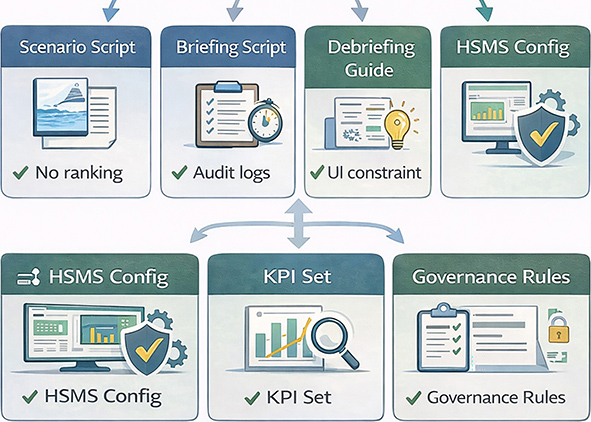
In safety-critical domains, training is a socio-technical infrastructure (spaces, interfaces, procedures, and preparation, execution, and final review phases) that supports learning and the development of a safety culture. From this perspective, the paper proposes an operational framework for Designer-in-the-Loop (DITL) to introduce Human State Monitoring Systems (HSMS) into maritime training, making the trade-offs between digital innovation and surveillance-related risks, such as bias and inequality, explicit and verifiable. Within this framework, On Watch is adopted as a case study, enabling operational testing in a concrete application context by integrating multimodal signals and translating them into non-prescriptive probabilistic indicators, without rankings or automated decision-making, in support of the final review phase. A pilot experiment, structured across three contexts – ECDIS, cooperative bridge, and interview – evaluates feasibility, usefulness, and acceptability through replicable technical-operational and socio-distributive key performance indicators.
Article info
Received: 09/03/2026; Revised: 15/04/2026; Accepted: 17/04/2026
Downloads
Article Metrics Graph
References
Aguinis, H. and Kraiger, K. (2009), “Benefits of Training and Development for Individuals and Teams, Organizations, and So-ciety”, in Annual Review of Psychology, vol. 60, pp. 451-474. [Online] Available at: doi.org/10.1146/annurev.psych.60.110707.163505 [Accessed 28 March 2026].
Ajunwa, I., Crawford, K. and Schultz, J. M. (2017), “Limitless Worker Surveillance”, in California Law Review, vol. 105, pp. 735-776. [Online] Available at: doi.org/10.15779/Z38BR8MF94 [Accessed 28 March 2026].
Arquilla, V. and Caruso, C. (2025), “Un approccio di integrazione nativa dell’inclusione nel meta-design – L’esperienza COmeta | Towards native integration of inclusivity in meta-design – The COmeta experience”, in Agathón | International Journal of Architecture, Art and Design, vol. 17, pp. 360-373. [Online] Available at: doi.org/10.69143/2464-9309/17252025 [Accessed 28 March 2026].
Arquilla, V. and Paracolli, A. (2023), “Design sull’esperienza dell’utente e sostenibilità degli oggetti con intelligenza artifi-ciale | User experience design and sustainability of AI-infused objects”, in Agathón | International Journal of Architecture, Art and Design, vol. 13, pp. 259-268. [Online] Available at: doi.org/10.19229/2464-9309/13222023 [Accessed 28 March 2026].
Buolamwini, J. and Gebru, T. (2018), “Gender Shades – Intersectional Accuracy Disparities in Commercial Gender Classifica-tion”, in Friedler, S. A. and Wilson, C. (eds), Proceedings of the 1st Conference on Fairness, Accountability and Transpar-ency, New York, NY, USA, February 23-24, 2018, Proceedings of Machine Learning Research, vol. 81, pp. 77-91. [Online] Available at: proceedings.mlr.press/v81/buolamwini18a.html [Accessed 28 March 2026].
Cheng, A., Eppich, W., Grant, V., Sherbino, J., Zendejas, B. and Cook, D. A. (2014), “Debriefing for technology-enhanced sim-ulation – A systematic review and meta-analysis”, in Medical Education, vol. 48, issue 7, pp. 657-666. [Online] Available at: doi.org/10.1111/medu.12432 [Accessed 28 March 2026].
D’Mello, S. K. and Kory, J. (2015), “A Review and Meta-Analysis of Multimodal Affect Detection Systems”, in ACM Compu-ting Surveys, vol. 47, issue 3, article 43, pp. 1-36. [Online] Available at: doi.org/10.1145/2682899 [Accessed 28 March 2026].
Endsley, M. R. (1995), “Toward a Theory of Situation Awareness in Dynamic Systems”, in Human Factors | The Journal of the Human Factors and Ergonomics Society, vol. 37, issue 1, pp. 32-64. [Online] Available at: doi.org/10.1518/001872095779049543 [Accessed 28 March 2026].
Eurofound (2020), Employee monitoring and surveillance – The challenges of digitalisation, Publications Office of the Eu-ropean Union, Luxembourg. [Online] Available at: doi.org/10.2806/424580 [Accessed 28 March 2026].
European Union (2024), Regulation (EU) 2024/1689 of the European Parliament and of the Council of 13 June 2024 lay-ing down harmonised rules on artificial intelligence and amending Regulations (EC) No 300/2008, (EU) No 167/2013, (EU) No 168/2013, (EU) 2018/858, (EU) 2018/1139 and (EU) 2019/2144 and Directives 2014/90/EU, (EU) 2016/797 and (EU) 2020/1828 (Artificial Intelligence Act) (Text with EEA relevance), document 32024R1689. [Online] Available at: da-ta.europa.eu/eli/reg/2024/1689/oj [Accessed 28 March 2026].
European Union (2016), Regulation (EU) 2016/679 of the European Parliament and of the Council of 27 April 2016 on the protection of natural persons with regard to the processing of personal data and on the free movement of such data, and repealing Directive 95/46/EC (General Data Protection Regulation) (Text with EEA relevance), document 32016R0679. [Online] Available at: data.europa.eu/eli/reg/2016/679/oj [Accessed 28 March 2026].
Fanning, R. M. and Gaba, D. M. (2007), “The role of debriefing in simulation-based learning”, in Simulation in Healthcare | Journal of the Society for Simulation in Healthcare, vol. 2, issue 2, pp. 115-125. [Online] Available at: doi.org/10.1097/SIH.0b013e3180315539 [Accessed 28 March 2026].
Gazzaniga, M. S. (2005), “Forty-five years of split-brain research and still going strong”, in Nature Reviews Neuroscience, vol. 6, issue 8, pp. 653-659. [Online] Available at: doi.org/10.1038/nrn1723 [Accessed 28 March 2026].
Hancock, P. A. and Matthews, G. (2019), “Workload and Performance – Associations, Insensitivities, and Dissociations”, in Human Factors, vol. 61, issue 3, pp. 374-392. [Online] Available at: doi.org/10.1177/0018720818809590 [Accessed 28 March 2026].
Hart, S. G. and Staveland, L. E. (1988), “Development of NASA-TLX (Task Load Index) – Results of Empirical and Theoreti-cal Research”, in Hancock, P. A. and Meshkati, N. (eds), Human Mental Workload, North-Holland, Oxford, pp. 139-183. [Online] Available at: doi.org/10.1016/S0166-4115(08)62386-9 [Accessed 28 March 2026].
ISO – International Organization for Standardization (2019), ISO 9241-210:2019 – Ergonomics of human-system interac-tion – Part 210 – Human-centred design for interactive systems. [Online] Available at: org/standard/77520.html [Accessed 28 March 2026].
Koelstra, S., Mühl, C., Soleymani, M., Lee, J.-S., Yazdani, A., Ebrahimi, T., Pun, T., Nijholt, A. and Patras, I. (2012), “DEAP – A Database for Emotion Analysis – Using Physiological Signals”, in IEEE Transactions on Affective Computing, vol. 3, issue 1, pp. 18-31. [Online] Available at: doi.org/10.1109/T-AFFC.2011.15 [Accessed 28 March 2026].
Liu, Y., Lan, Z., Cui, J., Krishnan, G., Sourina, O., Konovessis, D., Ang, H. E. and Mueller-Wittig, W. (2020), “Psychophysio-logical evaluation of seafarers to improve training in maritime virtual simulator”, in Advanced Engineering Informatics, vol. 44, article 101048, pp. 1-9. [Online] Available at: doi.org/10.1016/j.aei.2020.101048 [Accessed 28 March 2026].
MIM – Ministero dell’Istruzione e del Merito (2025), JOB&Orienta 2025 – Programma del Ministero dell’Istruzione e del Merito. [Online] Available at: mim.gov.it/documents/20182/8952594/Job%26Orienta%2B2025%2B-%2BProgramma%2Bdel%2BMinistero%2Bdell%27Istruzione%2Be%2Bdel%2B Merito.pdf/def37280-0067-4a6b-b1cc-09bdc31897ba?t=1764260799177&version=1.1 [Accessed 28 March 2026].
Mittelstadt, B. (2019), “Principles alone cannot guarantee ethical AI”, in Nature Machine Intelligence, vol. 1, issue 11, pp. 501-507. [Online] Available at: doi.org/10.1038/s42256-019-0114-4 [Accessed 28 March 2026].
NIST – National Institute of Standards and Technology (2023), Artificial Intelligence Risk Management Framework (AI RMF 1.0) – NIST AI 100-1. [Online] Available at: doi.org/10.6028/NIST.AI.100-1 [Accessed 28 March 2026].
OECD (2019), Recommendation of the Council on Artificial Intelligence. [Online] Available at: one.oecd.org/document/C/MIN(2019)3/FINAL/en [Accessed 28 March 2026].
Osello, A. Ugliotti, F. M., Rimella, N. and Loddo, F. (2024), “Modelli digitali e linguaggio naturale – Nuove prospettive per interpretare la complessità | Digital models and natural language – New perspectives for interpreting complexity”, in Agathón | International Journal of Architecture, Art and Design, vol. 16, pp. 212-219. [Online] Available at: doi.org/10.19229/2464-9309/16182024 [Accessed 28 March 2026].
Parasuraman, R. and Riley, V. (1997), “Humans and Automation – Use, Misuse, Disuse, Abuse”, in Human Factors | The Journal of the Human Factors and Ergonomics Society, vol. 39, issue 2, pp. 230-253. [Online] Available at: doi.org/10.1518/001872097778543886 [Accessed 28 March 2026].
Picard, R. W. (1997), Affective Computing, The MIT Press, Cambridge, MA. [Online] Available at: doi.org/10.7551/mitpress/1140.001.0001 [Accessed 28 March 2026].
Porfirione, C., Ferrari Tumay, X. and Leggiero, I (2024), “Conoscenza, innovazione e cambiamento – Il potere dell’errore nel design e nei sistemi complessi | Knowledge, innovation, and change – The power of error in design and complex systems”, in Agathón | International Journal of Architecture, Art and Design, vol. 16, pp. 232-241. [Online] Available at: doi.org/10.19229/2464-9309/16202024 [Accessed 28 March 2026].
Poria, S., Cambria, E., Bajpai, R. and Hussain, A. (2017), “A review of affective computing – From unimodal analysis to mul-timodal fusion”, in Information Fusion, vol. 37, pp. 98-125. [Online] Available at: doi.org/10.1016/j.inffus.2017.02.003 [Accessed 28 March 2026].
Raji, I. D. and Buolamwini, J. (2019), “Actionable Auditing – Investigating the Impact of Publicly Naming Biased Perfor-mance Results of Commercial AI Products”, in Proceedings of the 2019 AAAI/ACM Conference on AI, Ethics, and Society (AIES ’19), Honolulu, HI, USA, January 27-29, 2019, Association for Computing Machinery, New York, NY, pp. 429-435. [Online] Available at: doi.org/10.1145/3306618.3314244 [Accessed 28 March 2026].
Ronca, V., Uflaz, E., Turan, O., Bantan, H., MacKinnon, S. N., Lommi, A., Pozzi, S., Kurt, R. E., Arslan, O., Kurt, Y. B., Erdem, P., Akyuz, E., Vozzi, A., Di Flumeri, G., Aricò, P., Giorgi, A., Capotorto, R., Babiloni, F. and Borghini, G. (2023), “Neurophys-iological Assessment of An Innovative Maritime Safety System in Terms of Ship Operators’ Mental Workload, Stress, and At-tention in the Full Mission Bridge Simulator”, in Brain Sciences, vol. 13, issue 9, article 1319, pp. 1-19. [Online] Available at: doi.org/10.3390/brainsci13091319 [Accessed 28 March 2026].
Rosmino, A. (2024), “Corpi, menti e design – Un approccio integrato per l’innovazione museale | Bodies, minds, and design – An integrated approach to museum innovation”, in Agathón | International Journal of Architecture, Art and Design, vol. 16, pp. 278-289. [Online] Available at: doi.org/10.19229/2464-9309/16232024 [Accessed 28 March 2026].
Rudolph, J. W., Simon, R., Dufresne, R. L. and Raemer, D. B. (2006), “There’s no such thing as ‘nonjudgmental’ debriefing – A theory and method for debriefing with good judgment”, in Simulation in Healthcare | Journal of the Society for Simulation in Healthcare, vol. 1, issue 1, pp. 49-55. [Online] Available at: doi.org/10.1097/01266021-200600110-00006 [Accessed 28 March 2026].
Salas, E., Tannenbaum, S. I., Kraiger, K. and Smith-Jentsch, K. A. (2012), “The Science of Training and Development in Organi-zations – What Matters in Practice”, in Psychological Science in the Public Interest, vol. 13, issue 2, pp. 74-101. [Online] Available at: doi.org/10.1177/1529100612436661 [Accessed 28 March 2026].
Vacanti, A., De Chirico, M., Crippa, D. and Fagnoni, R. (2025), “Temporalità digitale – La responsabilità dell’Interaction De-sign nell’alienazione digitale | Digital temporality – The responsibility of Interaction Design in digital alienation”, in Agathón | International Journal of Architecture, Art and Design, vol. 17, pp. 336-347. [Online] Available at: doi.org/10.69143/2464-9309/17232025 [Accessed 28 March 2026].
Villani, T., Romagna, G. and Oddi, A. (2024), “Ottimizzare la fruibilità nei musei – Gestione integrata di dati sui modi d’uso dello spazio e dei contenuti culturali | Optimising usability in museums – Integrated management of data on the use of space and cultural content”, in Agathón | International Journal of Architecture, Art and Design, vol. 16, pp. 220-231. [Online] Available at: doi.org/10.19229/2464-9309/16192024 [Accessed 28 March 2026].
Wulvik, A. S., Dybvik, H. and Steinert, M. (2020), “Investigating the relationship between mental state (workload and affect) and physiology in a control room setting (ship bridge simulator)”, in Cognition, Technology & Work, vol. 22, issue 1, pp. 95-108. [Online] Available at: doi.org/10.1007/s10111-019-00553-8 [Accessed 28 March 2026].
Xue, H., Haugseggen, Ø., Røds, J.-F., Batalden, B.-M. and Prasad, D. K. (2024), “Assessment of stress levels based on biosignal during the simulator-based maritime navigation training and its impact on sailing route reliability”, in Transportation Re-search Interdisciplinary Perspectives, vol. 24, article 101047, pp. 1-14. [Online] Available at: doi.org/10.1016/j.trip.2024.101047 [Accessed 28 March 2026].
Zehr Gantz, S., Massari, S., McDonagh, D. and Vokoun, J. (2025), “Affrontare l’insicurezza alimentare – Empatia e Design Thinking per l’apprendimento trasformativo | Addressing food insecurity – Leveraging empathy and Design Thinking to achieve transformative learning”, in Agathón | International Journal of Architecture, Art and Design, vol. 17, pp. 384-397. [Online] Available at: doi.org/10.69143/2464-9309/17272025 [Accessed 28 March 2026].
Zeng, Z., Pantic, M., Roisman, G. I. and Huang, T. S. (2009), “A Survey of Affect Recognition Methods – Audio, Visual, and Spontaneous Expressions”, in IEEE Transactions on Pattern Analysis and Machine Intelligence, vol. 31, issue 1, pp. 39-58. [Online] Available at: doi.org/10.1109/TPAMI.2008.52 [Accessed 28 March 2026].
Zuboff, S. (2019), The Age of Surveillance Capitalism – The Fight for a Human Future at the New Frontier of Power, Publi-cAffairs, New York. [Online] Available at: hbs.edu/faculty/Pages/item.aspx?num=56791 [Accessed 28 March 2026].
Downloads
Published
How to Cite
Issue
Section
Categories
License
Copyright (c) 2026 Mario Ivan Zignego, Alessandro Bertirotti, Paolo Gemelli, Laura Pagani

This work is licensed under a Creative Commons Attribution 4.0 International License.
This Journal is published under Creative Commons Attribution Licence 4.0 (CC-BY).
License scheme | Legal code
This License allows anyone to:
Share: copy and redistribute the material in any medium or format.
Adapt: remix, transform, and build upon the material for any purpose, even commercially.
Under the following terms
Attribution: Users must give appropriate credit, provide a link to the license, and indicate if changes were made; users may do so in any reasonable manner, but not in any way that suggests the licensor endorses them or their use.
No additional restrictions: Users may not apply legal terms or technological measures that legally restrict others from doing anything the license permits.
Notices
Users do not have to comply with the license for elements of the material in the public domain or where your use is permitted by an applicable exception or limitation.
No warranties are given. The license may not give users all of the permissions necessary for their intended use. For example, other rights such as publicity, privacy, or moral rights may limit how you use the material.