Progettare con lo yan-lipao per l’innovazione nell’Industria 5.0
DOI:
https://doi.org/10.69143/2464-9309/19262026Parole chiave:
design orientato ai materiali, design industriale, industria 5.0, materiali a base biologica, integrazione artigianato-industriaAbstract
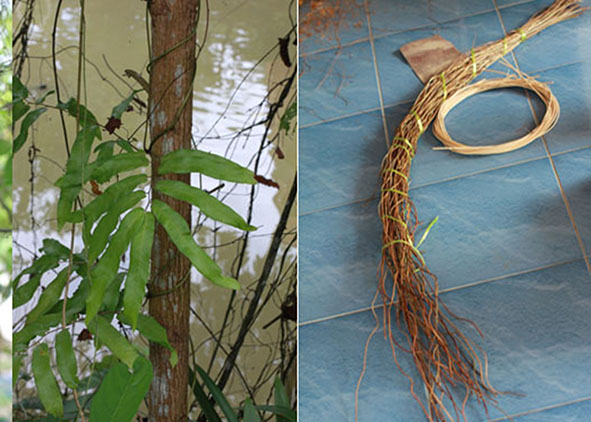
L’articolo indaga l’integrazione tra materiali di origine biologica locali, saperi artigianali tradizionali e design industriale nella prospettiva dell’Industria 5.0. Per superare la frammentazione tra sperimentazione materica, conoscenza artigianale e sviluppo del prodotto, la ricerca propone l’Hybrid Craft-Industry Innovation Framework e lo verifica attraverso un processo di Material-Driven Co-Creative Design applicato allo ‘yan-lipao’, materiale tradizionale della Thailandia meridionale. La metodologia impiegata combina caratterizzazione del materiale, workshop di co-progettazione, modellazione digitale e realizzazionde di quattro prototipi al fine di verificare la versatilità dello ‘yan-lipao’, la trasferibilità delle tecniche di intreccio a prodotti contemporanei e il valore della collaborazione tra sapere artigianale e strumenti progettuali. I risultati mostrano che conoscenze locali, sperimentazione materica e co-progettazione possono sostenere prodotti sostenibili, radicati nel contesto e coerenti con filiere inclusive. Il contributo offre una base replicabile per ricerche su materiali sostenibili, artigianato e innovazione industriale.
Info sull'articolo
Ricevuto: 08/03/2026; Revisionato: 12/04/2026; Accettato: 13/04/2026
Downloads
##plugins.generic.articleMetricsGraph.articlePageHeading##
Riferimenti bibliografici
Ashby, M. F. (2012), Materials and the Environment – Eco-informed Material Choice, Butterworth-Heinemann, Oxford.
Bai, L., Wang, X., Zhang, L., Feng, J., Liao, J., Chen, B., Wang, P. and Zhang, X. (2024), “A systematic study of interactions between sustainable development goals (SDGs) in Hainan Island”, in Scientific Reports, vol. 14, article 26613, pp. 1-17. [Online] Available at: doi.org/10.1038/s41598-024-77984-5 [Accessed 19 March 2026].
Binder, T., Brandt, E., Ehn, P. and Halse, J. (2015), “Democratic design experiments – Between parliament and laboratory”, in CoDesign | International Journal of CoCreation in Design and the Arts, vol. 11, issue 3-4, pp. 152-165. [Online] Available at: doi.org/10.1080/15710882.2015.1081248 [Accessed 19 March 2026].
Björgvinsson, E., Ehn, P. and Hillgren, P.-A. (2012), “Design things and design thinking – Contemporary participatory design challenges”, in Design Issues, vol. 28, issue 3, pp. 101-116. [Online] Available at: doi.org/10.1162/DESI_a_00165 [Accessed 19 March 2026].
Bocken, N. M. P., de Pauw, I., Bakker, C. and van der Grinten, B. (2016), “Product design and business model strategies for a circular economy”, in Journal of Industrial and Production Engineering, vol. 33, issue 5, pp. 308-320. [Online] Available at: doi.org/10.1080/21681015.2016.1172124 [Accessed 19 March 2026].
Bruijn, H., Duin, R., Huijbregts, M. A. J., Guinee, J. B., Gorree, M., Heijungs, R., Huppes, G., Kleijn, R., Koning, A., Oers, L., Wegener Sleeswijk, A., Suh, S. and Udo de Haes, H. A. (eds) (2002), Handbook on Life Cycle Assessment – Operational Guide to the ISO Standards, Springer, Dordrecht. [Online] Available at: doi.org/10.1007/0-306-48055-7 [Accessed 19 March 2026].
Correa, D., Bianconi, F., Filippucci, M. and Pelliccia, G. (2023), “Pattern modulari nel design igroscopico con stampa 4D – Forma e programmazione del materiale | Modular patterns in hygroscopic 4D printing design – Form and programming of the material”, in Agathón | International Journal of Architecture, Art and Design, vol. 14, pp. 264-273. [Online] Available at: doi.org/10.19229/2464-9309/14222023 [Accessed 19 March 2026].
Crippa, V., Rognoli, V. and Levi, M. (2012), “Materials and emotions – A study on the relations between materials and emotions in industrial products”, in Brassett, J., Hekkert, P., Ludden, G., McDonnell, J. and Malpass, M. (eds), Out of Control – Book of Abstract– Proceedings of 8th International Design and Emotion Conference, Central Saint Martins University of Art & Design, London, England, September 11-14, 2012, Central Saint Martins University of the Arts, London, pp. 1-8. [Online] Available at: researchgate.net/publication/287477143_Materials_and_emotions_A_study_ on_the_relations_between_materials_and_emotions_in_industrial_products [Accessed 10 March 2026].
Dal Falco, F. and Al Azhari, O. (2024), “Complessità e significati del mashrabiya nelle arti islamiche tra tradizione e innovazione digitale | Complexity and meanings of the mashrabiya in the Islamic arts between tradition and digital innovation”, in Agathón | International Journal of Architecture, Art and Design, vol. 16, pp. 290-303. [Online] Available at: doi.org/10.19229/2464-9309/16242024 [Accessed 19 March 2026].
EMF – Ellen MacArthur Foundation (2013), Towards the Circular Economy – Economic and business rationale for an accelerated transition. [Online] Available at: content.ellenmacarthurfoundation.org/m/27265af68f11ef30/ original/Towards-the-circular-economy-Vol-1.pdf [Accessed 19 March 2026].
European Commission – Directorate General for Research and Innovation (2021), Industry 5.0 – Towards a Sustainable, Human-centric and Resilient European Industry, Publications Office of the European Union, Luxembourg. [Online] Available at: data.europa.eu/doi/10.2777/308407 [Accessed 19 March 2026].
Gaddi, R. and Mastrolonardo, L. (2024), “Micro-reti locali per la transizione verde della filiera della lana | Local micro-networks for green transition of the wool supply chain”, in Agathón | International Journal of Architecture, Art and Design, vol. 15, pp. 344-353. [Online] Available at: doi.org/10.19229/2464-9309/15292024 [Accessed 19 March 2026].
Geissdoerfer, M., Savaget, P., Bocken, N. M. P. and Hultink, E. J. (2017), “The Circular Economy – A new sustainability paradigm?”, in Journal of Cleaner Production, vol. 143, pp. 757-768. [Online] Available at: doi.org/10.1016/j.jclepro.2016.12.048 [Accessed 19 March 2026].
Ghobakhloo, M., Amoozad Mahdiraji, H., Iranmanesh, M. and Jafari-Sadeghi, V. (2024), “From Industry 4.0 Digital Manufacturing to Industry 5.0 Digital Society – A Roadmap Toward Human-Centric, Sustainable, and Resilient Production”, in Information Systems Frontiers | A Journal of Research and Innovation, vol. 26, issue 1, pp. 1-33. [Online] Available at: doi.org/10.1007/s10796-024-10476-z [Accessed 19 March 2026].
Ghobakhloo, M., Iranmanesh, M., Mubarak, M. F., Mubarik, M., Rejeb, A. and Nilashi, M. (2022), “Identifying industry 5.0 contributions to sustainable development – A strategy roadmap for delivering sustainability values”, in Sustainable Production and Consumption, vol. 33, pp. 716-737. [Online] Available at: doi.org/10.1016/j.spc.2022.08.003 [Accessed 19 March 2026].
Giaccardi, E. and Karana, E. (2015), “Foundations of materials experience – An approach for HCI”, in Brown, D. and Kim, J. (eds), CHI 2015 – Proceedings of the 33rd Annual CHI Conference on Human Factors in Computing Systems, Seoul, Republic of Korea, April 18-23, 2015, Association for Computing Machinery, New York, NY, pp. 2447-2456. [Online] Available at: doi.org/10.1145/2702123.2702337 [Accessed 19 March 2026].
Huang, S., Wang, B., Li, X., Zheng, P., Mourtzis, D. and Wang, L. (2022), “Industry 5.0 and Society 5.0 – Comparison, complementation and co-evolution”, in Journal of Manufacturing Systems, vol. 64, pp. 424-428. [Online] Available at: doi.org/10.1016/j.jmsy.2022.07.010 [Accessed 19 March 2026].
ISO – International Organization for Standardization (2006a), ISO 14040:2006 – Environmental management – Life cycle assessment – Principles and framework, International Organization for Standardization, Geneva. [Online] Available at: iso.org/standard/37456.html [Accessed 19 March 2026].
ISO – International Organization for Standardization (2006b), ISO 14044:2006 – Environmental management – Life cycle assessment – Requirements and guidelines, International Organization for Standardization, Geneva. [Online] Available at: iso.org/standard/38498.html [Accessed 19 March 2026].
Ivanov, D. (2023), “The Industry 5.0 framework – Viability-based integration of the resilience, sustainability, and human-centricity perspectives”, in International Journal of Production Research, vol. 61, issue 5, pp. 1683-1695. [Online] Available at: doi.org/10.1080/00207543.2022.2118892 [Accessed 19 March 2026].
Karana, E., Barati, B., Rognoli, V. and Zeeuw van der Laan, A. (2015), “Material Driven Design (MDD) – A method to design for material experiences”, in International Journal of Design, vol. 9, issue 2, pp. 35-54. [Online] Available at: ijdesign.org/index.php/IJDesign/article/view/1965 [Accessed 19 March 2026].
Karana, E., Pedgley, O. and Rognoli, V. (eds) (2014), Materials Experience – Fundamentals of Materials and Design, Butterworth-Heinemann, Oxford.
Kirchherr, J., Reike, D. and Hekkert, M. (2017), “Conceptualizing the circular economy – An analysis of 114 definitions”, in Resources, Conservation and Recycling, vol. 127, pp. 221-232. [Online] Available at: doi.org/10.1016/j.resconrec.2017.09.005 [Accessed 19 March 2026].
Lloyd, P. (2017), “From design methods to future-focused thinking – 50 years of design research”, in Design Studies, vol. 48, pp. A1-A8. [Online] Available at: doi.org/10.1016/j.destud.2016.12.004 [Accessed 19 March 2026].
Luckman, S. (2015), Craft and the Creative Economy, Palgrave Macmillan, London. [Online] Available at: doi.org/10.1057/9781137399687 [Accessed 19 March 2026].
Maffei, S., Bolzan, P., Bianchini, M., Zeccara, F., Barbero, S., Campagnaro, C., Di Prima, N., Filippini, A., Puglielli, M., Rosato, L., Lotti, G. and Pontillo, G. (2024), “Svelare la complessità della transizione circolare per il settore del mobile imbottito | Unveiling the complexity of circular transition for the upholstered furniture sector”, in Agathón | International Journal of Architecture, Art and Design, vol. 16, pp. 304-313. [Online] Available at: doi.org/10.19229/2464-9309/16252024 [Accessed 19 March 2026].
Manzini, E. (2015), Design, When Everybody Designs – An Introduction to Design for Social Innovation, The MIT Press, Cambridge (MA).
McDonough, W. and Braungart, M. (2002), Cradle to Cradle – Remaking the Way We Make Things, North Point Press, New York (NY).
Morpurgo, E. (2024), “Biomateriali e zone umide – Filiere per l’edilizia e il tessile dalla valorizzazione di ecosistemi locali | Biomaterials and wetlands – Supply chains for construction and textiles through the enhancement of local ecosystems”, in Agathón | International Journal of Architecture, Art and Design, vol. 16, pp. 314-323. [Online] Available at: doi.org/10.19229/2464-9309/16262024 [Accessed 19 March 2026].
Olivastri, C. and Tagliasco, G. (2024), “Servizi per il riuso e il riparo – L’allestimento tra touchpoints e infrastrutture relazionali | Services for reuse and repair – The arrangement between touchpoints and relational infrastructures”, in Agathón | International Journal of Architecture, Art and Design, vol. 15, pp. 324-331. [Online] Available at: doi.org/10.19229/2464-9309/15272024 [Accessed 19 March 2026].
Osello, A., Del Giudice, M., Donato, A. J. and Fratto, A. (2024), “Verso la Neutralità Climatica – Il ruolo chiave del Digital Twin nell’Industria 5.0 | Towards Climate Neutrality – The key role of the Digital Twin in Industry 5.0”, in Agathón | International Journal of Architecture, Art and Design, vol. 15, pp. 276-285. [Online] Available at: doi.org/10.19229/2464-9309/15222024 [Accessed 19 March 2026].
Pedgley, O. (2014), “Chapter 24 – Materials Selection for Product Experience – New Thinking, New Tools”, in Karana, E., Pedgley, O. and Rognoli, V. (eds), Materials Experience – Fundamentals of Materials and Design, pp. 337-349. [Online] Available at: doi.org/10.1016/B978-0-08-099359-1.00024-2 [Accessed 19 March 2026].
Pietroni, L., Di Stefano, A. and Galloppo, D. (2023), “Il design modulare verso l’economia circolare – Dal ‘fare per disfare’ al ‘fare per rifare’ | Modular design towards the circular economy – From ‘making to unmake’ to ‘making to remake’”, in Agathón | International Journal of Architecture, Art and Design, vol. 14, pp. 274-283. [Online] Available at: doi.org/10.19229/2464-9309/14232023 [Accessed 19 March 2026].
Porfirione, C., Ferrari Tumay, X. and Leggiero, I. (2024), “Conoscenza, innovazione e cambiamento – Il potere dell’errore nel design e nei sistemi complessi | Knowledge, innovation, and change – The power of error in design and complex systems”, in Agathón | International Journal of Architecture, Art and Design, vol. 16, pp. 232-241. [Online] Available at: doi.org/10.19229/2464-9309/16202024 [Accessed 19 March 2026].
Pradhan, P., Weitz, N., Daioglou, V., Abrahão, G. M., Allen, C., Ambrósio, G., Arp, F., Asif, F., Bennich, T., Benton, T. G., Biermann, F., Cao, M., Carlsen, H., Chen, F., Chen, M., Daams, M., Dawes, J. H. P., Dhakal, S., Gilmore, E., González, L. J. M., Hubacek, K., Hu, Y., Jager, W., Samir, K. C., Kearney, N. M., Khot, U. A., Kluck, T., Kulkarni, S., Leininger, J., Li, C., Li, J., Lotze-Campen, H., Parrado-Hernando, G., Pedercini, M., Phuyal, R. K., Prell, C., Rijal, A., Schweizer, V., Sijtsma, F. J., Soergel, B., Spittler, N., van Vuuren, D., Warchold, A., Weber, E., Wicke, B., Widerberg, O., Wilts, R., Wingens, C., Wu, C., Xing, Q., Yan, J., Yuan, Z., Zhou, X. and Zimm, C. (2024), “Three foci at the science-policy interface for systemic Sustainable Development Goal acceleration”, in Nature Communications, vol. 15, article 8600, pp. 1-4. [Online] Available at: doi.org/10.1038/s41467-024-52926-x [Accessed 19 March 2026].
Rognoli, V. (2010), “A broad survey on expressive-sensorial characterization of materials for design education”, in METU | Journal of the Faculty of Architecture, vol. 27, issue 2, pp. 287-300. [Online] Available at: doi.org/10.4305/METU.JFA.2010.2.16 [Accessed 19 March 2026].
Rognoli, V., Bianchini, M., Maffei, S. and Karana, E. (2015), “DIY materials”, in Materials and Design, vol. 86, pp. 692-702. [Online] Available at: doi.org/10.1016/j.matdes.2015.07.020 [Accessed 19 March 2026].
Sanders, E. B.-N. and Stappers, P. J. (2008), “Co-creation and the new landscapes of design”, in CoDesign | International Journal of CoCreation in Design and the Arts, vol. 4, issue 1, pp. 5-18. [Online] Available at: doi.org/10.1080/15710880701875068 [Accessed 19 March 2026].
Sennett, R. (2008), The Craftsman, Yale University Press, New Haven (CT).
Spinuzzi, C. (2005), “The methodology of participatory design”, in Technical Communication, vol. 52, issue 2, pp. 163-174. [Online] Available at: ingentaconnect.com/contentone/stc/tc/2005/00000052/00000002/art00005 [Accessed 19 March 2026].
Sposito, C. and De Giovanni, G. (2023), “Affrontare la complessità – Integrare LCA, ERA ed ESA per valutare impatti e benefici antropici sulla biosfera | Dealing with complexity – Integrating LCA, ERA and ESA to assess human impacts and benefits on the biosphere”, in Agathón | International Journal of Architecture, Art and Design, vol. 14, pp. 12-39. [Online] Available at: doi.org/10.19229/2464-9309/1412023 [Accessed 19 March 2026].
Steen, M. (2013), “Co-design as a process of joint inquiry and imagination”, in Design Issues, vol. 29, issue 2, pp. 16-28. [Online] Available at: doi.org/10.1162/DESI_a_00207 [Accessed 19 March 2026].
Turner, C. and Oyekan, J. (2023), “Manufacturing in the Age of Human-Centric and Sustainable Industry 5.0 – Application to Holonic, Flexible, Reconfigurable and Smart Manufacturing Systems”, in Sustainability, vol. 15, issue 13, article 10169, pp. 1-29. [Online] Available at: doi.org/10.3390/su151310169 [Accessed 19 March 2026].
UN – United Nations | Department of Economic and Social Affairs (2024), Synergy Solutions for Climate and SDG Action – Bridging the Ambition Gap for the Future We Want – Report on strengthening evidence base, United Nations, New York (NY). [Online] Available at: sdgs.un.org/sites/default/files/2024-08/UN%20Synergy%20Solutions%20for%20Climate%20and%20SDG%20Action-4_0.pdf [Accessed 19 March 2026].
UNEP – United Nations Environment Programme (2023), Turning off the Tap – How the world can end plastic pollution and create a circular economy, UNEP, Nairobi. [Online] Available at: wedocs.unep.org/handle/20.500.11822/42277 [Accessed 19 March 2026].
Valenti, A., Trimarchi, A. and Farresin, S. (2023), “Design e pensiero ecologico – Le nuove narrative del progetto contemporaneo che mettono la Terra in primo piano | Design and ecological thinking – The new narratives of contemporary design placing Earth on centre stage”, in Agathón | International Journal of Architecture, Art and Design, vol. 13, pp. 19-30. [Online] Available at: doi.org/10.19229/2464-9309/1312023 [Accessed 19 March 2026].
Verganti, R. (2009), Design-Driven Innovation – Changing the Rules of Competition by Radically Innovating What Things Mean, Harvard Business Press, Boston (MA).
Yitmen, I., Alizadehsalehi, S. and Almusaed, A. (2023), “Investigating the casual relationships among enablers of the construction 5.0 paradigm – Integration of Operator 5.0 and Society 5.0 with Human-Centric Smart Production and Logistics”, in Sustainability, vol. 15, issue 11, article 9105, pp. 1-25. [Online] Available at: doi.org/10.3390/su15119105 [Accessed 19 March 2026].
Zannoni, M., Succini, L., Rosato, L. and Pasini, V. (2024), “Transitional industrial designer – La responsabilità di progettisti e imprese per una transizione sostenibile | Transitional industrial designer – The responsibility of designers and companies for a sustainable transition”, in Agathón | International Journal of Architecture, Art and Design, vol. 15, pp. 332-343. [Online] Available at: doi.org/10.19229/2464-9309/15282024 [Accessed 19 March 2026].
Zizic, M. C., Mladineo, M., Gjeldum, N. and Celent, L. (2022), “From Industry 4.0 towards Industry 5.0 – A Review and Analysis of Paradigm Shift for the People, Organization and Technology”, in Energies, vol. 15, issue 14, article 5221, pp. 1-20. [Online] Available at: doi.org/10.3390/en15145221 [Accessed 19 March 2026].
##submission.downloads##
Pubblicato
Come citare
Fascicolo
Sezione
Categorie
Licenza
Copyright (c) 2026 Rewat Suksikarn

TQuesto lavoro è fornito con la licenza Creative Commons Attribuzione 4.0 Internazionale.
AGATHÓN è pubblicata sotto la licenza Creative Commons Attribution License 4.0 (CC-BY).
License scheme | Legal code
Questa licenza consente a chiunque di:
Condividere: riprodurre, distribuire, comunicare al pubblico, esporre in pubblico, rappresentare, eseguire e recitare questo materiale con qualsiasi mezzo e formato.
Modificare: remixare, trasformare il materiale e basarti su di esso per le tue opere per qualsiasi fine, anche commerciale.
Alle seguenti condizioni
Attribuzione: si deve riconoscere una menzione di paternità adeguata, fornire un link alla licenza e indicare se sono state effettuate delle modifiche; si può fare ciò in qualsiasi maniera ragionevole possibile, ma non con modalità tali da suggerire che il licenziante avalli l'utilizzatore o l'utilizzo del suo materiale.
Divieto di restrizioni aggiuntive: non si possono applicare termini legali o misure tecnologiche che impongano ad altri soggetti dei vincoli giuridici su quanto la licenza consente di fare.
Note
Non si è tenuti a rispettare i termini della licenza per quelle componenti del materiale che siano in pubblico dominio o nei casi in cui il nuovo utilizzo sia consentito da una eccezione o limitazione prevista dalla legge.
Non sono fornite garanzie. La licenza può non conferire tutte le autorizzazioni necessarie per l'utilizzo che ci si prefigge. Ad esempio, diritti di terzi come i diritti all'immagine, alla riservatezza e i diritti morali potrebbero restringere gli usi del materiale.