Trasferimento tecnologico automotive-AEC – Framework DfMA e sistemi di facciata complessi
DOI:
https://doi.org/10.69143/2464-9309/19162026Parole chiave:
trasferimento tecnologico, industrializzazione della complessità, sistemi di facciata, ottimizzazione topologica, valutazione del cicloAbstract
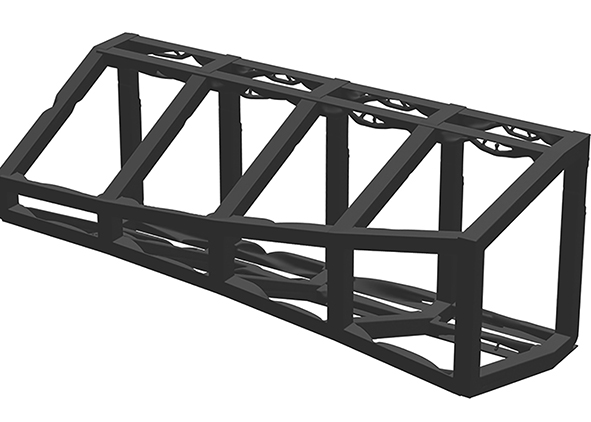
Nel settore AEC è sempre più urgente individuare soluzioni capaci di coniugare sostenibilità ambientale, qualità progettuale e scalabilità produttiva, in un contesto segnato da trasformazioni ambientali e tecnologiche, carenza di manodopera qualificata e stagnazione della produttività. In questo scenario il trasferimento tecnologico dal settore automotive a quello delle costruzioni rappresenta una leva strategica per governare la complessità degli involucri edilizi. Il contributo propone un framework Design for Manufacturing and Assembly di derivazione automotive, applicato a un macrocomponente di facciata realizzato in Glass-fibre Reinforced Concrete e Wire Arc Additive Manufacturing. L’integrazione tra modellazione parametrica, ottimizzazione topologica e analisi di Life Cycle Assessment consente di ridurre la massa della sottostruttura, migliorandone l’efficienza materica e orientando il progetto verso soluzioni industrializzabili, scalabili e coerenti con i principi della circolarità.
Info sull'articolo
Ricevuto: 10/03/2026; Revisionato: 11/04/2026; Accettato: 13/04/2026
Downloads
##plugins.generic.articleMetricsGraph.articlePageHeading##
Riferimenti bibliografici
Ahmad, J., González-Lezcano, R. A., Majdi, A., Ben Kahla, N., Deifalla, A. F. and El-Shorbagy, M. A. (2022), “Glass fibers re-inforce concrete – Overview on mechanical, durability and microstructure analysis”, in Materials, vol. 15, issue 15, article 5111, pp. 1-23. [Online] Available at: doi.org/10.3390/ma15155111 [Accessed 31 March 2026].
Alkhazaleh, R., Mykoniatis, K. and Alahmer, A. (2022), “The success of technology transfer in the Industry 4.0 era – A sys-tematic literature review”, in Journal of Open Innovation | Technology, Market, and Complexity, vol. 8, issue 4, article 202, pp. 1-18. [Online] Available at: doi.org/10.3390/joitmc8040202 [Accessed 31 March 2026].
Bendsøe, M. P. and Sigmund, O. (2004), Topology Optimization – Theory, Methods and Applications, Springer, Berlin. [Online] Available at: doi.org/10.1007/978-3-662-05086-6 [Accessed 31 March 2026].
Bentur, A. and Mindess, S. (2006), Fibre Reinforced Cementitious Composites, CRC Press, Boca Raton. [Online] Available at: doi.org/10.1201/9781482267747 [Accessed 8 April 2026].
Bishop, E. and Wilson, J. (2011), “Concept to realisation – GRC and complex facades”, in Proceedings of the GRCA Con-gress 2011, Istanbul, Turkey, September 4-8, 2011, Glassfibre Reinforced Concrete Association, Bingley, pp. 1-15. [Online] Available at: grca.org.uk/pdf/congress-2011/21%20Concept%20to%20Realisation%20GRC%20and%20Complex %20Facades.pdf [Accessed 31 March 2026].
Damtsas, E., Nieto Jiménez, A., Konstantatou, M., Herrmann, M. and Grigoriadis, K. (2025), “The design, fabrication, and structural and embodied carbon analysis of the world’s first manufactured topologically optimised multi-metal I-beam”, in Architectural Intelligence, vol. 4, issue 1, article 23, pp. 1-22. [Online] Available at: doi.org/10.1007/s44223-025-00100-8 [Accessed 31 March 2026].
de Matos Camarinha, R., Goulding, J. and Peter, C. (2023), “Construction sector transformation – Developing a new learning paradigm”, in Gomes Correia, A., Azenha, M., Cruz, P. J. S., Novais, P. and Pereira, P. (eds), Trends on Construction in the Dig-ital Era – ISIC 2022 – Proceedings of ISIC 2022, Guimarães, Portugal, September 6-9, 2022, Lecture Notes in Civil Engi-neering, vol. 306, Springer, Cham, pp. 369-379. [Online] Available at: doi.org/10.1007/978-3-031-20241-4_25 [Accessed 31 March 2026].
Ettlie, J. E. and Elsenbach, J. M. (2007), “Modified Stage-Gate® regimes in new product development”, in Journal of Product Innovation Management, vol. 24, issue 1, pp. 20-33. [Online] Available at: doi.org/10.1111/j.1540-5885.2006.00230.x [Ac-cessed 31 March 2026].
European Committee for Standardization (2019), EN 15804 – Sustainability of construction works – Environmental product declarations – Core rules for the product category of construction products. [Online] Available at: stand-ards.iteh.ai/catalog/standards/cen/c98127b4-8dc2-48a4-9338-3e1366b16669/en-15804-2012a2-2019 [Accessed 31 March 2026].
European Committee for Standardization (2011), EN 15978 – Sustainability of construction works – Assessment of envi-ronmental performance of buildings – Calculation method. [Online] Available at: stand-ards.iteh.ai/catalog/standards/cen/62c22cef-5666-4719-91f9-c21cb6aa0ab3/en-15978-2011 [Accessed 31 March 2026].
Giovanardi, M., Castellan, C., La Rosa, M., Pavlovic, A. and Pracucci, A. (2024), “Progettare BIPV – Strategie per gestire la complessità del fotovoltaico integrato in facciata | Designing BIPV – Strategies for managing complexity in the integration of photovoltaics in facades”, in Agathón | International Journal of Architecture, Art and Design, vol. 16, pp. 186-193. [Online] Available at: doi.org/10.19229/2464-9309/16152024 [Accessed 31 March 2026].
Henriksen, T., Lo, S. and Knaack, U. (2015), “An innovative approach to manufacture thin-walled glass fibre reinforced con-crete for tomorrow’s architectural building envelopes with complex geometries”, in Journal of Building Engineering, vol. 4, pp. 189-199. [Online] Available at: doi.org/10.1016/j.jobe.2015.09.006 [Accessed 31 March 2026].
Höweler, E. (2025), Design for Construction – Tectonic Imagination in Contemporary Architecture, Routledge, London. [Online] Available at: doi.org/10.4324/9781003434559 [Accessed 31 March 2026].
ISO – International Organization for Standardization (2006a), ISO 14040:2006 – Environmental management – Life cycle assessment – Principles and framework. [Online] Available at: iso.org/standard/37456.html [Accessed 31 March 2026].
ISO –International Organization for Standardization (2006b), ISO 14044:2006 – Environmental management – Life cycle assessment – Requirements and guidelines. [Online] Available at: iso.org/standard/38498.html [Accessed 31 March 2026].
Laghi, V., Palermo, M., Bruggi, M., Gasparini, G. and Trombetti, T. (2023), “Blended structural optimization for wire-and-arc additively manufactured beams”, in International Journal of Steel Structures, vol. 8, pp. 381-392. [Online] Available at: doi.org/10.1007/s40964-022-00335-1 [Accessed 31 March 2026].
Laghi, V., Savino, E. and Gasparini, G. (2025), “Reduction of the environmental impact of complex-shaped steel joints through topology optimization and large-scale metal 3D printing”, in Results in Engineering, vol. 27, article 105610, pp. 1-14. [Online] Available at: doi.org/10.1016/j.rineng.2025.105610 [Accessed 31 March 2026].
Manni, V. and Valzano, L. S. (2023), “Modularità e architettura adattiva – Una strategia per la gestione di sistemi d’involucro complessi | Modularity and adaptive architecture – A strategy for managing complex envelope systems”, in Agathón | Interna-tional Journal of Architecture, Art and Design, vol. 14, pp. 134-151. [Online] Available at: doi.org/10.19229/2464-9309/14112023 [Accessed 31 March 2026].
Morbiducci, R., Polverino, S. and Battaglia, C. (2023), “Stampa 4D per componenti costruttivi modulari – Applicazioni e prin-cipali sviluppi | 4D printing for modular construction components – Applications and main developments”, in Agathón | In-ternational Journal of Architecture, Art and Design, vol. 14, pp. 182-193. [Online] Available at: doi.org/10.19229/2464-9309/14152023 [Accessed 31 March 2026].
Onat, M. (2025), “Investigation of changes in body-in-white components and their impact during the transition from internal combustion engine vehicles to electric vehicles”, in International Journal of Automotive Engineering and Technologies, vol. 14, issue 2, pp. 123-141. [Online] Available at: doi.org/10.18245/ijaet.1630727 [Accessed 31 March 2026].
Osello, A., Del Giudice, M., Donato, A. J. and Fratto, A. (2024), “Verso la Neutralità Climatica – Il ruolo chiave del Digital Twin nell’Industria 5.0 | Towards Climate Neutrality – The key role of the Digital Twin in Industry 5.0”, in Agathón | Inter-national Journal of Architecture, Art and Design, vol. 15, pp. 276-285. [Online] Available at: doi.org/10.19229/2464-9309/15222024 [Accessed 8 April 2026].
Palumbo, E., Mazzei, I., Perpetua, M. and Pomponi, F. (2025), “Impatti ambientali e sociali nel ciclo vita per una progettazione a basso carbonio | Environmental and social life cycle for low-carbon design”, in Agathón | International Journal of Archi-tecture, Art and Design, vol. 18, pp. 294-303. [Online] Available at: doi.org/10.69143/2464-9309/18172025 [Accessed 31 March 2026].
Paoletti, I. (2003), Una finestra sul trasferimento – Tecnologie innovative per l’architettura, Libreria Clup, Milano.
Purslow, G. J. (1990), “Stud frame cladding – A technical appraisal”, in Construction and Building Materials, vol. 4, issue 1, pp. 11-15. [Online] Available at: doi.org/10.1016/0950-0618(90)90013-Q [Accessed 31 March 2026].
Raspall, F., Araya, S., Pazols, M., Valenzuela, E., Castillo, M. and Benavides, P. (2025), “Wire arc additive manufacturing for widespread architectural application – A review informed by large-scale prototypes”, in Buildings, vol. 15, issue 6, article 906, pp. 1-21. [Online] Available at: doi.org/10.3390/buildings15060906 [Accessed 31 March 2026].
RIBA – Royal Institute of British Architects (2020), RIBA Plan of Work 2020 Overview, RIBA, London. [Online] Available at: riba.org/media/syneeeto/2020ribaplanofworkoverviewpdf.pdf [Accessed 8 April 2026].
Richard, R.-B. (2017), “Industrialized building system categorization”, in Smith, R. E. and Quale, J. D. (eds), Offsite Architec-ture – Constructing the future, Routledge, London, pp. 3-20. [Online] Available at: doi.org/10.4324/9781315743332-1 [Ac-cessed 31 March 2026].
Samad, M. F. A. and George, K. Y. (2022), “Application of Design for Manufacturing and Assembly (DFMA) method to vehi-cle door design”, in Defence S and T Technical Bulletin, vol. 15, issue 1, pp. 34-41. [Online] Available at: eprints.utem.edu.my/id/eprint/26996/ [Accessed 31 March 2026].
Shah, I. H., Hadjipantelis, N., Walter, L., Myers, R. J. and Gardner, L. (2023), “Environmental life cycle assessment of wire arc additively manufactured steel structural components”, in Journal of Cleaner Production, vol. 389, article 136071, pp. 1-14. [Online] Available at: doi.org/10.1016/j.jclepro.2023.136071 [Accessed 31 March 2026].
Smith, R. E., Elliott, J. W. and Grosskopf, K. (2017), “Offsite construction in education – A survey of prefabrication in design and construction academia”, in Smith, R. E. and Quale, J. D. (eds), Offsite Architecture – Constructing the future, Routledge, London, pp. 128-138. [Online] Available at: doi.org/10.4324/9781315743332-8 [Accessed 31 March 2026].
Spreafico, C., Kokare, S. and Godina, R. (2026), “Prospective life cycle assessment of future wire arc additive manufacturing deposition process for large-scale steel parts”, in Environmental Impact Assessment Review, vol. 116, article 108111, pp. 1-17. [Online] Available at: doi.org/10.1016/j.eiar.2025.108111 [Accessed 31 March 2026].
Takezawa, A., Nishiwaki, S. and Kitamura, M. (2010), “Shape and topology optimization based on the phase field method and sensitivity analysis”, in Journal of Computational Physics, vol. 229, issue 7, pp. 2697-2718. [Online] Available at: doi.org/10.1016/j.jcp.2009.12.017 [Accessed 31 March 2026].
UN – United Nations (2015), Transforming our World – The 2030 Agenda for Sustainable Development. [Online] Available at: sdgs.un.org/2030agenda [Accessed 31 March 2026].
Vibæk, K. S. (2017), “System structures – A theory of industrialised architecture”, in Smith, R. E. and Quale, J. D. (eds), Offsite Architecture – Constructing the future, Routledge, London, pp. 21-36. [Online] Available at: doi.org/10.4324/9781315743332-2 [Accessed 31 March 2026].
Waqar, A., Al Hajj, F., Danish, M., Khan, M. B. and Houda, M. (2025), “Evaluating the influence of modern construction methods on sustainable construction success”, in Cleaner and Responsible Consumption, vol. 19, article 100327, pp. 1-14. [Online] Available at: doi.org/10.1016/j.clrc.2025.100327 [Accessed 9 April 2026].
Wood, B. (2021), Data Driven Infrastructure – From Digital Tools to Manufactured Components. [Online] Available at: cdbb.cam.ac.uk/system/ files/documents/data_driven_infrastructure_screen.pdf [Accessed 8 April 2026].
##submission.downloads##
Pubblicato
Come citare
Fascicolo
Sezione
Categorie
Licenza
Copyright (c) 2026 Ingrid Maria Paoletti, Giuseppe Conti, Giorgio Castellano, Federica Pradella

TQuesto lavoro è fornito con la licenza Creative Commons Attribuzione 4.0 Internazionale.
AGATHÓN è pubblicata sotto la licenza Creative Commons Attribution License 4.0 (CC-BY).
License scheme | Legal code
Questa licenza consente a chiunque di:
Condividere: riprodurre, distribuire, comunicare al pubblico, esporre in pubblico, rappresentare, eseguire e recitare questo materiale con qualsiasi mezzo e formato.
Modificare: remixare, trasformare il materiale e basarti su di esso per le tue opere per qualsiasi fine, anche commerciale.
Alle seguenti condizioni
Attribuzione: si deve riconoscere una menzione di paternità adeguata, fornire un link alla licenza e indicare se sono state effettuate delle modifiche; si può fare ciò in qualsiasi maniera ragionevole possibile, ma non con modalità tali da suggerire che il licenziante avalli l'utilizzatore o l'utilizzo del suo materiale.
Divieto di restrizioni aggiuntive: non si possono applicare termini legali o misure tecnologiche che impongano ad altri soggetti dei vincoli giuridici su quanto la licenza consente di fare.
Note
Non si è tenuti a rispettare i termini della licenza per quelle componenti del materiale che siano in pubblico dominio o nei casi in cui il nuovo utilizzo sia consentito da una eccezione o limitazione prevista dalla legge.
Non sono fornite garanzie. La licenza può non conferire tutte le autorizzazioni necessarie per l'utilizzo che ci si prefigge. Ad esempio, diritti di terzi come i diritti all'immagine, alla riservatezza e i diritti morali potrebbero restringere gli usi del materiale.