Biofilia e rigenerazione urbana – Soluzioni Tech-NbS stampate in 3D per microinterventi resilienti
DOI:
https://doi.org/10.69143/2464-9309/19142026Parole chiave:
manifattura additiva, soluzioni basate sulla natura, sistemi di facciata, biodiversità, coinvolgimento di comunità scolasticheAbstract
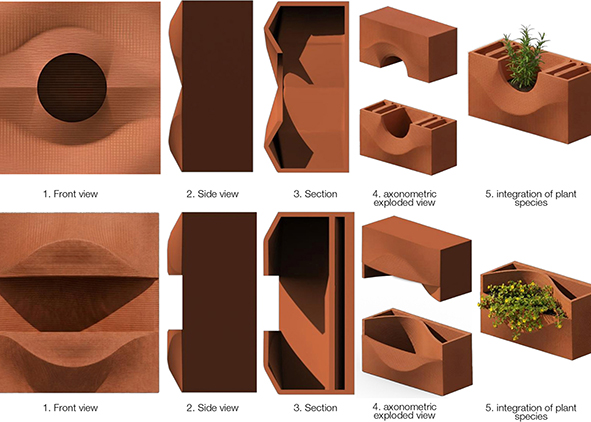
L’articolo presenta il quadro metodologico e i primi esiti sperimentali della ricerca Urban Bloomers, finanziata dal bando UniFI Extra 2025 – Public Engagement, dedicata allo sviluppo di sistemi di facciata vegetata riconducibili a soluzioni tecnologiche basate sulla natura, stampati in 3D in argilla e co-progettati con attori istituzionali, imprese, ricercatori e comunità scolastiche per interventi di rigenerazione orientati alla biodiversità negli spazi ricreativi scolastici dell’area mediterranea. Attraverso l’analisi dello stato dell’arte, l’organizzazione di attività partecipate di osservazione, identificazione e mappatura delle specie, workshop di co-progettazione, modellazione parametrica e prototipazione additiva la ricerca definisce criteri progettuali, costruttivi ed ecologici per lo sviluppo di moduli biofilici capaci di integrare specie vegetali tolleranti agli stress climatici, migliorare il microclima e sostenere processi di apprendimento ambientale. Gli esiti preliminari restituiscono un framework metodologico replicabile e lo sviluppo di un primo prototipo di sistema di facciata Living Wall System tecnologico, orientato all’integrazione tra prestazioni ecologiche, qualità dello spazio educativo e applicazione in situ.
Info sull'articolo
Ricevuto: 15/03/2026; Revisionato: 30/04/2026; Accettato: 01/05/2026
Downloads
##plugins.generic.articleMetricsGraph.articlePageHeading##
Riferimenti bibliografici
Aronne, M., Schwarzer-Fischer, E., Bertana, V., Mossotti, G., Scheithauer, U., Ferrero, S. and Scaltrito, L. (2026), “Exploring circularity in ceramic 3D printing – Possibilities and implementation”, in Open Ceramics, vol. 25, article 100915, pp. 1-16. [Online] Available at: doi.org/10.1016/j.oceram.2026.100915 [Accessed 11 April 2026].
Ascione, F., De Masi, R. F., Mastellone, M., Ruggiero, S. and Vanoli, G. P. (2020), “Green Walls, a Critical Review – Knowledge gaps, design parameters, Thermal Performances and Multi-Criteria Design Approaches”, in Energies, vol. 13, issue 9, article 2296, pp. 1-39. [Online] Available at: doi.org/10.3390/en13092296 [Accessed 11 April 2026].
Ayad, C. V. G., Khateeb, S. E., Said, N. G. and Elbardisy, W. M. (2025), “Optimization of 3D-printed modular living walls in hot arid regions”, in Ain Shams Engineering Journal, vol. 16, issue 10, article 103601, pp. 1-14. [Online] Available at: doi.org/10.1016/j.asej.2025.103601 [Accessed 20 April 2026].
Basnou, C., Pino, J., Davies, C., Winkel, G. and De Vreese, R. (2020), “Co-design processes to address Nature-based Solutions and ecosystem services demands – The long and winding road towards inclusive urban planning”, in Frontiers in Sustainable Cities, vol. 2, article 572556, pp. 1-4. [Online] Available at: doi.org/10.3389/frsc.2020.572556 [Accessed 11 April 2026].
Berretta, T., Desideri, F. and Staltari, M. (2024), “Il progetto dello spazio pubblico, tra complessità e crisi ecologica – Da sfida a opportunità per la rigenerazione urbana | Public space project, between complexity and ecological crisis – From challenge to opportunity for urban regeneration”, in Agathón | International Journal of Architecture, Art and Design, vol. 16, pp. 74-87. [Online] Available at: doi.org/10.19229/2464-9309/1662024 [Accessed 11 April 2026].
Bologna, R. and Hasanaj, G. (2023), “Modelli evoluti per la costruzione di un catalogo NbS per la resilienza e la biodiversità | Advanced models for the construction of an NbS catalogue for resilience and biodiversity”, in Agathón | International Journal of Architecture, Art and Design, vol. 13, pp. 179-190. [Online] Available at: doi.org/10.19229/2464-9309/13152023 [Accessed 11 April 2026].
Camacho, D. D., Clayton, P., O’Brien, W. J., Seepersad, C., Juenger, M., Ferron, R. and Salamone, S. (2018), “Applications of additive manufacturing in the construction industry – A forward-looking review”, in Automation in Construction, vol. 89, pp. 110-119. [Online] Available at: doi.org/10.1016/j.autcon.2017.12.031 [Accessed 11 April 2026].
Chahin, S., Afify, A., Mohsen, H. and Youssef, M. (2022), “Role of 3D printed green walls in healing architecture”, in BAU Journal | Health and Wellbeing, vol. 5, issue 1, article 1, pp. 1-19. [Online] Available at: doi.org/10.54729/srop3798 [Accessed 11 April 2026].
Coccia, L., Cipolletti, S. and Corvaro, G. (2024), “Green Room – Un dispositivo architettonico e urbano per l’efficientamento energetico e il comfort ambientale | Green Room – An architectural and urban device for energy efficiency and environmental comfort”, in Agathón | International Journal of Architecture, Art and Design, vol. 15, pp. 238-251. [Online] Available at: doi.org/10.19229/2464-9309/15192024 [Accessed 11 April 2026].
Crawford, A., In-Na, P., Caldwell, G., Armstrong, R. and Bridgens, B. (2022), “Clay 3D printing as a bio-design research tool – Development of photosynthetic living building components”, in Architectural Science Review, vol. 65, issue 3, pp. 185-195. [Online] Available at: doi.org/10.1080/00038628.2022.2058908 [Accessed 20 April 2026].
Cui, D., Zhang, Y., Li, X., Yuan, L., Mak, C. M. and Kwok, K. (2022), “Effects of different vertical façade greenery systems on pedestrian thermal comfort in deep street canyons”, in Urban Forestry & Urban Greening, vol. 72, article 127582, pp. 1-13. [Online] Available at: doi.org/10.1016/j.ufug.2022.127582 [Accessed 20 April 2026].
Dallere, C. and Tempestini, M. (2024), “Il Centro di Formazione a Salez – Progettare la sostenibilità con interazioni semplici tra utenti e architettura | An Educational Centre in Salez – Designing sustainability through simple interactions between users and architecture”, in Agathón | International Journal of Architecture, Art and Design, vol. 16, pp. 118-129. [Online] Available at: doi.org/10.19229/2464-9309/16102024 [Accessed 11 April 2026].
De Jesus, M. P., Lourenço, J. M., Arce, R. M., and Macias, M. (2017), “Green façades and in situ measurements of outdoor building thermal behaviour”, in Building and Environment, vol. 119, pp. 11-19. [Online] Available at: doi.org/10.1016/j.buildenv.2017.03.041 [Accessed 20 April 2026].
Delfosse, F. (2025), “BANYAN Eco Wall – World’s first 3D printed green wall”, in bigrep.com, 27/08/2025. [Online] Available at: bigrep.com/posts/banyan-eco-wall/ [Accessed 11 April 2026].
El-Sayegh, S., Romdhane, L. and Manjikian, S. (2020), “A critical review of 3D printing in construction – Benefits, challenges and risks”, in Archives of Civil and Mechanical Engineering, vol. 20, issue 2, article 34, pp. 1-25. [Online] Available at: doi.org/10.1007/s43452-020-00038-w [Accessed 11 April 2026].
El-Zoklah, M. H., and Refaat, T. (2021), “How to measure the green façades environmental effectiveness? A proposal to green façade systems technical guide”, in International Journal of Sustainable Building Technology and Urban Development, vol. 12, issue 2, pp. 154-169. [Online] Available at: doi.org/10.22712/susb.20210013 [Accessed 20 April 2026].
European Commission (2024), ERA industrial technologies roadmap on human-centric research and innovation for the manufacturing sector, Publications Office of the European Union, Luxembourg. [Online] Available at: data.europa.eu/doi/10.2777/0266 [Accessed 11 April 2026].
Gasparini, K. (2023), “Design litico e manifattura additiva – Un connubio possibile per l’economia circolare | Lithic design and additive manufacturing – A feasible partnership for the circular economy”, in Agathón | International Journal of Architecture, Art and Design, vol. 14, pp. 316-325. [Online] Available at: doi.org/10.19229/2464-9309/14272023 [Accessed 11 April 2026].
Gyawali, B., Haghnazar, R., Akula, P., Alba, K. and Nasir, V. (2024), “A review on 3D printing with clay and sawdust / natural fibers – Printability, rheology, properties and applications”, in Results in Engineering, vol. 24, article 103024, pp. 1-27. [Online] Available at: doi.org/10.1016/j.rineng.2024.103024 [Accessed 11 April 2026].
Irga, P. J., Torpy, F. R., Griffin, D. and Wilkinson, S. J. (2023), “Vertical Greening Systems – A Perspective on Existing Technologies and New Design Recommendation”, in Sustainability, vol. 15, issue 7, article 6014, pp. 1-13. [Online] Available at: doi.org/10.3390/su15076014 [Accessed 11 April 2026].
Khan, R. (2023), “Biomic Wall fuses ceramic 3D printing & ecological design for self-regulating greening façade”, in Designboom, 16/08/2023. [Online] Available at: designboom.com/architecture/biomic-wall-ceramic-3d-printing-ecological-design-self-regulating-greening-facade-university-of-innsbruck-08-16-2023/ [Accessed 11 April 2026].
Kõiv, K., Annus, I., Kändler, N., Truu, M., Kaur, K. and Suits, K. (2024), “Smart Nature-Based Solutions for Stormwater Management in Urban Areas – An Analysis of Pilot Cases”, in Engineering Proceedings, vol. 69, issue 1, article 18, pp. 1-4. [Online] Available at: doi.org/10.3390/engproc2024069018 [Accessed 11 April 2026].
Lolli, F., Coruzzolo, A. M., Neto, P. G. T., Sellitto, M. A. and Gamberini, R. (2023), “Key enabling technologies and concepts for the Human-Centric Industrial Revolution”, in Human Factors and Wearable Technologies, vol. 85, pp. 36-46. [Online] Available at: doi.org/10.54941/ahfe1003625 [Accessed 11 April 2026].
Longato, D., Cortinovis, C., Balzan, M. and Geneletti, D. (2023), “A method to prioritize and allocate nature-based solutions in urban areas based on ecosystem service demand”, in Landscape and Urban Planning, vol. 235, article 104743, pp. 1-14. [Online] Available at: doi.org/10.1016/j.landurbplan.2023.104743 [Accessed 11 April 2026].
Lunt, P. H., Buckley, J., Mitchell, S., Thomas, G., Churella, E., and Murphy, T. R. (2025), “Biodiversity Performance of living wall systems in urban environments – A UK case study of plant selection and substrate Effects on Multi-Taxa Communities”, in Urban Science, vol. 9, issue 12, article 519, pp. 1-19. [Online] Available at: doi.org/10.3390/urbansci9120519 [Accessed 20 April 2026].
Madrid, J. A., Ortega, G. S., Carabaño, J. G., Olsson, N. O. E. and Ríos, J. A. T. (2023), “3D claying – 3D printing and recycling clay”, in Crystals, vol. 13, issue 3, article 375, pp. 1-20. [Online] Available at: doi.org/10.3390/cryst13030375 [Accessed 11 April 2026].
Mahmoud, I., Morello, E., Bisello, A. and Kolokotsa, D. (2024), “Embedding technologies for improving Nature-Based Solutions performance and fostering social inclusion in urban greening strategies – Augmented NBS for cities”, in Urban Forestry & Urban Greening, vol. 93, article 128215, pp. 1-3. [Online] Available at: doi.org/10.1016/j.ufug.2024.128215 [Accessed 11 April 2026].
Miller, E. (2014), “CELLA by ecoid”, in contemporist.com, 14/04/2014. [Online] Available at: contemporist.com/cella-by-ecoid/ [Accessed 11 April 2026].
Montgomery, G. A., Belitz, M. W., Guralnick, R. P. and Tingley, M. W. (2021), “Standards and Best Practices for Monitoring and Benchmarking Insects”, in Frontiers in Ecology and Evolution, vol. 8, article 579193, pp. 1-18. [Online] Available at: doi.org/10.3389/fevo.2020.579193 [Accessed 20 April 2026].
Nasr, Y., Zakhem, H. E., Hamami, A. E. A., Bachawati, M. E. and Belarbi, R. (2024), “Comprehensive Assessment of the Impact of green roofs and walls on building energy Performance – A scientific review”, in Energies, vol. 17, issue 20, article 5160, pp. 1-52. [Online] Available at: doi.org/10.3390/en17205160 [Accessed 11 April 2026].
O’Donnell, M., Collier, M., Pineda-Pinto, M., Cooper, C., Nulty, F. and Rodriguez Castañeda, N. (2025), “Redefining co-design for social-ecological research and practice – A systematic literature review”, in Environmental Science & Policy, vol. 164, article 103998, pp. 1-14. [Online] Available at: doi.org/10.1016/j.envsci.2025.103998 [Accessed 11 April 2026].
Perini, K. and Rosasco, P. (2013), “Cost-benefit analysis for green façades and living wall systems”, in Building and Environment, vol. 70, pp. 110-121. [Online] Available at: doi.org/10.1016/j.buildenv.2013.08.012 [Accessed 11 April 2026].
Qiao, L. (2025), “Study on the dynamic heat transfer role of vertical greening in building microclimate based on multi-objective coupling”, in Journal of Renewable and Sustainable Energy, vol. 17, issue 2, article 025101, pp. 1-8. [Online] Available at: doi.org/10.1063/5.0240874 [Accessed 11 April 2026].
Radić, M., Brković Dodig, M. and Auer, T. (2019), “Green Facades and Living Walls – A Review Establishing the Classification of Construction Types and Mapping the Benefits”, in Sustainability, vol. 11, issue 17, article 4579, pp. 1-23. [Online] Available at: doi.org/10.3390/su11174579 [Accessed 11 April 2026].
Radujković, M., Versele, A. and Breesch, H. (2024), “Exploratory Analysis of a Novel Modular Green Wall’s Impact on Indoor Temperature and Energy Consumption in Residential Buildings – A Case Study from Belgium”, in Energies, vol. 17, issue 21, article 5267, pp. 1-25. [Online] Available at: doi.org/10.3390/en17215267 [Accessed 20 April 2026].
Riley, B. (2017), “The state of the art of living walls – Lessons learned”, in Building and Environment, vol. 114, pp. 219-232. [Online] Available at: doi.org/10.1016/j.buildenv.2016.12.016 [Accessed 11 April 2026].
Santi, G., Bertolazzi, A., Leporelli, E., Turrini, U. and Croatto, G. (2020), “Green systems integrated to the building envelope – Strategies and technical solution for the Italian case”, in Sustainability, vol. 12, issue 11, article 4615, pp. 1-18. [Online] Available at: doi.org/10.3390/su12114615 [Accessed 20 April 2026].
Snep, R. P. H., Voeten, J. G. W. F., Mol, G. and Van Hattum, T. (2020), “Nature Based Solutions for Urban Resilience – A Distinction Between No-Tech, Low-Tech and High-Tech Solutions”, in Frontiers in Environmental Science, vol. 8, article 599060, pp. 1-9. [Online] Available at: doi.org/10.3389/fenvs.2020.599060 [Accessed 11 April 2026].
Thompson, D. (2020), “The ‘Weight’ is Over for Lightweight 3D-Printed Parts – Companies collaborate to create suspended 3D-printed garden structure”, in machinedesign.com, 29/05/2020. [Online] Available at: machinedesign.com/3d-printing-cad/article/21132685/igus-inc-the-weight-is-over-for-lightweight-3d-printed-parts [Accessed 11 April 2026].
Tiago, P., Evaristo, I. and Pinto, B. (2024), “The role of BioBlitzes in citizen science – Insights from participants and experts”, in Frontiers in Environmental Science, vol. 12, article 1347428, pp. 1-14. [Online] Available at: doi.org/10.3389/fenvs.2024.1347428 [Accessed 11 April 2026].
Turrin, M., de Ruiter, P. and Tenpierik, M. J. (2021), “Additive Manufacturing for Integral Design and Engineering”, in Knaack, U., Tessmann, O., Wibranek, B., Rosendahl, P. and Borg Costanzi, C. (eds), BE-AM 2021 – Symposium and Exhibition, Darmstadt, pp. 104-119. [Online] Available at: be-am.de/wp-content/uploads/2024/11/BE-AM_Booklet_2021.pdf [Accessed 20 April 2026].
Valente, R., Mozingo, L. A., Bosco, R. and Giacobbe, S. (2024), “Gestione integrata delle risorse naturali in contesti urbani sostenibili | Integrated natural resource management in sustainable urban context”, in Agathón | International Journal of Architecture, Art and Design, vol. 15, pp. 180-189. [Online] Available at: doi.org/10.19229/2464-9309/15142024 [Accessed 11 April 2026].
Velasco, P. M., Ortíz, M. M., Giró, M. M., and Velasco, L. M. (2014), “Fired clay bricks manufactured by adding wastes as sustainable construction material – A review”, in Construction and Building Materials, vol. 63, pp. 97-107. [Online] Available at: doi.org/10.1016/j.conbuildmat.2014.03.045 [Accessed 20 April 2026].
Wei, R., Xu, C., Song, D., Tong, H. and Chen, Z. (2023), “Study on the Correlation Analysis between Urban Morphological Factors and Microclimate Based on Empirical Methods on a University Campus in a Hot-Summer – Cold-Winter Region”, in Buildings, vol. 13, issue 8, article 1920, pp. 1-25. [Online] Available at: doi.org/10.3390/buildings13081920 [Accessed 11 April 2026].
Wolf, A., Bauer, S. and Knaack, U. (2024), “Green klinkers – A Strategy to Include Plants in Double-Shell Masonry”, in Lowke, D., Freund, N., Böhler, D. and Herding, F. (eds), Digital Concrete 2024 – Supplementary Proceedings – Fourth RILEM International Conference on Concrete and Digital Fabrication, Munich, Germany, September 4-6, 2024, Technische Universität Braunschweig, Braunschweig, pp. 1-8. [Online] Available at: doi.org/10.24355/dbbs.084-202408191008-0 [Accessed 11 April 2026].
##submission.downloads##
Pubblicato
Come citare
Fascicolo
Sezione
Categorie
Licenza
Copyright (c) 2026 Rosa Romano, Elisa Mazzoni

TQuesto lavoro è fornito con la licenza Creative Commons Attribuzione 4.0 Internazionale.
AGATHÓN è pubblicata sotto la licenza Creative Commons Attribution License 4.0 (CC-BY).
License scheme | Legal code
Questa licenza consente a chiunque di:
Condividere: riprodurre, distribuire, comunicare al pubblico, esporre in pubblico, rappresentare, eseguire e recitare questo materiale con qualsiasi mezzo e formato.
Modificare: remixare, trasformare il materiale e basarti su di esso per le tue opere per qualsiasi fine, anche commerciale.
Alle seguenti condizioni
Attribuzione: si deve riconoscere una menzione di paternità adeguata, fornire un link alla licenza e indicare se sono state effettuate delle modifiche; si può fare ciò in qualsiasi maniera ragionevole possibile, ma non con modalità tali da suggerire che il licenziante avalli l'utilizzatore o l'utilizzo del suo materiale.
Divieto di restrizioni aggiuntive: non si possono applicare termini legali o misure tecnologiche che impongano ad altri soggetti dei vincoli giuridici su quanto la licenza consente di fare.
Note
Non si è tenuti a rispettare i termini della licenza per quelle componenti del materiale che siano in pubblico dominio o nei casi in cui il nuovo utilizzo sia consentito da una eccezione o limitazione prevista dalla legge.
Non sono fornite garanzie. La licenza può non conferire tutte le autorizzazioni necessarie per l'utilizzo che ci si prefigge. Ad esempio, diritti di terzi come i diritti all'immagine, alla riservatezza e i diritti morali potrebbero restringere gli usi del materiale.