Biophilia and urban regeneration – 3D-printed Tech-NbS for resilient micro-interventions
DOI:
https://doi.org/10.69143/2464-9309/19142026Keywords:
additive manufacturing, nature-based solutions, façade systems, biodiversity, engagement of school communitiesAbstract
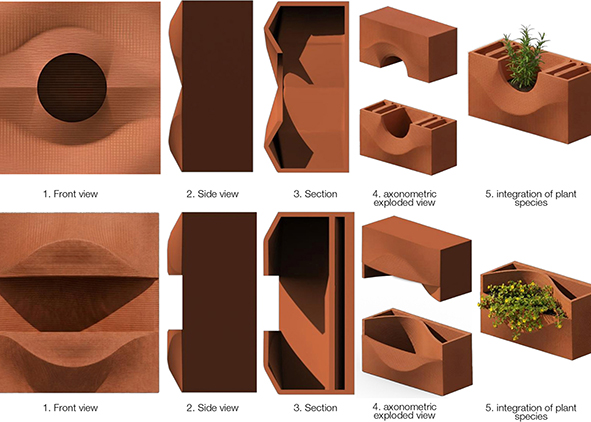
The article presents the methodological framework and the first experimental outcomes of Urban Bloomers, a research project funded through the UniFI Extra 2025 – Public Engagement call and dedicated to the development of vegetated façade systems as technology-enabled Nature-based Solutions, 3D printed in clay and co-designed with institutional actors, companies, researchers, and school communities for biodiversity-oriented regeneration interventions in Mediterranean school recreational spaces. Through a state-of-the-art analysis, participatory activities for the observation, identification, and mapping of species, co-design workshops, parametric modelling, and additive prototyping, the research defines design, construction, and ecological criteria for the development of biophilic modules capable of integrating climate-stress-tolerant plant species, improving the microclimate, and supporting environmental learning processes. The preliminary outcomes provide a replicable methodological framework and the development of a first prototype of a Living Wall System (LWS) façade, oriented towards integrating ecological performance, the spatial quality of educational environments, and in situ application.
Article info
Received: 15/03/2026; Revised: 30/04/2026; Accepted: 01/05/2026
Downloads
Article Metrics Graph
References
Aronne, M., Schwarzer-Fischer, E., Bertana, V., Mossotti, G., Scheithauer, U., Ferrero, S. and Scaltrito, L. (2026), “Exploring circularity in ceramic 3D printing – Possibilities and implementation”, in Open Ceramics, vol. 25, article 100915, pp. 1-16. [Online] Available at: doi.org/10.1016/j.oceram.2026.100915 [Accessed 11 April 2026].
Ascione, F., De Masi, R. F., Mastellone, M., Ruggiero, S. and Vanoli, G. P. (2020), “Green Walls, a Critical Review – Knowledge gaps, design parameters, Thermal Performances and Multi-Criteria Design Approaches”, in Energies, vol. 13, issue 9, article 2296, pp. 1-39. [Online] Available at: doi.org/10.3390/en13092296 [Accessed 11 April 2026].
Ayad, C. V. G., Khateeb, S. E., Said, N. G. and Elbardisy, W. M. (2025), “Optimization of 3D-printed modular living walls in hot arid regions”, in Ain Shams Engineering Journal, vol. 16, issue 10, article 103601, pp. 1-14. [Online] Available at: doi.org/10.1016/j.asej.2025.103601 [Accessed 20 April 2026].
Basnou, C., Pino, J., Davies, C., Winkel, G. and De Vreese, R. (2020), “Co-design processes to address Nature-based Solutions and ecosystem services demands – The long and winding road towards inclusive urban planning”, in Frontiers in Sustainable Cities, vol. 2, article 572556, pp. 1-4. [Online] Available at: doi.org/10.3389/frsc.2020.572556 [Accessed 11 April 2026].
Berretta, T., Desideri, F. and Staltari, M. (2024), “Il progetto dello spazio pubblico, tra complessità e crisi ecologica – Da sfida a opportunità per la rigenerazione urbana | Public space project, between complexity and ecological crisis – From challenge to opportunity for urban regeneration”, in Agathón | International Journal of Architecture, Art and Design, vol. 16, pp. 74-87. [Online] Available at: doi.org/10.19229/2464-9309/1662024 [Accessed 11 April 2026].
Bologna, R. and Hasanaj, G. (2023), “Modelli evoluti per la costruzione di un catalogo NbS per la resilienza e la biodiversità | Advanced models for the construction of an NbS catalogue for resilience and biodiversity”, in Agathón | International Journal of Architecture, Art and Design, vol. 13, pp. 179-190. [Online] Available at: doi.org/10.19229/2464-9309/13152023 [Accessed 11 April 2026].
Camacho, D. D., Clayton, P., O’Brien, W. J., Seepersad, C., Juenger, M., Ferron, R. and Salamone, S. (2018), “Applications of additive manufacturing in the construction industry – A forward-looking review”, in Automation in Construction, vol. 89, pp. 110-119. [Online] Available at: doi.org/10.1016/j.autcon.2017.12.031 [Accessed 11 April 2026].
Chahin, S., Afify, A., Mohsen, H. and Youssef, M. (2022), “Role of 3D printed green walls in healing architecture”, in BAU Journal | Health and Wellbeing, vol. 5, issue 1, article 1, pp. 1-19. [Online] Available at: doi.org/10.54729/srop3798 [Accessed 11 April 2026].
Coccia, L., Cipolletti, S. and Corvaro, G. (2024), “Green Room – Un dispositivo architettonico e urbano per l’efficientamento energetico e il comfort ambientale | Green Room – An architectural and urban device for energy efficiency and environmental comfort”, in Agathón | International Journal of Architecture, Art and Design, vol. 15, pp. 238-251. [Online] Available at: doi.org/10.19229/2464-9309/15192024 [Accessed 11 April 2026].
Crawford, A., In-Na, P., Caldwell, G., Armstrong, R. and Bridgens, B. (2022), “Clay 3D printing as a bio-design research tool – Development of photosynthetic living building components”, in Architectural Science Review, vol. 65, issue 3, pp. 185-195. [Online] Available at: doi.org/10.1080/00038628.2022.2058908 [Accessed 20 April 2026].
Cui, D., Zhang, Y., Li, X., Yuan, L., Mak, C. M. and Kwok, K. (2022), “Effects of different vertical façade greenery systems on pedestrian thermal comfort in deep street canyons”, in Urban Forestry & Urban Greening, vol. 72, article 127582, pp. 1-13. [Online] Available at: doi.org/10.1016/j.ufug.2022.127582 [Accessed 20 April 2026].
Dallere, C. and Tempestini, M. (2024), “Il Centro di Formazione a Salez – Progettare la sostenibilità con interazioni semplici tra utenti e architettura | An Educational Centre in Salez – Designing sustainability through simple interactions between users and architecture”, in Agathón | International Journal of Architecture, Art and Design, vol. 16, pp. 118-129. [Online] Available at: doi.org/10.19229/2464-9309/16102024 [Accessed 11 April 2026].
De Jesus, M. P., Lourenço, J. M., Arce, R. M., and Macias, M. (2017), “Green façades and in situ measurements of outdoor building thermal behaviour”, in Building and Environment, vol. 119, pp. 11-19. [Online] Available at: doi.org/10.1016/j.buildenv.2017.03.041 [Accessed 20 April 2026].
Delfosse, F. (2025), “BANYAN Eco Wall – World’s first 3D printed green wall”, in bigrep.com, 27/08/2025. [Online] Available at: bigrep.com/posts/banyan-eco-wall/ [Accessed 11 April 2026].
El-Sayegh, S., Romdhane, L. and Manjikian, S. (2020), “A critical review of 3D printing in construction – Benefits, challenges and risks”, in Archives of Civil and Mechanical Engineering, vol. 20, issue 2, article 34, pp. 1-25. [Online] Available at: doi.org/10.1007/s43452-020-00038-w [Accessed 11 April 2026].
El-Zoklah, M. H., and Refaat, T. (2021), “How to measure the green façades environmental effectiveness? A proposal to green façade systems technical guide”, in International Journal of Sustainable Building Technology and Urban Development, vol. 12, issue 2, pp. 154-169. [Online] Available at: doi.org/10.22712/susb.20210013 [Accessed 20 April 2026].
European Commission (2024), ERA industrial technologies roadmap on human-centric research and innovation for the manufacturing sector, Publications Office of the European Union, Luxembourg. [Online] Available at: data.europa.eu/doi/10.2777/0266 [Accessed 11 April 2026].
Gasparini, K. (2023), “Design litico e manifattura additiva – Un connubio possibile per l’economia circolare | Lithic design and additive manufacturing – A feasible partnership for the circular economy”, in Agathón | International Journal of Architecture, Art and Design, vol. 14, pp. 316-325. [Online] Available at: doi.org/10.19229/2464-9309/14272023 [Accessed 11 April 2026].
Gyawali, B., Haghnazar, R., Akula, P., Alba, K. and Nasir, V. (2024), “A review on 3D printing with clay and sawdust / natural fibers – Printability, rheology, properties and applications”, in Results in Engineering, vol. 24, article 103024, pp. 1-27. [Online] Available at: doi.org/10.1016/j.rineng.2024.103024 [Accessed 11 April 2026].
Irga, P. J., Torpy, F. R., Griffin, D. and Wilkinson, S. J. (2023), “Vertical Greening Systems – A Perspective on Existing Technologies and New Design Recommendation”, in Sustainability, vol. 15, issue 7, article 6014, pp. 1-13. [Online] Available at: doi.org/10.3390/su15076014 [Accessed 11 April 2026].
Khan, R. (2023), “Biomic Wall fuses ceramic 3D printing & ecological design for self-regulating greening façade”, in Designboom, 16/08/2023. [Online] Available at: designboom.com/architecture/biomic-wall-ceramic-3d-printing-ecological-design-self-regulating-greening-facade-university-of-innsbruck-08-16-2023/ [Accessed 11 April 2026].
Kõiv, K., Annus, I., Kändler, N., Truu, M., Kaur, K. and Suits, K. (2024), “Smart Nature-Based Solutions for Stormwater Management in Urban Areas – An Analysis of Pilot Cases”, in Engineering Proceedings, vol. 69, issue 1, article 18, pp. 1-4. [Online] Available at: doi.org/10.3390/engproc2024069018 [Accessed 11 April 2026].
Lolli, F., Coruzzolo, A. M., Neto, P. G. T., Sellitto, M. A. and Gamberini, R. (2023), “Key enabling technologies and concepts for the Human-Centric Industrial Revolution”, in Human Factors and Wearable Technologies, vol. 85, pp. 36-46. [Online] Available at: doi.org/10.54941/ahfe1003625 [Accessed 11 April 2026].
Longato, D., Cortinovis, C., Balzan, M. and Geneletti, D. (2023), “A method to prioritize and allocate nature-based solutions in urban areas based on ecosystem service demand”, in Landscape and Urban Planning, vol. 235, article 104743, pp. 1-14. [Online] Available at: doi.org/10.1016/j.landurbplan.2023.104743 [Accessed 11 April 2026].
Lunt, P. H., Buckley, J., Mitchell, S., Thomas, G., Churella, E., and Murphy, T. R. (2025), “Biodiversity Performance of living wall systems in urban environments – A UK case study of plant selection and substrate Effects on Multi-Taxa Communities”, in Urban Science, vol. 9, issue 12, article 519, pp. 1-19. [Online] Available at: doi.org/10.3390/urbansci9120519 [Accessed 20 April 2026].
Madrid, J. A., Ortega, G. S., Carabaño, J. G., Olsson, N. O. E. and Ríos, J. A. T. (2023), “3D claying – 3D printing and recycling clay”, in Crystals, vol. 13, issue 3, article 375, pp. 1-20. [Online] Available at: doi.org/10.3390/cryst13030375 [Accessed 11 April 2026].
Mahmoud, I., Morello, E., Bisello, A. and Kolokotsa, D. (2024), “Embedding technologies for improving Nature-Based Solutions performance and fostering social inclusion in urban greening strategies – Augmented NBS for cities”, in Urban Forestry & Urban Greening, vol. 93, article 128215, pp. 1-3. [Online] Available at: doi.org/10.1016/j.ufug.2024.128215 [Accessed 11 April 2026].
Miller, E. (2014), “CELLA by ecoid”, in contemporist.com, 14/04/2014. [Online] Available at: contemporist.com/cella-by-ecoid/ [Accessed 11 April 2026].
Montgomery, G. A., Belitz, M. W., Guralnick, R. P. and Tingley, M. W. (2021), “Standards and Best Practices for Monitoring and Benchmarking Insects”, in Frontiers in Ecology and Evolution, vol. 8, article 579193, pp. 1-18. [Online] Available at: doi.org/10.3389/fevo.2020.579193 [Accessed 20 April 2026].
Nasr, Y., Zakhem, H. E., Hamami, A. E. A., Bachawati, M. E. and Belarbi, R. (2024), “Comprehensive Assessment of the Impact of green roofs and walls on building energy Performance – A scientific review”, in Energies, vol. 17, issue 20, article 5160, pp. 1-52. [Online] Available at: doi.org/10.3390/en17205160 [Accessed 11 April 2026].
O’Donnell, M., Collier, M., Pineda-Pinto, M., Cooper, C., Nulty, F. and Rodriguez Castañeda, N. (2025), “Redefining co-design for social-ecological research and practice – A systematic literature review”, in Environmental Science & Policy, vol. 164, article 103998, pp. 1-14. [Online] Available at: doi.org/10.1016/j.envsci.2025.103998 [Accessed 11 April 2026].
Perini, K. and Rosasco, P. (2013), “Cost-benefit analysis for green façades and living wall systems”, in Building and Environment, vol. 70, pp. 110-121. [Online] Available at: doi.org/10.1016/j.buildenv.2013.08.012 [Accessed 11 April 2026].
Qiao, L. (2025), “Study on the dynamic heat transfer role of vertical greening in building microclimate based on multi-objective coupling”, in Journal of Renewable and Sustainable Energy, vol. 17, issue 2, article 025101, pp. 1-8. [Online] Available at: doi.org/10.1063/5.0240874 [Accessed 11 April 2026].
Radić, M., Brković Dodig, M. and Auer, T. (2019), “Green Facades and Living Walls – A Review Establishing the Classification of Construction Types and Mapping the Benefits”, in Sustainability, vol. 11, issue 17, article 4579, pp. 1-23. [Online] Available at: doi.org/10.3390/su11174579 [Accessed 11 April 2026].
Radujković, M., Versele, A. and Breesch, H. (2024), “Exploratory Analysis of a Novel Modular Green Wall’s Impact on Indoor Temperature and Energy Consumption in Residential Buildings – A Case Study from Belgium”, in Energies, vol. 17, issue 21, article 5267, pp. 1-25. [Online] Available at: doi.org/10.3390/en17215267 [Accessed 20 April 2026].
Riley, B. (2017), “The state of the art of living walls – Lessons learned”, in Building and Environment, vol. 114, pp. 219-232. [Online] Available at: doi.org/10.1016/j.buildenv.2016.12.016 [Accessed 11 April 2026].
Santi, G., Bertolazzi, A., Leporelli, E., Turrini, U. and Croatto, G. (2020), “Green systems integrated to the building envelope – Strategies and technical solution for the Italian case”, in Sustainability, vol. 12, issue 11, article 4615, pp. 1-18. [Online] Available at: doi.org/10.3390/su12114615 [Accessed 20 April 2026].
Snep, R. P. H., Voeten, J. G. W. F., Mol, G. and Van Hattum, T. (2020), “Nature Based Solutions for Urban Resilience – A Distinction Between No-Tech, Low-Tech and High-Tech Solutions”, in Frontiers in Environmental Science, vol. 8, article 599060, pp. 1-9. [Online] Available at: doi.org/10.3389/fenvs.2020.599060 [Accessed 11 April 2026].
Thompson, D. (2020), “The ‘Weight’ is Over for Lightweight 3D-Printed Parts – Companies collaborate to create suspended 3D-printed garden structure”, in machinedesign.com, 29/05/2020. [Online] Available at: machinedesign.com/3d-printing-cad/article/21132685/igus-inc-the-weight-is-over-for-lightweight-3d-printed-parts [Accessed 11 April 2026].
Tiago, P., Evaristo, I. and Pinto, B. (2024), “The role of BioBlitzes in citizen science – Insights from participants and experts”, in Frontiers in Environmental Science, vol. 12, article 1347428, pp. 1-14. [Online] Available at: doi.org/10.3389/fenvs.2024.1347428 [Accessed 11 April 2026].
Turrin, M., de Ruiter, P. and Tenpierik, M. J. (2021), “Additive Manufacturing for Integral Design and Engineering”, in Knaack, U., Tessmann, O., Wibranek, B., Rosendahl, P. and Borg Costanzi, C. (eds), BE-AM 2021 – Symposium and Exhibition, Darmstadt, pp. 104-119. [Online] Available at: be-am.de/wp-content/uploads/2024/11/BE-AM_Booklet_2021.pdf [Accessed 20 April 2026].
Valente, R., Mozingo, L. A., Bosco, R. and Giacobbe, S. (2024), “Gestione integrata delle risorse naturali in contesti urbani sostenibili | Integrated natural resource management in sustainable urban context”, in Agathón | International Journal of Architecture, Art and Design, vol. 15, pp. 180-189. [Online] Available at: doi.org/10.19229/2464-9309/15142024 [Accessed 11 April 2026].
Velasco, P. M., Ortíz, M. M., Giró, M. M., and Velasco, L. M. (2014), “Fired clay bricks manufactured by adding wastes as sustainable construction material – A review”, in Construction and Building Materials, vol. 63, pp. 97-107. [Online] Available at: doi.org/10.1016/j.conbuildmat.2014.03.045 [Accessed 20 April 2026].
Wei, R., Xu, C., Song, D., Tong, H. and Chen, Z. (2023), “Study on the Correlation Analysis between Urban Morphological Factors and Microclimate Based on Empirical Methods on a University Campus in a Hot-Summer – Cold-Winter Region”, in Buildings, vol. 13, issue 8, article 1920, pp. 1-25. [Online] Available at: doi.org/10.3390/buildings13081920 [Accessed 11 April 2026].
Wolf, A., Bauer, S. and Knaack, U. (2024), “Green klinkers – A Strategy to Include Plants in Double-Shell Masonry”, in Lowke, D., Freund, N., Böhler, D. and Herding, F. (eds), Digital Concrete 2024 – Supplementary Proceedings – Fourth RILEM International Conference on Concrete and Digital Fabrication, Munich, Germany, September 4-6, 2024, Technische Universität Braunschweig, Braunschweig, pp. 1-8. [Online] Available at: doi.org/10.24355/dbbs.084-202408191008-0 [Accessed 11 April 2026].
Downloads
Published
How to Cite
Issue
Section
Categories
License
Copyright (c) 2026 Rosa Romano, Elisa Mazzoni

This work is licensed under a Creative Commons Attribution 4.0 International License.
This Journal is published under Creative Commons Attribution Licence 4.0 (CC-BY).
License scheme | Legal code
This License allows anyone to:
Share: copy and redistribute the material in any medium or format.
Adapt: remix, transform, and build upon the material for any purpose, even commercially.
Under the following terms
Attribution: Users must give appropriate credit, provide a link to the license, and indicate if changes were made; users may do so in any reasonable manner, but not in any way that suggests the licensor endorses them or their use.
No additional restrictions: Users may not apply legal terms or technological measures that legally restrict others from doing anything the license permits.
Notices
Users do not have to comply with the license for elements of the material in the public domain or where your use is permitted by an applicable exception or limitation.
No warranties are given. The license may not give users all of the permissions necessary for their intended use. For example, other rights such as publicity, privacy, or moral rights may limit how you use the material.